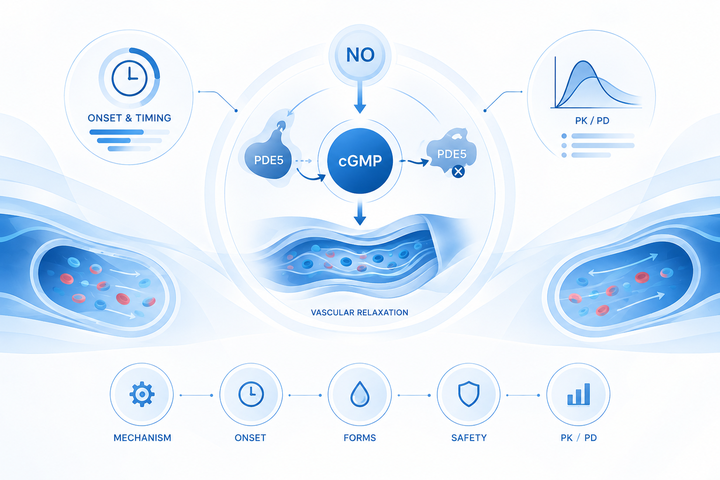
Sildenafil is a phosphodiesterase type 5 inhibitor whose biological interpretation connects mechanism, the PDE5 pathway, the NO/cGMP pathway, and downstream vascular relaxation. Its clinical pharmacology also depends on pharmacodynamics and pharmacokinetics, providing a framework for understanding exposure, signaling, concentration-dependent effects and biological timing without implying a uniform response.
The concept of sildenafil sildenafil onset reflects several overlapping processes rather than a single fixed time point. absorption, time to peak, the evolving PK curve, and the pharmacodynamic onset curve contribute to temporal interpretation. Biological differences described under onset variability can modify how concentration and pathway activity develop across individuals and physiological states.
Formulation, exposure and safety add further interpretive layers. Conventional tablets, alternative oral forms, and form absorption comparison concepts can influence drug-release context without changing sildenafil's molecular target. Dose-linked exposure is explored through onset by dose and dose selection, while side effects, contraindications and CYP3A4 interactions define important mechanistic safety boundaries.
A mechanistic sildenafil overview begins by integrating mechanism, pharmacodynamics and pharmacokinetics. Sildenafil inhibits PDE5 rather than directly generating nitric oxide, so interpretation depends on the existing NO/cGMP pathway and the tissue distribution of the PDE5 pathway. Drug concentration changes after absorption and distribution, while vascular relaxation represents a downstream pharmacodynamic consequence of altered cyclic nucleotide degradation rather than an independent drug action.
Temporal biology links molecular signaling to systemic exposure. The sildenafil onset concept is therefore related to how fast sildenafil works at a mechanistic level, but it is not defined solely by plasma appearance. time to peak, the PK curve, the onset curve, and half-life describe different aspects of exposure and effect. elimination progressively reduces circulating drug, whereas pharmacodynamic intensity depends on target engagement, pathway activity and physiological context.
The same integrated framework accommodates dose, formulation and comparison questions. Exposure associated with 25 mg, 50 mg and 100 mg can differ quantitatively while retaining the same molecular target. Oral tablets, ODT presentations and oral suspension differ in formulation characteristics. Broader interpretation may also involve form onset comparison, onset comparison and PK comparison, which separate formulation kinetics from intrinsic PDE5 pharmacology.
| Layer | Primary biological concept | Interpretive role |
|---|---|---|
| Molecular | PDE5 inhibition and cGMP preservation | Defines the proximal pharmacodynamic mechanism |
| Systemic | Absorption, distribution, metabolism and elimination | Defines concentration over time |
| Temporal | Onset curve, peak exposure and decline | Connects PK with evolving PD activity |
The core mechanism of sildenafil is selective inhibition of phosphodiesterase type 5, an enzyme that hydrolyzes cyclic guanosine monophosphate. Within the PDE5 pathway, reduced cGMP breakdown permits cGMP signaling to persist when the upstream NO/cGMP pathway is active. This relationship explains why pharmacodynamics depends on endogenous signaling rather than sildenafil functioning as a direct nitric-oxide donor. Downstream vascular relaxation reflects altered smooth-muscle signaling, calcium handling and contractile tone within responsive vascular tissues.
The pharmacodynamic sequence is distinct from systemic drug disposition. absorption establishes circulating sildenafil, distribution carries drug to target tissues, and the evolving PK curve influences the degree of available PDE5 inhibition. At the same time, the onset curve reflects the interaction between concentration and pathway readiness. time to peak is a pharmacokinetic descriptor rather than a direct measure of maximum biological effect, while half-life describes the rate of systemic concentration decline.
Mechanistic specificity also explains several safety and interaction domains. The nitrates interaction is biologically important because nitrates amplify nitric-oxide signaling upstream of cGMP, while sildenafil reduces downstream cGMP degradation. alpha blockers influence vascular tone through a different pathway, creating potential pharmacodynamic overlap. vision risks, hearing risks and priapism represent distinct safety domains rather than extensions of the intended vascular mechanism. Their interpretation belongs alongside contraindications and broader side effects biology.
| Pathway step | Mechanistic event | Pharmacological meaning |
|---|---|---|
| Nitric oxide signaling | Guanylate cyclase activation increases cGMP | Provides upstream cyclic nucleotide signaling |
| PDE5 activity | PDE5 hydrolyzes cGMP | Limits persistence of cGMP signaling |
| Sildenafil exposure | PDE5 inhibition reduces cGMP degradation | Modifies duration and magnitude of pathway signaling |
Sildenafil sildenafil onset is best understood as a developing PK/PD relationship rather than a universal clock time. How fast sildenafil works mechanistically depends on gastrointestinal absorption, systemic concentrations and target engagement. The time to peak describes plasma pharmacokinetics, whereas the onset curve represents the evolving pharmacodynamic context. Interindividual onset variability can arise from physiology, gastrointestinal transit, metabolic capacity and pathway responsiveness, making the PK curve only one layer of temporal interpretation.
Nutritional and metabolic variables can shift absorption kinetics without altering sildenafil's molecular identity. Onset with food and onset with fatty food are associated with changes in gastrointestinal processing and absorption rate. Food interactions therefore differ conceptually from enzyme-mediated CYP3A4 interactions. Onset with alcohol adds another physiological variable, while alcohol interactions may involve vascular, neurological and metabolic overlap. These domains help distinguish delayed concentration development from changes in pathway-level pharmacodynamics.
Physiological state further contributes to temporal heterogeneity. Onset in older adults can be interpreted alongside age-related differences in clearance and systemic exposure. Onset in diabetes may involve vascular, endothelial and autonomic biology, while onset in obesity introduces distributional and metabolic considerations. Onset by dose examines exposure-related differences without assuming a proportional pharmacodynamic relationship. These concepts connect with CYP3A4 metabolism, half-life and elimination as determinants of systemic concentration over time.
| Variability domain | Potential PK/PD contribution | Interpretive distinction |
|---|---|---|
| Food composition | May alter absorption rate and peak timing | Primarily pharmacokinetic |
| Physiological state | May alter clearance, vascular signaling or distribution | Mixed PK and PD |
| Dose exposure | Changes systemic concentration | Does not change the molecular target |
The pharmacokinetics of sildenafil begin with oral absorption and entry into systemic circulation. The resulting PK curve reflects rising concentrations, a time to peak and subsequent decline. After absorption, distribution carries sildenafil through plasma and tissues where PDE5 is expressed. These processes provide the exposure component required for pharmacodynamics, but plasma concentration alone does not completely define pathway activity. Consequently, sildenafil onset and the onset curve remain integrated PK/PD concepts.
Food can modify the rate at which an oral formulation reaches systemic circulation. Onset with food, onset with fatty food and broader food interactions are therefore useful for separating gastrointestinal kinetics from molecular pharmacology. Formulation properties examined through form absorption comparison may also influence dissolution or release. Conventional tablets, chewable preparations and oral suspension can differ in formulation behavior while delivering the same active molecule and engaging the same PDE5 target.
Absorption-related differences should be distinguished from dose-related exposure. The 25 mg, 50 mg and 100 mg dose categories represent different quantities of sildenafil rather than distinct mechanisms. Onset by dose examines how concentration development may vary across exposure levels, whereas dose selection and dose adjustment are broader clinical-pharmacology concepts. For mechanistic interpretation, absorption comparison, onset comparison and PK comparison help keep exposure rate, concentration magnitude and target pharmacology analytically separate.
| PK phase | Key process | Relationship to timing |
|---|---|---|
| Rising phase | Gastrointestinal absorption | Determines early concentration development |
| Peak region | Maximum observed plasma concentration | Defines a PK landmark rather than a universal PD peak |
| Post-peak phase | Metabolism and elimination | Produces declining systemic exposure |
Sildenafil undergoes hepatic biotransformation in which CYP3A4 metabolism is a major pathway, with additional enzymatic contribution from other cytochrome systems. This metabolic layer is central to pharmacokinetics because clearance influences systemic exposure after absorption and distribution. The resulting PK curve incorporates both parent drug and metabolite kinetics. Half-life describes the rate of concentration decline, whereas elimination encompasses the broader removal of drug-related material from the body.
Metabolic inhibition or induction can shift exposure independently of sildenafil's intrinsic molecular target. CYP3A4 interactions may alter concentrations by changing metabolic clearance, distinguishing them from pharmacodynamic interactions such as the nitrates interaction or overlap involving alpha blockers. Changes in exposure can subsequently affect sildenafil onset, the onset curve and the duration of measurable systemic concentrations. Mechanistic interpretation therefore benefits from considering pharmacodynamics and PK together rather than treating metabolic interaction and target-level action as interchangeable phenomena.
Organ function can also influence pharmacokinetic behavior. Dose in renal impairment is mechanistically relevant because renal dysfunction can correlate with altered systemic physiology and metabolite handling, while dose in hepatic impairment relates more directly to metabolic capacity. Dose in older adults reflects age-associated exposure differences, and onset in older adults provides a temporal perspective. These contexts connect with dose adjustment, half-life and elimination as clinical-pharmacology domains rather than independent mechanisms.
| Disposition component | Biological role | Potential consequence of variability |
|---|---|---|
| CYP3A4 metabolism | Biotransformation of sildenafil | Changes systemic clearance |
| Half-life | Rate descriptor for concentration decline | Influences persistence of exposure |
| Elimination | Removal of drug-related material | Completes systemic disposition |
Sildenafil can be encountered in several oral formulation concepts, including tablets, soft tabs, chewable preparations and ODT presentations. Formulation can influence disintegration, dissolution and the environment preceding gastrointestinal absorption, but it does not redefine the sildenafil molecule or its mechanism. A form onset comparison therefore requires separating pharmaceutical release characteristics from systemic pharmacokinetics, while form absorption comparison focuses more narrowly on how formulation properties may shape concentration development.
Liquid-oriented forms introduce additional pharmaceutical variables. Oral suspension and liquid form concepts involve dispersed or dissolved drug systems whose behavior depends on formulation composition and physical stability. Form stability addresses preservation of chemical and physical properties rather than PDE5 biology. Once sildenafil reaches systemic circulation, its distribution, CYP3A4 metabolism, half-life and elimination follow the active molecule's disposition pathways, although bioavailability and absorption rate can vary by product characteristics.
Branding and formulation should also be separated analytically. Generics, brand names and brand vs generic discussions concern product identity, regulatory equivalence and formulation context rather than a different pharmacological target. Similarly, vs generic and vs brand comparisons do not inherently imply different PDE5 biology. Mechanistic evaluation is better anchored in pharmacokinetics, pharmacodynamics, absorption comparison and PK comparison, which identify measurable dimensions without assuming clinically meaningful divergence.
| Form category | Primary pharmaceutical distinction | Shared pharmacological feature |
|---|---|---|
| Conventional tablet | Solid oral dosage form requiring disintegration and dissolution | Sildenafil-mediated PDE5 inhibition |
| ODT or chewable concept | Alternative disintegration characteristics | Same active molecular target |
| Suspension or liquid concept | Drug dispersed or dissolved in a liquid vehicle | Systemic action still depends on absorbed sildenafil |
The sildenafil 25 mg, 50 mg and 100 mg categories represent increasing amounts of the same PDE5 inhibitor. They do not represent different molecular mechanisms. Dose-related interpretation is therefore primarily an exposure question involving pharmacokinetics, concentration-dependent target occupancy and pharmacodynamics. Onset by dose is conceptually linked to concentration development, while PK curve and onset curve analysis help distinguish changes in systemic exposure from changes in pathway responsiveness.
Dose concepts also intersect with physiological variability. Dose selection, dose adjustment and dose titration are clinical-pharmacology categories that reflect exposure, tolerability and patient-specific factors without changing the sildenafil target. Dose in older adults, dose in diabetes, dose in renal impairment and dose in hepatic impairment provide physiological contexts in which clearance, distribution, metabolic capacity or vascular biology can differ.
Dose-linked exposure also connects to interaction and safety interpretation. CYP3A4 interactions can modify circulating concentrations independently of the nominal dose, while the nitrates interaction reflects pharmacodynamic pathway convergence rather than altered sildenafil quantity. Alpha blockers provide another vascular interaction context. Safety domains such as side effects, vision risks, hearing risks and priapism are evaluated through exposure and biological susceptibility rather than assuming a simple one-to-one relationship with dose.
| Dose concept | Mechanistic interpretation | What remains constant |
|---|---|---|
| 25 mg | Lower nominal amount of sildenafil | PDE5 as the molecular target |
| 50 mg | Intermediate nominal amount of sildenafil | NO/cGMP pathway dependence |
| 100 mg | Higher nominal amount of sildenafil | Core pharmacological mechanism |
The relationship between sildenafil and food is principally a pharmacokinetic question when considering oral absorption. Onset with food and onset with fatty food can reflect altered gastric processing, dissolution and intestinal delivery. Food interactions therefore belong alongside absorption, time to peak and the PK curve. The resulting temporal changes can influence sildenafil onset and onset variability without changing sildenafil's affinity for PDE5 or its underlying molecular identity.
Alcohol introduces overlapping pharmacokinetic and pharmacodynamic considerations. Onset with alcohol may be interpreted through gastrointestinal, hepatic and systemic vascular effects, while alcohol interactions encompass broader physiological overlap. Sildenafil itself acts through the PDE5 pathway and NO/cGMP pathway, whereas alcohol has multiple biological actions outside this mechanism. Consequently, changes in vascular relaxation, pharmacodynamics, CYP3A4 metabolism or absorption should be considered as potentially distinct contributors.
Metabolic and physiological states can further alter onset interpretation. Onset in diabetes and dose in diabetes intersect with endothelial signaling, vascular physiology and systemic metabolic factors. Onset in obesity may incorporate distributional and metabolic variability, whereas onset in older adults can reflect age-associated changes in clearance and exposure. These domains connect to distribution, half-life, elimination and onset curve concepts without implying that any physiological state produces a fixed temporal pattern.
| Context | Primary mechanistic layer | Possible source of variability |
|---|---|---|
| Food | Absorption kinetics | Gastric emptying and intestinal delivery |
| Alcohol | Mixed PK and PD context | Vascular, gastrointestinal and metabolic effects |
| Metabolic physiology | Distribution, clearance and vascular signaling | Interindividual systemic differences |
Sildenafil safety is linked to both its intended pharmacology and effects occurring in other physiological systems. Side effects and common side effects can often be interpreted through systemic vasodilation or PDE-related biology, whereas rare side effects may involve less frequent physiological responses. The mechanism, PDE5 pathway, NO/cGMP pathway and vascular relaxation provide a mechanistic foundation, but adverse-event interpretation also requires consideration of exposure, tissue selectivity and individual susceptibility.
Specific safety domains have distinct biological contexts. Vision risks are evaluated in relation to ocular physiology and phosphodiesterase selectivity, while hearing risks involve auditory safety signals whose precise causal pathways are not fully reducible to vascular smooth-muscle biology. Priapism represents prolonged erectile-tissue signaling and requires mechanistic separation from expected transient PDE5 pathway modulation. These subjects belong alongside contraindications, overdose, pharmacodynamics and pharmacokinetics, because exposure and coexisting physiological factors can shape safety interpretation.
Safety assessment also overlaps with drug interactions. The nitrates interaction is mechanistically notable because both pathways increase cGMP-mediated vascular relaxation through complementary processes. Alpha blockers can contribute additional vascular tone reduction through adrenergic blockade. CYP3A4 interactions differ by changing sildenafil exposure through altered metabolism. Food interactions and alcohol interactions introduce additional PK or PD variability, while timing mistakes and overdose represent exposure-context categories rather than new molecular mechanisms.
| Safety domain | Biological context | Mechanistic category |
|---|---|---|
| Vascular effects | Systemic smooth-muscle signaling | On-target pharmacodynamics |
| Visual or auditory events | Sensory-organ physiology and selectivity | Special safety domain |
| Priapism | Prolonged erectile-tissue signaling | Excessive persistence of local physiological response |
Drug interactions with sildenafil can be divided into pharmacodynamic and pharmacokinetic mechanisms. The nitrates interaction is pharmacodynamic because nitrate-derived nitric oxide increases cGMP formation while sildenafil inhibits its degradation through the PDE5 pathway. This convergence amplifies the NO/cGMP pathway and vascular relaxation. Alpha blockers modify vascular tone through adrenergic signaling, creating a separate form of hemodynamic overlap. These mechanisms are distinct from CYP3A4 metabolism and concentration-mediated interaction biology.
CYP3A4 interactions alter sildenafil pharmacokinetics by changing metabolic clearance. Depending on the direction and magnitude of enzyme modulation, the PK curve, half-life and overall exposure can shift without modifying PDE5 itself. These changes may secondarily influence sildenafil onset, onset curve characteristics and systemic pharmacodynamics. Absorption remains a separate process, emphasizing why enzyme interactions and gastrointestinal effects should not be grouped together merely because both can change observed drug concentration over time.
Food and alcohol create additional interaction categories. Food interactions, onset with food and onset with fatty food primarily emphasize gastrointestinal and absorption-rate mechanisms. Alcohol interactions and onset with alcohol involve broader systemic physiology. Safety interpretation connects these domains with contraindications, side effects, timing mistakes and overdose, while retaining the distinction between metabolic exposure changes and direct pharmacodynamic pathway convergence.
| Interaction type | Representative mechanism | Primary layer |
|---|---|---|
| Nitrates | Convergent enhancement of cGMP signaling | Pharmacodynamic |
| CYP3A4 modulators | Altered metabolic clearance | Pharmacokinetic |
| Food or alcohol | Absorption or systemic physiological effects | Mixed contextual |
Comparisons among PDE5 inhibitors are most informative when separated into molecular, PK and temporal dimensions. Vs tadalafil, vs vardenafil and vs avanafil all involve drugs sharing PDE5 inhibition as a central pharmacological principle, but they differ in molecular structure and disposition. PK comparison, absorption comparison, onset comparison and duration comparison allow these differences to be characterized without implying superiority or assuming that one kinetic parameter determines an overall clinical effect.
The sildenafil comparison with vs daily tadalafil additionally introduces regimen-related exposure patterns as a pharmacokinetic concept, while vs cialis soft includes both molecule and formulation differences. These questions should be distinguished from form onset comparison within sildenafil products. Mechanistically, the relevant reference layers remain PDE5 pathway, pharmacodynamics, pharmacokinetics, half-life and time to peak, because molecule-specific disposition can differ despite a shared enzyme target.
Other comparisons involve fundamentally different categories. Vs injections contrasts oral PDE5 inhibition with locally or systemically delivered agents that may use different pharmacological pathways. Vs generic and vs brand instead concern product identity rather than distinct target biology. Brand vs generic, generics and brand names should therefore be interpreted separately from true molecule-to-molecule comparisons. Across categories, mechanism, PK comparison and duration comparison provide clearer analytical dimensions than broad undifferentiated rankings.
| Comparison dimension | What is being compared | Mechanistic significance |
|---|---|---|
| PDE5 inhibitor versus PDE5 inhibitor | Structure, potency and disposition | Shared target with differing PK characteristics |
| Brand versus generic | Product and formulation characteristics | Same active molecular mechanism when equivalent |
| Oral PDE5 inhibitor versus injection | Distinct delivery and pharmacological systems | Potentially different target and exposure biology |
A systems-level view integrates mechanism, pharmacodynamics and pharmacokinetics rather than interpreting each parameter in isolation. The PDE5 pathway defines the molecular target, the NO/cGMP pathway provides physiological signaling context, and vascular relaxation represents a downstream tissue response. At the systemic level, absorption, distribution and CYP3A4 metabolism determine the concentration trajectory available to engage that pathway over time.
Temporal interpretation requires distinguishing measured PK landmarks from observed pharmacodynamic phenomena. Time to peak identifies a plasma concentration feature, while sildenafil onset and the onset curve represent evolving biological activity. Half-life and elimination describe declining exposure, but pathway activity may depend additionally on tissue concentrations and physiological signaling. Onset variability, onset in diabetes and onset in older adults illustrate why population averages cannot be assumed to represent every physiological context.
Evidence interpretation also requires separating formulation, dose and interaction effects. Form absorption comparison asks whether pharmaceutical properties alter concentration development, whereas onset by dose evaluates exposure-linked timing across nominal quantities. CYP3A4 interactions modify clearance, while the nitrates interaction modifies pharmacodynamic signaling. PK comparison, onset comparison, duration comparison and absorption comparison are therefore complementary analytical tools rather than interchangeable measures of a single biological property.
| Evidence layer | Typical observation | Interpretive limitation |
|---|---|---|
| PK | Concentration, peak time and half-life | Does not directly equal pharmacodynamic response |
| PD | Target and pathway activity | Depends on physiological signaling context |
| Integrated PK/PD | Exposure linked with evolving effect | Still subject to interindividual variability |
Sildenafil is a selective phosphodiesterase type 5 inhibitor. Its principal pharmacodynamic action is reduction of cGMP degradation in tissues where PDE5 participates in nitric-oxide-dependent signaling. Pharmacokinetically, orally absorbed sildenafil enters systemic circulation, distributes to tissues, undergoes predominantly hepatic metabolism involving CYP3A4, and is subsequently eliminated. Its overall biological profile therefore combines molecular target engagement, vascular signaling, concentration changes over time, metabolic clearance and physiological variability rather than representing a single isolated mechanism.
Sildenafil onset describes the developing relationship between systemic drug exposure and pharmacodynamic pathway activity. It begins with absorption and rising plasma concentrations but is not identical to the first appearance of drug in blood. Target engagement, nitric-oxide-dependent cGMP signaling, tissue distribution and physiological responsiveness also contribute. Consequently, onset is better represented as a curve than as one universal time point. Food, formulation, metabolic capacity, age, vascular physiology and other variables can alter components of that temporal profile.
Timing variability can arise from differences in gastric emptying, intestinal absorption, hepatic metabolism, systemic distribution, vascular signaling and drug clearance. Physiological states such as aging, diabetes or obesity may influence one or more of these processes without changing sildenafil's molecular target. Food composition and interacting substances can introduce additional variability. For this reason, pharmacokinetic timing landmarks observed in populations represent distributions rather than fixed biological constants, and plasma concentration profiles do not necessarily map identically to pharmacodynamic activity in every physiological setting.
PDE5 normally hydrolyzes cyclic guanosine monophosphate, or cGMP, within responsive tissues. Sildenafil binds to PDE5 and reduces this enzymatic breakdown, allowing cGMP signaling to persist when cGMP has been generated through upstream physiological pathways. This does not mean sildenafil directly supplies nitric oxide or creates cGMP independently. Its action depends on existing signaling biology. The resulting pharmacodynamic changes can influence smooth-muscle tone and vascular relaxation where the nitric-oxide and cGMP system is physiologically active.
Nitric oxide activates soluble guanylate cyclase, which increases intracellular cGMP. cGMP then participates in signaling that lowers smooth-muscle contractile tone. PDE5 limits this signal by degrading cGMP. Sildenafil inhibits PDE5, thereby slowing cGMP breakdown and modifying the persistence of nitric-oxide-dependent signaling. The distinction between upstream nitric-oxide generation and downstream PDE5 inhibition is important mechanistically. Sildenafil amplifies an existing pathway rather than functioning as a direct nitric-oxide donor or independently initiating the entire signaling cascade.
The principal pharmacokinetic layers are absorption, systemic distribution, hepatic metabolism and elimination, which collectively generate the concentration-time profile. Pharmacodynamic layers include PDE5 target engagement, preservation of cGMP signaling and downstream changes in smooth-muscle physiology. Peak plasma concentration, half-life and total exposure are pharmacokinetic measurements, whereas target inhibition and pathway activity are pharmacodynamic concepts. Integrated PK/PD analysis connects these layers while recognizing that concentration and biological effect can evolve on related but not perfectly identical time courses.
Different sildenafil strengths contain different nominal amounts of the same active molecule and therefore share the same molecular target and core PDE5-inhibitory mechanism. Increasing nominal dose can alter systemic exposure and concentration-time characteristics, but it does not create a different signaling pathway. Dose-linked interpretation therefore focuses on pharmacokinetics, target exposure and concentration-dependent pharmacodynamics. Physiological characteristics, metabolic interactions and organ function can also alter exposure, meaning that nominal dose alone does not completely describe the concentration profile experienced by a biological system.
Different oral forms can differ in pharmaceutical properties such as disintegration, dissolution, physical state and delivery vehicle. These factors may influence the rate or consistency of absorption and therefore the early concentration-time profile. Once sildenafil reaches systemic circulation, however, the active molecule retains the same PDE5-inhibitory mechanism. Tablets, orally disintegrating concepts, chewable preparations, suspensions and other liquid forms should therefore be distinguished primarily by formulation and absorption characteristics rather than being treated as fundamentally different pharmacological agents.
Sildenafil safety encompasses on-target vascular pharmacology and several specialized physiological domains. Systemic vasodilatory effects reflect cGMP-related vascular signaling, while visual effects can involve phosphodiesterase selectivity and ocular physiology. Auditory safety signals and priapism represent additional domains whose biology is more complex than ordinary vascular relaxation alone. Safety interpretation also depends on systemic exposure, interacting drugs, underlying physiology and metabolic clearance. These mechanisms are considered separately from claims about therapeutic outcomes because adverse-event biology and intended pharmacodynamics are not identical concepts.
Sildenafil interactions can be pharmacodynamic or pharmacokinetic. Nitrates represent pharmacodynamic convergence because they increase nitric-oxide-derived cGMP while sildenafil reduces cGMP degradation. Alpha blockers affect vascular tone through adrenergic mechanisms, creating another form of physiological overlap. CYP3A4 interactions are primarily pharmacokinetic because they can alter sildenafil metabolic clearance and systemic exposure. Food mainly affects absorption kinetics, whereas alcohol can introduce gastrointestinal, vascular, neurological and metabolic influences. These categories should be distinguished because they modify different stages of the overall drug-response system.
Sildenafil, tadalafil, vardenafil and avanafil share PDE5 inhibition as a principal pharmacological mechanism, but their molecular structures and pharmacokinetic properties differ. Comparative interpretation therefore considers absorption rate, time to peak concentration, metabolic pathways, half-life, systemic exposure and pharmacodynamic characteristics separately. A difference in one parameter does not establish global biological superiority. Mechanistic comparison is most informative when it distinguishes the shared PDE5 target from molecule-specific disposition and recognizes that pharmacokinetic differences can influence temporal profiles without changing the basic signaling pathway being modulated.
Mechanistic evidence may come from enzyme studies, receptor or pathway experiments, pharmacokinetic measurements, physiological studies and clinical pharmacology datasets. Each evidence type answers a different question. Enzyme assays characterize target interaction, concentration measurements describe systemic exposure, and physiological measurements reflect downstream biological activity. Translating one layer directly into another can oversimplify the system. A stronger interpretation integrates molecular mechanism, concentration-time data, pharmacodynamic signaling and physiological variability while avoiding assumptions that a single laboratory parameter predicts every clinical or individual-level phenomenon.
At the systems level, oral absorption creates circulating sildenafil, distribution carries it to PDE5-containing tissues, and metabolism plus elimination shape the changing concentration profile. Available drug then inhibits PDE5, reducing cGMP degradation where nitric-oxide-dependent signaling is active. Downstream smooth-muscle responses reflect both target inhibition and the physiological state of the signaling system. This integrated framework explains why onset, peak concentration, half-life and pharmacodynamic activity are connected but not interchangeable measurements, and why interactions can influence different stages of the same overall biological network.
Physiological states can alter multiple components of sildenafil pharmacology. Aging may influence metabolic clearance and systemic exposure. Diabetes can affect endothelial, vascular and autonomic biology. Obesity may modify distributional and metabolic characteristics. Hepatic impairment can alter drug metabolism, while renal impairment can coexist with changes in systemic physiology and metabolite handling. None of these states creates a new sildenafil mechanism; instead, they modify the biological environment in which absorption, exposure, clearance, nitric-oxide signaling and PDE5 inhibition are expressed and measured.