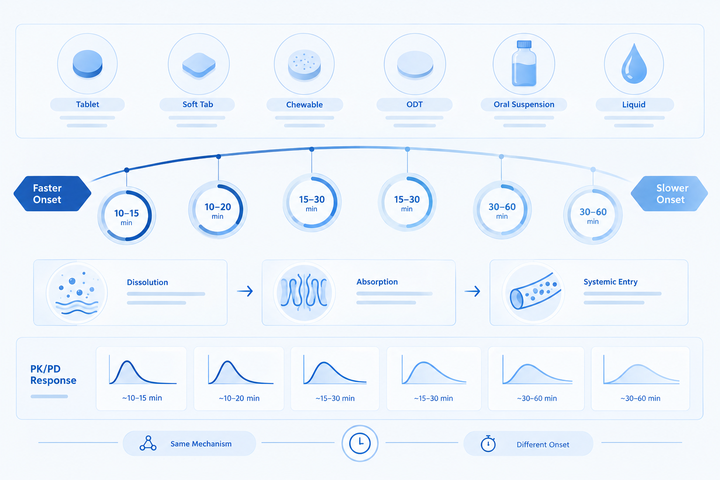
Sildenafil onset comparison is a PK/PD framework for interpreting how systemic drug exposure develops into measurable pharmacodynamic activity. The sequence begins with pharmaceutical drug input and absorption, followed by systemic concentration, distribution, concentration-response relationships, and downstream biological response. Pharmacokinetics describes the concentration-time process, while pharmacodynamics describes the relationship between sildenafil exposure and biological effect. The time to peak is a PK descriptor and should not be treated as an exact synonym for onset. Instead, onset emerges as concentrations rise through the exposure-response relationship. This distinction is central to interpreting sildenafil onset, the onset curve, and how fast sildenafil works as separate but connected concepts.
Onset comparison also requires separating formulation, dose, and physiological variables. Dosage forms can influence dissolution, drug input, and early absorption, while administered amount can influence exposure and concentration-time behavior. Physiological conditions can modify absorption, distribution, metabolism, or concentration-response relationships. Formulation-specific concepts such as soft tabs onset, chewable onset, and odt onset therefore belong primarily to the drug-input layer. Food-related concepts such as onset with food and onset with fatty food similarly concern exposure timing. These variables can contribute to onset variability without implying a change in sildenafil's intrinsic molecular mechanism.
A complete onset comparison follows the sequence of absorption, systemic exposure, distribution, metabolism, concentration-time behavior, and pharmacodynamic response. Hepatic CYP3A4 metabolism contributes to disposition, while the PK curve provides a visual representation of concentration over time. Onset interpretation then considers when exposure reaches concentrations associated with measurable pharmacodynamic activity. Differences related to dose can be examined through onset by dose, while physiological comparisons can include onset in older adults, onset in diabetes, and onset in obesity. This layered terminology keeps onset, peak concentration, exposure, and duration conceptually distinct.
Sildenafil onset begins with pharmaceutical drug input followed by systemic absorption and rising plasma concentration. These processes belong to the PK layer and can be represented through the pharmacokinetics and PK curve. As exposure develops, sildenafil reaches tissues and interacts with PDE5, creating a concentration-dependent pharmacodynamic relationship. Thus, sildenafil onset represents an integrated PK/PD phenomenon rather than a single absorption event or isolated time measurement.
Time to peak identifies when measured concentration reaches its maximum, whereas onset concerns emergence of pharmacodynamic activity. The two events can be temporally related without being identical. Time to peak is therefore a PK parameter, while pharmacodynamics describes the exposure-response relationship that connects concentration with biological activity. The onset curve provides a conceptual bridge between these layers.
Distribution can influence the relationship between plasma concentration and tissue exposure, while metabolic processes influence the persistence and decline of systemic sildenafil. These layers connect absorption, distribution, and CYP3A4 metabolism. Onset interpretation therefore follows a sequence from drug input to exposure and then to pharmacodynamic response, rather than equating any single PK milestone with onset.
| Onset Element | PK Layer | PD Layer |
|---|---|---|
| Drug input | Dissolution and availability for absorption | No direct pharmacodynamic event |
| Absorption | Systemic concentration begins to rise | Provides exposure for concentration-response interaction |
| Time to peak | Maximum measured concentration | Not identical to pharmacodynamic onset |
| Exposure | Plasma concentration over time | Drives concentration-dependent response |
| Onset | Exposure reaches relevant concentration range | Measurable pharmacodynamic activity emerges |
Formulation influences the physical pathway by which sildenafil becomes available for absorption. Conventional tablets require disintegration and dissolution, while alternative dosage forms can alter dispersion or dissolution characteristics. Soft tabs onset, chewable onset, and odt onset therefore represent formulation-specific PK questions. The resulting drug-input profile can influence early systemic exposure while leaving the active molecule and its pharmacodynamic target unchanged.
A formulation comparison should distinguish dissolution from absorption and absorption from systemic exposure. A dosage form may have particular physical characteristics, but observed onset depends on the complete pathway from drug availability to plasma concentration and then concentration-response behavior. This is the focus of form onset comparison and absorption. The resulting onset curve represents an integrated temporal relationship rather than a direct measurement of dissolution.
Formulation-related variability can appear in the early concentration-time profile and may contribute to observed differences between products or dosage forms. Concepts such as generic onset and brand vs generic onset can therefore be interpreted through formulation, drug input, and exposure. The pharmacodynamic layer remains associated with sildenafil concentration and PDE5 interaction, maintaining a distinction between pharmaceutical form and intrinsic pharmacology.
| Formulation | PK Influence | Onset Interpretation |
|---|---|---|
| Tablet | Disintegration and dissolution precede absorption | Early onset reflects resulting systemic drug input |
| Soft-tab | Different physical dissolution characteristics may alter input | Interpret through early exposure and concentration-response behavior |
| Chewable | Mastication and dispersion can alter formulation handling | Onset remains linked to systemic exposure |
| ODT | Rapid disintegration changes dosage-form behavior | Systemic absorption remains a separate PK step |
| Suspension or liquid | Drug is dispersed before systemic absorption | Interpret through resulting concentration-time profile |
Dose-based onset analysis examines how administered sildenafil amount relates to systemic exposure and the concentration-response relationship. The concept is represented by onset by dose, where dose is treated as an input variable rather than as a clinical instruction. Specific dose levels can be discussed as exposure categories, including onset 25 mg, onset 50 mg, and onset 100 mg, while maintaining separation between dose and onset.
A change in administered amount can alter concentration and exposure, but onset is not determined by dose alone. Absorption rate, formulation, distribution, and concentration-response behavior all contribute to the temporal relationship. The PK curve shows how systemic concentration develops, while pharmacodynamics describes how concentration relates to biological activity. Consequently, dose-related onset interpretation requires integration of PK and PD layers.
Dose and onset should remain distinct from duration and peak concentration. A larger administered amount can change exposure metrics without establishing a direct one-to-one change in onset timing. The analytical sequence includes absorption, systemic exposure, concentration-response behavior, and the resulting onset curve. This framework allows dose-related terminology to be interpreted mechanistically without converting exposure relationships into dosing recommendations.
| Dose | Exposure Effect | Onset Interpretation |
|---|---|---|
| Lower exposure category | Produces a corresponding sildenafil exposure profile | Onset depends on concentration-response relationship |
| Intermediate exposure category | Changes systemic concentration and exposure metrics | Interpret through exposure timing and PD linkage |
| Higher exposure category | Can modify concentration-time characteristics | Onset remains distinct from dose itself |
| Any dose category | Formulation and absorption remain relevant | No single dose parameter independently defines onset |
Physiological conditions can alter the PK/PD sequence underlying sildenafil onset. Age-related changes, metabolic conditions, body-composition differences, food exposure, and other physiological variables can influence absorption, distribution, metabolism, or concentration-response relationships. Examples include onset in older adults, onset in diabetes, and onset in obesity. Each represents a context for examining onset variability rather than a standalone determinant.
Food-related conditions primarily enter the analysis through gastrointestinal drug input and absorption. Onset with food and onset with fatty food can therefore be represented as changes in the early exposure phase. Onset with alcohol belongs to a broader contextual category requiring separation of PK, physiological, and pharmacodynamic variables rather than attributing onset to one factor.
Condition-driven interpretation should distinguish changes in absorption from changes in distribution or metabolism. For example, metabolic processes involving CYP3A4 metabolism belong to disposition, while tissue distribution represents a separate layer. The resulting onset variability can therefore be described as an emergent property of multiple interacting PK and PD factors rather than as a fixed characteristic of a physiological condition.
| Condition | PK Influence | Onset Interpretation |
|---|---|---|
| Older age | May modify distribution or metabolic characteristics | Interpret through integrated PK/PD behavior |
| Diabetes | Physiological changes may affect relevant PK variables | Consider condition-related exposure variability |
| Obesity | Body composition can influence distribution-related interpretation | Separate distribution from onset itself |
| Food exposure | Can modify gastrointestinal drug input and absorption | Interpret through early concentration-time behavior |
| Other physiological variation | May affect absorption, disposition, or response | Represents a potential source of onset variability |
The PK curve represents sildenafil concentration as a function of time and provides the primary visual framework for exposure-timing analysis. Its rising phase reflects systemic drug input and absorption, the peak reflects maximum measured concentration, and the descending phase reflects distribution and elimination processes. The time to peak and PK curve are therefore useful descriptors, but neither independently defines pharmacodynamic onset.
Onset variability can arise when the early concentration-time trajectory differs between observations. Formulation, food, physiological characteristics, and other PK variables can alter the shape or timing of the exposure rise. These factors are represented through onset variability, absorption, and pharmacokinetics. Interpretation requires distinguishing variation in drug input from variation in concentration-response behavior.
The onset curve adds a PD layer to the PK curve by representing how exposure translates into biological activity over time. The two curves can be conceptually aligned without assuming that their landmarks are identical. This distinction is particularly important when interpreting onset curve, sildenafil onset, and form onset comparison. A complete analysis treats exposure timing and pharmacodynamic response as linked but separate dimensions.
| PK Metric | Role in Onset | Interpretation |
|---|---|---|
| Absorption rate | Controls early systemic drug input | Influences the rising concentration phase |
| Cmax | Marks maximum measured concentration | Does not independently define onset |
| Tmax | Marks time of maximum concentration | Distinct from pharmacodynamic onset |
| Exposure | Determines concentration available for PD interaction | Links PK to concentration-response behavior |
| PK curve shape | Displays temporal exposure pattern | Useful for identifying exposure-timing variability |
Mechanistic onset interpretation begins with systemic sildenafil exposure and proceeds to target interaction. Sildenafil inhibits PDE5, reducing enzymatic cGMP hydrolysis and influencing the NO/cGMP signaling environment. The pharmacodynamic response therefore depends on concentration at the relevant biological site and the concentration-response relationship. This separates the PK sequence from the molecular mechanism and explains why pharmacodynamics should not be reduced to a single time-to-peak measurement.
The mechanistic chain can be represented as absorption, systemic exposure, tissue distribution, PDE5 interaction, cGMP signaling, and downstream biological response. Distribution contributes to the relationship between plasma exposure and tissue availability, while CYP3A4 metabolism contributes to systemic disposition. The resulting onset curve integrates temporal exposure with pharmacodynamic activity rather than describing only one biochemical step.
This layered model allows onset to be compared across formulations, doses, and physiological contexts without assigning a single universal onset determinant. Formulation influences drug input, dose influences exposure, and physiological variables can modify multiple PK or PD layers. The final interpretation remains anchored to the sildenafil PDE5 pathway and its relationship with NO/cGMP pathway signaling, while onset timing is treated as an emergent PK/PD property.
| Mechanistic Layer | PK Role | PD Role |
|---|---|---|
| Absorption | Determines systemic drug input | Provides concentration for biological interaction |
| Distribution | Relates plasma exposure to tissue disposition | Supports interpretation of target-site exposure |
| PDE5 interaction | Concentration determines available target interaction | Produces PDE5 inhibition and altered cGMP handling |
| NO/cGMP signaling | Depends on sildenafil exposure at the relevant site | Represents downstream signaling consequences |
| Onset | Exposure develops over time | Biological activity emerges through concentration-response behavior |
Sildenafil onset refers to the emergence of measurable pharmacodynamic activity after systemic exposure develops. It is not identical to absorption, time to peak concentration, or the moment a dosage form dissolves. Onset reflects the integrated relationship between sildenafil concentration and biological response. Pharmacokinetic processes establish exposure over time, while pharmacodynamic processes determine how that exposure translates into target interaction and downstream biological activity.
PK/PD interpretation treats onset as the result of sequential processes rather than a single time point. Absorption produces rising systemic concentration, distribution relates exposure to tissues, and concentration-response behavior connects sildenafil exposure with pharmacodynamic activity. Time to peak is a PK measurement, while onset is a PD observation. The two can be related temporally but should remain conceptually distinct when interpreting sildenafil exposure and response.
Formulation can influence the early drug-input process through differences in disintegration, dissolution, dispersion, and absorption. Tablets, soft-tabs, chewable forms, ODT products, suspensions, and liquids can therefore produce different pharmaceutical input characteristics. These differences may alter the early concentration-time profile. However, formulation does not inherently change sildenafil's molecular target. Onset remains an integrated PK/PD phenomenon involving systemic exposure and concentration-response behavior.
Dose can influence systemic sildenafil exposure and therefore the concentration-time profile, but dose is not synonymous with onset. The temporal relationship also depends on absorption, formulation, distribution, and concentration-response behavior. A change in administered amount can modify exposure metrics without producing a directly proportional change in onset timing. Dose-related onset is therefore best interpreted through the complete PK/PD sequence rather than through dose alone.
Physiological conditions can influence different layers of the PK/PD sequence. Age, metabolic conditions, body composition, food exposure, and other physiological variables may affect absorption, distribution, metabolism, systemic exposure, or concentration-response relationships. The resulting onset variation is therefore context-dependent. A physiological condition should not be treated as a single universal onset determinant because multiple mechanisms can contribute to observed differences in exposure timing and pharmacodynamic response.
Onset variability can arise from differences in formulation, absorption, food exposure, administered amount, physiological characteristics, distribution, metabolism, and concentration-response relationships. These factors can modify different stages of the pathway from drug input to pharmacodynamic activity. Variability is therefore an emergent PK/PD property rather than a single fixed characteristic. Interpreting onset variability requires identifying which component of the concentration-time or response relationship is changing.
The sildenafil PK curve displays systemic concentration over time. Its rising phase reflects drug input and absorption, the peak represents maximum measured concentration, and the descending phase reflects disposition processes. Time to peak is useful for describing the concentration-time profile but does not independently define pharmacodynamic onset. Onset requires linking the exposure curve with concentration-response behavior. Therefore, the PK curve and onset curve should be viewed as connected but distinct representations.