PK/PD Focus • Mechanistic Overview

Sildenafil Onset With Fatty Food — Mechanistic PK/PD Interpretation

Sildenafil onset with fatty food is primarily a pharmacokinetic question involving gastrointestinal handling, absorption, and concentration development. A meal containing substantial fat can alter the temporal profile of oral drug absorption, making the relationship between sildenafil onset, absorption, time to peak, and the PK curve important for interpretation. These landmarks describe exposure biology rather than guaranteed clinical effects.

The pharmacodynamic layer begins after systemic sildenafil exposure develops sufficiently to interact with PDE5. Its relationship with the PDE5 pathway, NO/cGMP pathway, and vascular relaxation helps explain why absorption and concentration changes can influence temporal pharmacology. The onset curve therefore represents an integrated interpretation rather than a direct synonym for a plasma concentration curve.

Fatty-food effects also interact with dose, formulation, physiology, metabolism, and background variability. Interpretation can therefore involve onset variability, onset by dose, onset in older adults, and broader food interactions. These factors belong to separate but connected PK/PD layers, so a change in one landmark should not automatically be interpreted as a change in every downstream pharmacological process.

Fatty Food and Sildenafil Onset: The Integrated PK/PD Model
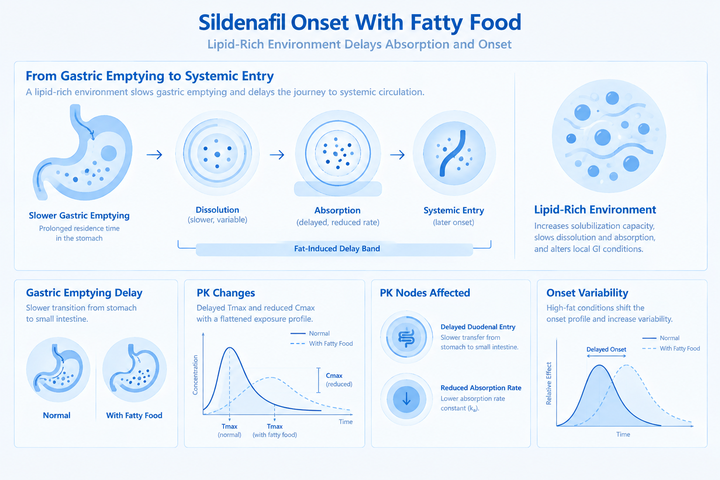
Fatty food

A fatty-food condition can influence sildenafil onset primarily by modifying the gastrointestinal phase preceding systemic exposure. Oral absorption is not instantaneous; gastric emptying, intestinal transit, dissolution, and uptake contribute to the developing concentration profile. The resulting relationship among absorption, pharmacokinetics, sildenafil onset, and the PK curve is therefore temporal rather than binary. A fatty meal can shift concentration development without creating a separate pharmacodynamic mechanism. The underlying PDE5 target remains the same, while exposure kinetics may differ.

Once systemic concentration develops, pharmacodynamics provides the next layer of interpretation. Sildenafil inhibits PDE5, reducing enzymatic degradation of cyclic GMP within tissues where nitric-oxide signaling is active. This connects concentration to the PDE5 pathway, NO/cGMP pathway, and downstream vascular relaxation. Consequently, a food-associated alteration in absorption belongs upstream of receptor-enzyme interaction. The pharmacodynamics layer translates exposure into target engagement, but it should not be treated as identical to the absorption profile.

The complete sequence can be represented as gastrointestinal handling, systemic exposure, PDE5 inhibition, intracellular signaling, and vascular physiology. This framework distinguishes how fast sildenafil works mechanistically from any single numerical landmark. The onset curve summarizes temporal pharmacology, whereas time to peak identifies a concentration landmark and onset variability describes dispersion around temporal behavior. Food therefore modifies one component of a multistage system.

PK/PD stage Mechanistic role Food relevance
Absorption Development of systemic sildenafil concentration Meal composition can alter absorption kinetics
PDE5 inhibition Target-level pharmacodynamic interaction Depends on systemic exposure rather than food directly
NO/cGMP signaling Downstream intracellular signaling context Indirectly related through exposure and physiology

Fatty Food, Absorption, and Concentration Development

The most direct mechanistic effect of a fatty meal concerns oral drug absorption and the concentration-time trajectory. Gastric emptying can be slower after a substantial meal, while intestinal drug delivery and dissolution may also change. These processes are central to absorption and pharmacokinetics. They help explain why fatty-food onset should be interpreted through concentration development rather than as an isolated clinical endpoint. The PK curve records this changing exposure over time.

The concentration profile has an ascending phase, a peak region, and a declining phase. Fatty-food conditions may alter the ascending portion more prominently than later disposition processes, although the magnitude and pattern depend on study conditions and formulation. The distinction among time to peak, onset curve, and sildenafil onset is therefore essential. Time to peak is a PK landmark; onset is an integrated temporal pharmacodynamic concept; and the curve describes how exposure or pharmacological activity develops.

After absorption, sildenafil undergoes distribution and metabolic processing. Distribution, CYP3A4 metabolism, half-life, and elimination shape the later concentration profile. A fatty meal does not replace these processes or create a different elimination pathway. Instead, it can influence the timing of the concentration entering systemic circulation. This distinction prevents an absorption-related shift from being incorrectly interpreted as a fundamental alteration in sildenafil's molecular mechanism or disposition architecture.

Process Primary determinant Temporal interpretation
Gastric emptying Meal composition and gastrointestinal physiology Can influence delivery to the absorption site
Systemic absorption Drug availability and gastrointestinal conditions Shapes the ascending concentration phase
Disposition Distribution, metabolism, elimination Shapes concentration decline after absorption

Fatty Food Versus Time to Peak

Time to peak is a pharmacokinetic landmark identifying when measured plasma concentration reaches its observed maximum under defined study conditions. It is not synonymous with onset. Fatty-food conditions can influence the absorption phase and consequently the position of the peak on a concentration-time axis. Understanding time to peak alongside sildenafil onset, absorption, and the PK curve prevents these distinct concepts from being collapsed into one temporal measure.

The peak is preceded by concentration accumulation and followed by distribution and elimination. A shift in peak timing can therefore arise from altered input into the systemic compartment without necessarily implying an equivalent shift in every pharmacodynamic event. The onset curve is broader because it describes temporal development of pharmacological activity. Its interpretation also involves pharmacodynamics, PDE5 pathway, and vascular relaxation.

A concentration maximum also does not represent the end of pharmacological activity. Sildenafil remains subject to metabolic transformation and elimination after peak concentration. The CYP3A4 metabolism, half-life, and elimination layers determine the descending portion of the PK profile. Accordingly, fatty-food interpretation should distinguish a possible alteration in absorption timing from later disposition characteristics. The distinction is particularly important when comparing observed concentration curves across different nutritional conditions.

Landmark Definition Food-related interpretation
Absorption phase Drug enters systemic circulation May be temporally modified by meal conditions
Time to peak Time associated with maximum measured concentration Can reflect changes in concentration development
Onset Temporal emergence of pharmacodynamic effect Not equivalent to the concentration maximum

Fatty Food and the Onset Curve

An onset curve is best understood as a conceptual representation of pharmacological activity developing over time, rather than simply a copy of plasma concentration. Food can affect the upstream concentration trajectory, which may influence when pharmacodynamic exposure becomes established. This relationship connects onset curve, absorption, pharmacokinetics, and pharmacodynamics. The curve should therefore be interpreted as a PK/PD construct with both exposure and biological-response components.

Sildenafil's pharmacodynamic pathway involves PDE5 inhibition in the setting of nitric-oxide-mediated cyclic GMP signaling. The relevant sequence includes systemic concentration, interaction with the PDE5 pathway, modulation of the NO/cGMP pathway, and vascular signaling associated with vascular relaxation. A fatty-food effect occurs principally before this target-level sequence. Therefore, the food condition is an upstream modifier of exposure rather than a direct modifier of PDE5's molecular identity.

The relationship between a food-shifted concentration curve and an onset curve is not necessarily one-to-one. Factors such as concentration-effect relationships, physiological signaling, baseline vascular state, and temporal hysteresis can influence how plasma exposure maps onto pharmacodynamic activity. Comparing PK curve, time to peak, and onset variability therefore provides a more complete framework than relying on a single curve feature.

Curve concept Primary domain Interpretation
PK curve Drug concentration over time Describes systemic exposure
Onset curve Pharmacodynamic development Integrates temporal exposure with biological signaling
Peak time PK landmark Marks maximum observed concentration

Fatty Food and Dose-Linked Onset Interpretation

Dose changes alter the amount of sildenafil entering the pharmacokinetic system, while food conditions can alter how that amount develops over time. The distinction between these variables is important when considering onset by dose, 25 mg, 50 mg, and 100 mg. A dose-related exposure difference should not automatically be interpreted as a proportional change in onset timing, because concentration magnitude and absorption rate are separate PK characteristics.

The concentration-effect relationship also determines how a change in exposure is translated into pharmacodynamics. Sildenafil's interaction with the PDE5 pathway occurs downstream of absorption, while the NO/cGMP pathway provides the signaling context. Food therefore intersects with dose through the exposure profile rather than through a new molecular mechanism. The resulting interpretation belongs to pharmacokinetics and pharmacodynamics simultaneously.

Different dose levels can produce different concentration-time profiles, but observed temporal landmarks also depend on assay conditions, formulation, meal composition, and physiological variability. A fatty-food comparison involving onset by dose should therefore separate exposure magnitude from absorption timing. Later CYP3A4 metabolism, half-life, and elimination remain relevant regardless of the nominal dose category.

Dose concept PK interpretation Food interaction layer
25 mg Lower nominal amount of drug Absorption conditions can still affect concentration development
50 mg Intermediate nominal amount Food remains an upstream absorption variable
100 mg Higher nominal amount Dose magnitude and meal effects remain separable PK factors

Fatty Food Versus Alcohol: Distinct Temporal Variables

Fatty food and alcohol should not be treated as interchangeable modifiers of sildenafil timing. A fatty meal primarily raises questions about gastrointestinal handling, gastric emptying, and oral absorption. Alcohol introduces additional physiological and pharmacological variables that can affect vascular tone and systemic state. The distinction is reflected in fatty-food onset, onset with alcohol, food interactions, and alcohol interactions.

From a PK perspective, nutritional composition can alter gastrointestinal drug input, whereas alcohol may coexist with effects on hemodynamics and other biological systems. The pharmacodynamic layer therefore becomes particularly important when interpreting alcohol-related conditions. Sildenafil acts through the PDE5 pathway and NO/cGMP pathway, with downstream vascular signaling. A food-associated absorption change and an alcohol-associated physiological effect represent different causal pathways even when both are discussed in relation to timing.

Comparative interpretation should also consider the concentration-time profile. PK curve, pharmacokinetics, and pharmacodynamics describe different layers of evidence. The onset curve integrates them conceptually, while onset variability captures dispersion caused by multiple factors. Thus, food and alcohol can both appear in onset discussions without producing equivalent mechanisms.

Condition Principal mechanistic domain Interpretive distinction
Fatty food Gastrointestinal absorption Primarily an upstream PK variable
Alcohol Systemic physiological and pharmacological context Can involve both PK and PD considerations
Combined conditions Multiple interacting variables Causal attribution becomes more complex

Fatty Food Across Physiological States

Meal-related onset variability can differ between physiological states because gastrointestinal function, vascular biology, metabolism, and body composition are not uniform across populations. Relevant contexts include onset in older adults, onset in diabetes, and onset in obesity. These categories should be interpreted as physiological modifiers rather than deterministic predictors. The underlying sequence remains absorption, systemic exposure, PDE5 inhibition, NO/cGMP signaling, and vascular response.

Age-related physiological changes can influence hepatic metabolism, renal handling, gastrointestinal function, and vascular responsiveness, while diabetes can involve altered endothelial signaling and metabolic physiology. Obesity may alter body composition, gastric physiology, and systemic pharmacokinetic characteristics. These factors interact with absorption, distribution, CYP3A4 metabolism, and elimination. A fatty meal therefore operates within a broader physiological environment rather than as an isolated determinant of temporal exposure.

The pharmacodynamic component may also vary because vascular signaling and nitric-oxide responsiveness can differ across physiological states. Sildenafil's target pathway remains centered on PDE5 inhibition and cyclic GMP preservation, but the surrounding biological system affects how concentration is translated into signaling. This is why PDE5 pathway, NO/cGMP pathway, vascular relaxation, and onset variability should be evaluated together.

Physiological context Potential PK/PD domain Food-related interpretation
Older adults Metabolism, elimination, vascular physiology Meal effects occur within altered systemic physiology
Diabetes Metabolic and endothelial signaling Food and disease-state variables may coexist
Obesity Body composition and gastrointestinal physiology Exposure interpretation may involve multiple interacting variables

Fatty Food and Later Pharmacokinetic Disposition

Although fatty-food discussions usually focus on absorption, later pharmacokinetic phases remain necessary for complete interpretation. Once sildenafil enters systemic circulation, distribution determines movement between compartments, while CYP3A4 metabolism contributes substantially to biotransformation. The resulting half-life and elimination processes shape the declining portion of the PK curve. A fatty meal therefore should not be assumed to redefine the complete disposition profile.

The temporal relationship between absorption and elimination is dynamic. If drug input is altered, the ascending concentration profile can change while intrinsic metabolic pathways remain governed by enzyme activity and systemic physiology. This distinction links pharmacokinetics with absorption, while keeping pharmacodynamics conceptually separate. The observed concentration at any time reflects the balance between drug entering and drug being distributed, metabolized, and eliminated.

A complete food-linked interpretation therefore follows the molecule across the entire concentration-time sequence rather than focusing exclusively on an early landmark. The time to peak describes a maximum concentration point, while onset curve describes temporal pharmacodynamic development. How fast sildenafil works is consequently a composite question involving absorption, concentration, target engagement, signaling, and disposition rather than a single elimination parameter.

PK layer Principal process Relation to fatty food
Distribution Movement between systemic compartments Follows systemic entry and concentration development
CYP3A4 metabolism Biotransformation Represents a disposition pathway distinct from meal composition
Elimination Removal of drug and metabolites Shapes later concentration decline

Fatty Food and PDE5 Pharmacodynamics

Sildenafil's pharmacodynamic mechanism begins with inhibition of phosphodiesterase type 5, an enzyme involved in cyclic GMP degradation. This mechanism is downstream from oral absorption, so a fatty-food condition does not fundamentally change the identity of the PDE5 pathway. Instead, meal-related changes in systemic exposure can modify the temporal context in which PDE5 inhibition occurs. The resulting framework connects pharmacodynamics, absorption, and the sildenafil onset concept.

The relevant signaling environment includes nitric oxide, soluble guanylate cyclase, cyclic GMP, and smooth-muscle regulation. Sildenafil's PDE5 inhibition reduces cyclic GMP breakdown, while the NO/cGMP pathway supplies the endogenous signaling context. The downstream vascular process can be described through vascular relaxation. Food acts upstream by potentially modifying concentration development, so the mechanistic sequence should remain ordered rather than treating meal composition as a direct PDE5 modulator.

Temporal pharmacodynamics can also differ from simple plasma concentration behavior because biological signaling involves target occupancy, endogenous NO generation, tissue distribution, and downstream transduction. Consequently, onset curve, PK curve, and time to peak provide complementary information. A food-related change in one PK landmark should not be assumed to reproduce identically at every PD stage.

PD component Mechanistic role Food relationship
PDE5 inhibition Reduces cyclic GMP degradation Downstream of systemic sildenafil exposure
NO/cGMP signaling Provides endogenous signaling context Influenced indirectly through exposure timing
Vascular relaxation Downstream smooth-muscle response Represents a later PD layer

Interpreting Food-Linked Onset Variability

Food-linked onset variability reflects the fact that meal effects are not represented by a single universal curve. Fat content, meal size, composition, gastric emptying, gastrointestinal motility, formulation, and study conditions can influence oral drug input. These variables belong within onset variability and food interactions. The relationship with absorption, time to peak, and the PK curve is therefore probabilistic and context dependent.

Variability also emerges after absorption. Differences in hepatic enzyme activity, distribution, body composition, and systemic physiology can alter exposure. The relevant pathways include distribution, CYP3A4 metabolism, half-life, and elimination. Consequently, two concentration profiles affected by similar meals may still diverge because disposition differs. This is why mechanistic interpretation should distinguish meal-related input variability from intrinsic pharmacokinetic variability.

At the PD level, vascular physiology and endogenous NO signaling add another source of variation. The sequence involving PDE5 pathway, NO/cGMP pathway, and vascular relaxation can modify the relationship between concentration and pharmacodynamic development. Thus, onset curve interpretation should integrate both PK dispersion and PD heterogeneity rather than attributing every temporal difference to food.

Variability source Primary layer Potential effect on interpretation
Meal composition Absorption Changes gastrointestinal drug input
Metabolic capacity Disposition Changes concentration decline and exposure
Vascular physiology Pharmacodynamics Changes concentration-to-response context

A Systems-Level Framework for Fatty-Food Timing Biology

A systems-level interpretation starts with the gastrointestinal environment, proceeds through oral absorption and systemic concentration, and then follows target engagement and vascular signaling. This sequence integrates absorption, pharmacokinetics, pharmacodynamics, and sildenafil onset. Fatty food is principally an upstream modifier of drug input, while PDE5 inhibition represents the target-level mechanism. The distinction keeps nutritional conditions separate from the molecular action of sildenafil.

The concentration-time component can be represented through the PK curve, with time to peak describing its maximum concentration landmark. The pharmacodynamic component is represented conceptually through the onset curve, which incorporates the relationship between exposure and biological signaling. Differences between these representations are important because absorption, concentration, target inhibition, and vascular signaling occur sequentially but are not interchangeable measurements.

Finally, interpretation must account for dose, meal composition, alcohol, physiology, metabolism, and elimination. The relevant contextual domains include onset by dose, onset with alcohol, onset in older adults, onset in diabetes, and onset in obesity. The resulting framework treats fatty-food timing as one component of multidimensional PK/PD variability rather than a standalone determinant.

Systems layer Key variables Interpretive purpose
Input Meal composition, gastric emptying, absorption Explains early concentration development
Exposure Distribution, metabolism, elimination Explains concentration trajectory
Effect biology PDE5, NO/cGMP, vascular signaling Explains pharmacodynamic development

Frequently Asked Questions

Fatty food can influence sildenafil onset primarily through the pharmacokinetic phase that precedes systemic exposure. Meal composition may alter gastric emptying and gastrointestinal drug delivery, which can change the rate at which sildenafil appears in plasma. This affects concentration development rather than changing sildenafil's molecular target. The pharmacodynamic mechanism remains based on PDE5 inhibition in the context of nitric-oxide and cyclic-GMP signaling. Therefore, fatty food is best interpreted as an upstream modifier of exposure timing within a larger PK/PD sequence.

The relationship between fatty food and sildenafil absorption concerns gastrointestinal drug input. A substantial meal containing fat can alter gastric emptying and the movement of orally administered drug toward the intestinal absorption site. These changes can modify the shape of the early concentration-time profile. Absorption is therefore a pharmacokinetic process, while PDE5 inhibition is pharmacodynamic. A food-associated change in absorption should not be interpreted as a change in sildenafil's molecular mechanism, target specificity, or downstream signaling identity.

Fatty-food conditions can influence the temporal development of sildenafil plasma concentrations and therefore may affect the observed time associated with maximum concentration under particular study conditions. Time to peak is a pharmacokinetic landmark, however, rather than a direct measurement of pharmacodynamic onset. The peak occurs after the ascending concentration phase and before the later declining phase. Consequently, a change in time to peak should be interpreted alongside the complete concentration-time curve, absorption characteristics, and pharmacodynamic context rather than treated as synonymous with onset.

A fatty meal can alter the early portion of the sildenafil concentration-time curve by modifying gastrointestinal drug input. Changes in gastric emptying and absorption can influence the ascending phase and the timing of maximum concentration. The later descending phase is governed by distribution, metabolism, and elimination and should be analyzed separately. Thus, the complete PK curve reflects multiple processes rather than food alone. A food-associated change in one region of the curve does not necessarily imply a proportional alteration in every pharmacokinetic parameter.

The sildenafil onset curve is a conceptual pharmacodynamic representation of how drug-related biological activity develops over time. Fatty food can influence the upstream concentration trajectory through gastrointestinal absorption, which may alter the temporal input available for pharmacodynamic processes. The onset curve therefore should not be considered identical to the plasma concentration curve. PDE5 inhibition, nitric-oxide signaling, cyclic-GMP biology, and vascular physiology contribute additional layers between systemic exposure and pharmacodynamic development, making onset an integrated PK/PD concept rather than a simple concentration landmark.

Fatty-food-linked onset can vary because meal composition is only one component of gastrointestinal and systemic pharmacology. Meal size, fat content, gastric emptying, intestinal transit, formulation characteristics, metabolic capacity, body composition, and physiological state can all contribute to differences in concentration development. Pharmacodynamic variability adds another layer through vascular signaling and endogenous nitric-oxide biology. Therefore, observed timing differences cannot always be attributed exclusively to the presence of fat. Mechanistic interpretation is strongest when absorption, disposition, and pharmacodynamics are considered together.

Dose and food are separate pharmacokinetic variables that can interact within the same concentration-time system. Different sildenafil dose levels change the amount of drug entering systemic circulation, whereas a fatty meal can modify the temporal characteristics of oral absorption. A difference in exposure magnitude is therefore not equivalent to a difference in absorption rate. Pharmacodynamic interpretation also depends on the concentration-effect relationship and PDE5 target engagement. Dose-linked and food-linked effects should consequently be treated as distinct dimensions within an integrated PK/PD framework.

A general food condition encompasses a broad range of meal compositions, whereas a fatty-food condition specifically emphasizes a meal with substantial fat content. The pharmacokinetic consequences can differ according to meal size, composition, caloric content, and gastrointestinal characteristics. Consequently, evidence obtained under a defined high-fat or substantial-fat meal condition should not automatically be generalized to every type of food. Mechanistically, both conditions primarily concern oral absorption and concentration development, but the magnitude and timing of the effect depend on the specific nutritional context.

Fatty food and alcohol represent different mechanistic variables. Fatty food primarily raises questions about gastrointestinal handling and oral absorption, whereas alcohol can introduce additional systemic physiological and vascular effects alongside any pharmacokinetic considerations. Sildenafil itself acts through PDE5 inhibition and the nitric-oxide/cyclic-GMP signaling system. Therefore, an alcohol-associated physiological change should not automatically be interpreted as an absorption effect. Comparing the two requires separation of gastrointestinal PK effects from systemic PD and hemodynamic influences.

Physiological state can modify how a fatty meal interacts with sildenafil pharmacokinetics and pharmacodynamics. Older age may be associated with differences in metabolism, elimination, gastrointestinal function, and vascular physiology. Diabetes can involve altered metabolic and endothelial signaling, while obesity can influence body composition and gastrointestinal physiology. These factors may coexist with meal-related absorption changes. Accordingly, physiological state is best considered a contextual source of PK/PD variability rather than a deterministic explanation for any particular temporal pattern.

The most coherent interpretation follows sildenafil through sequential PK and PD stages. The analysis begins with gastrointestinal conditions and oral absorption, continues through systemic concentration and distribution, and then considers PDE5 inhibition and nitric-oxide/cyclic-GMP signaling. Later metabolism and elimination shape the concentration decline. Fatty food therefore represents an upstream pharmacokinetic variable rather than a direct modifier of PDE5 itself. This framework avoids equating absorption, peak concentration, onset, and pharmacodynamic activity, which are related but distinct concepts.

PK and PD should be integrated by connecting concentration development with target-level and physiological mechanisms without treating them as identical measurements. Food can alter oral absorption and thereby influence the concentration-time profile. The resulting systemic exposure provides the context for PDE5 inhibition, which affects cyclic-GMP degradation within an active nitric-oxide signaling environment. Distribution, metabolism, and elimination then shape exposure over time. A complete interpretation therefore combines absorption, concentration, target engagement, signaling, and physiological response rather than relying on a single timing landmark.

Mayo Clinic — Sildenafil Overview NHS — Sildenafil Information MedlinePlus — Sildenafil Drugs.com — Sildenafil Monograph PubMed — Sildenafil Studies