PK/PD Integration • Variability Biology

Sildenafil Onset Variability — PK/PD Timing & Physiological Differences

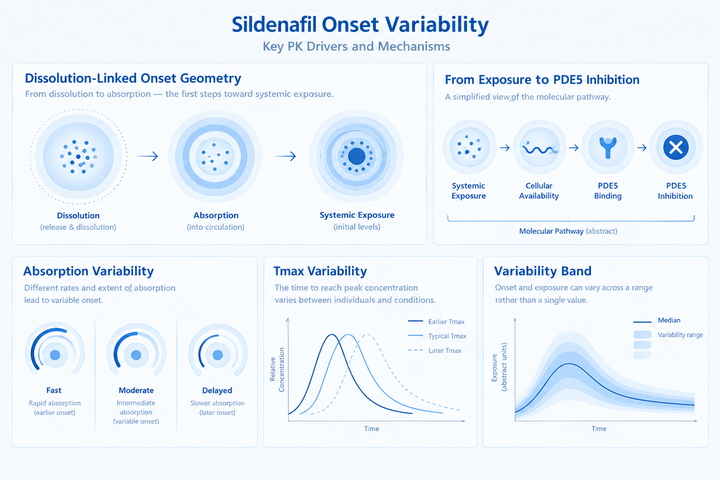
Sildenafil onset variability describes differences in the temporal relationship between drug exposure and pharmacodynamic activity. The concept connects sildenafil onset, how fast sildenafil works, time to peak, and the onset curve with absorption, concentration, and pharmacokinetics. It is therefore broader than a single clock time because exposure and biological response develop through linked PK and PD processes.

The temporal sequence begins with absorption, followed by systemic concentration, distribution, and interaction with the PDE5 pathway. Pharmacodynamic interpretation also involves the NO/cGMP pathway and vascular relaxation. Food, alcohol, dose, metabolic handling, and physiological characteristics can modify the shape or timing of exposure, creating measurable variation around population-level PK/PD patterns.

A complete interpretation therefore distinguishes onset from time to peak and from a complete PK curve. Factors such as onset with food, onset with alcohol, onset by dose, onset in older adults, onset in diabetes, and onset in obesity illustrate why onset variability is best understood as a systems-level pharmacological phenomenon rather than a fixed interval.

Onset Variability as PK/PD Integration
Onset factors

Sildenafil onset variability is fundamentally a PK/PD integration problem. Absorption determines how drug enters systemic circulation, while pharmacokinetics describes concentration over time and pharmacodynamics connects exposure with PDE5-related biological activity. The resulting temporal profile can be examined through sildenafil onset, onset curve, and PK curve concepts. Thus, variability may arise from either exposure kinetics or the relationship between concentration and downstream biological signaling.

After systemic entry, sildenafil concentration changes through distribution, CYP3A4 metabolism, and eventual elimination. Pharmacodynamic activity involves the PDE5 pathway, modulation of cyclic GMP availability through the NO/cGMP pathway, and downstream vascular relaxation. Because these processes are sequential but overlapping, an observed onset pattern cannot be reduced to absorption alone. How fast sildenafil works is therefore a temporal interpretation of interacting PK and PD layers.

The distinction between time to peak and onset is especially important. Peak concentration is a pharmacokinetic landmark, whereas onset describes a broader temporal transition in pharmacodynamic activity. An onset curve can represent changing biological activity, while a PK curve represents concentration over time. Pharmacodynamics, PDE5 pathway, and vascular relaxation therefore provide the biological bridge between concentration and temporal interpretation.

Layer Primary variable Temporal interpretation
PK Systemic concentration Exposure changes over time
PD PDE5 inhibition Biological activity follows exposure
Integrated PK/PD relationship Onset reflects linked processes

Absorption, Concentration, and the Onset Sequence

The first major source of onset variability is absorption, which determines the rate at which sildenafil becomes available systemically. Pharmacokinetics then describes the resulting concentration-time trajectory, including rising exposure toward time to peak. The PK curve provides the quantitative framework, while the onset curve represents the temporal relationship between exposure and pharmacodynamic activity. Consequently, altered absorption can shift concentration dynamics without necessarily implying an identical shift in every downstream biological process.

Once circulating concentration rises, sildenafil reaches relevant molecular targets and inhibits the PDE5 pathway. PDE5 inhibition modifies cyclic GMP handling within the broader NO/cGMP pathway, which participates in smooth-muscle signaling and vascular relaxation. This sequence is described through pharmacodynamics rather than absorption alone. The interval between systemic entry and measurable biological activity therefore reflects a chain of linked events, making sildenafil onset a composite rather than a single PK measurement.

Distribution and metabolic handling further shape the exposure profile. Distribution describes movement between circulating and tissue compartments, while CYP3A4 metabolism contributes to clearance. The half-life and elimination phases primarily influence persistence and decline rather than the initial entry process. These layers can nevertheless affect the overall PK curve and its relationship with the onset curve, especially when interpreting variability across individuals or experimental conditions.

Stage Mechanistic event Relevant measure
Entry Gastrointestinal absorption Absorption rate
Exposure Systemic concentration rises Concentration-time profile
Response PDE5 inhibition and signaling Pharmacodynamic activity

Variability Versus Time to Peak, Onset Curve, and PK Curve

An onset variability analysis should distinguish sildenafil onset from time to peak. Time to peak identifies when measured plasma concentration reaches its maximum, whereas onset is a broader PK/PD concept involving the emergence of pharmacodynamic activity. The PK curve displays concentration across time, while the onset curve can depict a biological transition. Pharmacokinetics and pharmacodynamics therefore answer related but distinct temporal questions.

The distinction also matters because maximum concentration does not inherently represent the beginning of pharmacodynamic activity. As sildenafil concentration rises, interaction with the PDE5 pathway can occur before the concentration maximum, while the downstream NO/cGMP pathway and vascular relaxation involve additional biological steps. Consequently, how fast sildenafil works cannot be inferred from peak concentration alone. The absorption phase, distribution, and concentration-response relationship all contribute to interpretation.

Variability can therefore affect different landmarks to different degrees. Changes in absorption may alter the rising limb of the PK curve, whereas changes in metabolism may influence later exposure. Distribution, CYP3A4 metabolism, half-life, and elimination help characterize the complete concentration trajectory. The onset variability concept is therefore best interpreted by examining the entire temporal profile rather than treating one landmark as a substitute for another.

Concept What it represents Primary domain
Time to peak Time of maximum measured concentration PK
Onset curve Temporal pharmacodynamic transition PK/PD
PK curve Concentration across time PK

Dose-Linked Onset Variability

Dose-linked onset interpretation concerns how different exposure levels influence concentration and pharmacodynamic relationships. The onset by dose concept can be considered across 25 mg, 50 mg, and 100 mg exposure conditions without treating dose as a direct clock-time determinant. Pharmacokinetics describes how systemic concentrations change, while pharmacodynamics describes concentration-dependent PDE5 inhibition and downstream signaling.

Across dose levels, the central mechanistic question is whether exposure magnitude and concentration-time shape change together or independently. Absorption establishes systemic entry, followed by interaction with the PDE5 pathway. Subsequent modulation of the NO/cGMP pathway and vascular relaxation provides the pharmacodynamic layer. The onset curve can therefore be examined alongside the PK curve to distinguish concentration changes from response-pattern changes.

Dose-linked interpretation also requires separation of initial onset from later disposition. Distribution, CYP3A4 metabolism, half-life, and elimination influence the complete exposure profile. Differences among 25 mg, 50 mg, and 100 mg therefore should be interpreted through concentration-response relationships rather than assumed to represent proportionally different onset intervals. This framework keeps time to peak distinct from pharmacodynamic onset.

Dose concept PK interpretation PD interpretation
25 mg Lower nominal exposure condition PDE5-related concentration-response context
50 mg Intermediate nominal exposure condition Concentration-dependent signaling context
100 mg Higher nominal exposure condition Concentration-response interpretation

Food and Absorption-Linked Variability

Food can modify the temporal characteristics of sildenafil exposure, making onset with food an important PK interpretation domain. Onset with fatty food is particularly relevant because meal composition can influence gastrointestinal processes and the rate of systemic drug appearance. These effects belong primarily to absorption and pharmacokinetics, although the resulting concentration trajectory can influence pharmacodynamics and the observed onset curve.

Food-linked variability should not be interpreted as a simple change in every PK landmark. A meal can influence the rising portion of the PK curve, while the downstream PDE5 pathway, NO/cGMP pathway, and vascular relaxation remain pharmacodynamic processes. The concepts of time to peak and sildenafil onset therefore remain distinct. Food interactions describe a broader interaction context, whereas onset variability focuses on temporal exposure-response interpretation.

Meal composition and systemic handling can interact with later disposition processes. Distribution, CYP3A4 metabolism, half-life, and elimination characterize the complete PK profile after absorption. Consequently, onset with food should be viewed as a modification of a dynamic concentration-time system rather than an isolated onset switch. The PK curve and onset curve provide complementary representations of that temporal relationship.

Food factor Primary PK domain Interpretive consequence
Meal presence Gastrointestinal processes May alter concentration-time development
Fat content Absorption dynamics Can modify the rising exposure phase
Food interaction PK context Requires separation of exposure and PD

Alcohol-Linked Onset Variability

Alcohol-linked onset interpretation requires separation of direct PK effects from broader physiological interactions. Onset with alcohol and alcohol interactions describe an exposure context in which gastrointestinal conditions, vascular physiology, and systemic metabolic factors may coexist. The absorption phase and resulting pharmacokinetics therefore need to be considered alongside pharmacodynamics, rather than treating alcohol as a single determinant of onset.

The pharmacodynamic layer involves sildenafil inhibition of the PDE5 pathway, modulation of the NO/cGMP pathway, and downstream vascular relaxation. Alcohol can itself affect vascular tone and systemic physiology, creating a context in which temporal biological interpretation becomes more complex. The onset curve may therefore reflect overlapping processes rather than a pure sildenafil concentration-response relationship. The PK curve remains useful for separating exposure changes from physiological background effects.

Later PK layers remain relevant when considering alcohol-associated variability. Distribution, CYP3A4 metabolism, half-life, and elimination determine the broader concentration trajectory. Thus, time to peak cannot by itself describe alcohol-linked onset variation. A mechanistic analysis instead compares absorption, concentration, molecular inhibition, and vascular signaling while recognizing that sildenafil onset is an integrated PK/PD phenomenon.

Alcohol-related factor Relevant layer Interpretation
Gastrointestinal context Absorption May influence exposure development
Vascular effects Pharmacodynamics Can modify physiological background
Systemic handling PK Shapes concentration over time

Onset Variability in Older Adults

Age-associated onset variability reflects changes across several physiological layers rather than a single chronological effect. Onset in older adults can involve altered gastrointestinal function, body composition, hepatic metabolic capacity, renal elimination, and vascular physiology. These factors can modify pharmacokinetics and pharmacodynamics. The resulting temporal profile is best considered through absorption, distribution, and the PK curve rather than a presumed fixed onset pattern.

Age-related changes in distribution and metabolism can influence the concentration-time relationship. Distribution is affected by body composition and plasma protein relationships, while CYP3A4 metabolism contributes to sildenafil clearance. The half-life and elimination phases consequently provide context for overall exposure. These PK changes intersect with the PDE5 pathway, NO/cGMP pathway, and vascular relaxation at the PD level.

The interpretation should also distinguish onset from time to peak and from the broader onset curve. How fast sildenafil works is not represented by one PK landmark because molecular inhibition and vascular signaling follow concentration changes. Age-associated variability therefore illustrates why sildenafil onset is best framed as a systems-level relationship between exposure, target engagement, and physiological response.

Age-associated factor PK/PD domain Potential temporal relevance
Body composition Distribution Can alter concentration distribution
Hepatic metabolic capacity CYP3A4 metabolism Can affect exposure persistence
Vascular physiology Pharmacodynamics Can modify response context

Onset Variability in Diabetes

Diabetes-associated onset variability involves both pharmacokinetic and vascular physiological considerations. Onset in diabetes can be interpreted through absorption, pharmacokinetics, and pharmacodynamics, while chronic metabolic changes can influence vascular signaling and endothelial function. The onset curve therefore reflects an interaction between systemic exposure and the physiological environment in which sildenafil acts, rather than a diabetes-specific clock mechanism.

At the molecular level, sildenafil inhibits the PDE5 pathway and interacts functionally with the NO/cGMP pathway. Diabetes can alter nitric oxide signaling, endothelial biology, smooth-muscle physiology, and vascular responsiveness, creating potential differences in the pharmacodynamic context. The vascular relaxation layer therefore needs to be distinguished from concentration alone. The PK curve describes exposure, whereas the onset curve incorporates temporal biological interpretation.

Metabolic state may also intersect with systemic disposition. Distribution, CYP3A4 metabolism, half-life, and elimination remain relevant to the complete PK profile. Consequently, time to peak alone cannot characterize onset variability in diabetes. A comprehensive framework connects sildenafil onset with concentration, PDE5 inhibition, NO/cGMP signaling, vascular physiology, and the surrounding metabolic state.

Diabetes-related domain Primary mechanism Temporal interpretation
Metabolic state Systemic physiological environment May modify PK/PD context
Endothelial signaling NO-related vascular biology Influences PD interpretation
Drug exposure Absorption and disposition Defines concentration trajectory

Onset Variability in Obesity

Obesity can introduce additional variability into sildenafil onset interpretation through changes in body composition, physiology, and metabolic context. Onset in obesity can be examined through absorption, distribution, and pharmacokinetics. Altered proportions of adipose and lean tissue may influence distribution characteristics, while associated physiological changes can affect vascular biology. These mechanisms should be evaluated alongside pharmacodynamics rather than assuming a uniform effect on onset.

The concentration-response relationship remains central. Sildenafil acts through the PDE5 pathway, while downstream biology involves the NO/cGMP pathway and vascular relaxation. Obesity-associated endothelial and metabolic changes can modify the physiological background in which these pathways operate. The onset curve therefore provides a conceptual bridge between exposure and biological activity, while the PK curve remains focused on concentration-time behavior.

Disposition remains important because CYP3A4 metabolism, half-life, and elimination shape exposure beyond the initial absorption phase. These variables can influence the complete temporal profile without necessarily defining initial onset independently. The distinction between time to peak, sildenafil onset, and onset variability is therefore particularly useful when examining obesity as a physiological modifier.

Obesity-related factor Mechanistic domain Temporal relevance
Body composition Distribution May influence compartmental exposure
Metabolic physiology PK/PD context Can modify systemic interpretation
Vascular physiology NO/cGMP signaling Can influence pharmacodynamic context

Metabolism, Half-Life, and Elimination

Metabolic variability can alter the sildenafil concentration-time profile and therefore affect interpretation of onset within the wider PK/PD sequence. CYP3A4 metabolism is a major disposition pathway, while half-life summarizes the decline phase of systemic exposure. Elimination describes removal of drug-related material from the system. These processes follow initial absorption and distribution, so their strongest influence is often visible across the broader PK curve.

Although metabolism and elimination are often discussed as duration-related concepts, they remain relevant to onset variability because the complete concentration trajectory is continuous. Pharmacokinetics connects the rising and declining exposure phases, while pharmacodynamics interprets concentration in relation to target engagement. Sildenafil inhibition of the PDE5 pathway interacts with the NO/cGMP pathway and vascular relaxation, creating a PK-to-PD chain that cannot be reduced to clearance alone.

Variability in metabolic handling can also affect how exposure is compared across physiological states or interacting substances. Onset variability should therefore be interpreted with the onset curve, time to peak, and sildenafil onset concepts kept separate. A delayed or prolonged concentration profile does not automatically specify a corresponding pharmacodynamic landmark. The mechanistic distinction between exposure, target inhibition, and vascular signaling remains essential.

Disposition process Primary role Temporal phase
CYP3A4 metabolism Biotransformation Throughout systemic disposition
Half-life Characterizes concentration decline Elimination phase
Elimination Drug removal Later exposure profile

Systems-Level Interpretation of Onset Variability

A systems-level model integrates absorption, pharmacokinetics, pharmacodynamics, and physiological context. The sequence begins with drug entry, proceeds through concentration development, and reaches molecular inhibition of the PDE5 pathway. The resulting influence on the NO/cGMP pathway and vascular relaxation supplies the downstream PD layer. Sildenafil onset is therefore an integrated temporal construct rather than an isolated absorption measurement.

Different modifiers act at different points in this sequence. Onset with food and onset with fatty food primarily highlight absorption-related variation, while onset with alcohol introduces both physiological and interaction context. Onset by dose emphasizes exposure magnitude, and onset in older adults, onset in diabetes, and onset in obesity illustrate systemic physiological variation.

The most informative interpretation compares the PK curve with the onset curve while retaining time to peak as a distinct PK landmark. Distribution, CYP3A4 metabolism, half-life, and elimination complete the disposition framework. This integrated approach explains why how fast sildenafil works is best represented as a dynamic PK/PD relationship with multiple potential sources of variability.

System layer Representative variables Role in variability
PK entry Absorption, food, dose Shapes exposure development
Disposition Distribution, CYP3A4, elimination Shapes concentration trajectory
PD PDE5, NO/cGMP, vascular signaling Shapes biological interpretation

Frequently Asked Questions

Sildenafil onset variability refers to differences in the temporal relationship between systemic drug exposure and pharmacodynamic activity. It does not represent one universally fixed interval. Absorption, concentration-time behavior, distribution, metabolism, physiological conditions, and the concentration-response relationship can all contribute to variation. Onset is therefore best understood as a PK/PD concept connecting changing sildenafil concentrations with PDE5 inhibition and downstream nitric oxide–cyclic GMP signaling. Population pharmacokinetic measurements describe typical patterns, while variability analysis considers why individual observations or experimental conditions can differ around those patterns.

Absorption variability concerns differences in the rate or extent at which sildenafil enters systemic circulation after administration. Onset variability is broader because it includes what happens after absorption, including concentration development, distribution, target interaction, PDE5 inhibition, and downstream signaling. A change in absorption can alter the rising concentration-time profile, but the resulting pharmacodynamic timing also depends on the concentration-response relationship and physiological environment. Consequently, absorption is one contributor to onset variability rather than a complete definition of the phenomenon.

Time to peak is a pharmacokinetic landmark identifying when measured sildenafil plasma concentration reaches its maximum. Onset variability describes a broader temporal relationship between exposure and pharmacodynamic activity. These concepts can be related because concentration rises before reaching its maximum, but they are not interchangeable. PDE5 inhibition and downstream nitric oxide–cyclic GMP signaling can occur during the concentration-rising phase. Therefore, a peak concentration measurement cannot by itself define the beginning, development, or variability of pharmacodynamic activity.

The PK curve represents sildenafil concentration as a function of time and provides the exposure framework needed to interpret temporal variability. Its rising phase reflects absorption and systemic entry, while later portions reflect distribution and elimination processes. Onset interpretation adds a pharmacodynamic layer by relating concentration to PDE5 inhibition and downstream signaling. Comparing these concepts helps distinguish changes in exposure from changes in biological response. A shift in the concentration-time profile does not necessarily produce an identical shift in every pharmacodynamic landmark because PK and PD are related but distinct processes.

An onset curve is a conceptual or quantitative representation of how pharmacodynamic activity develops over time, whereas onset variability describes differences in that temporal pattern across conditions or populations. The curve may be influenced by absorption, concentration, molecular target engagement, and downstream signaling. Variability can therefore appear as changes in the timing, slope, or overall relationship between exposure and biological activity. The precise meaning depends on how the curve is defined and measured. Importantly, an onset curve should not automatically be treated as equivalent to a plasma concentration-time curve.

Physiological states can modify both sildenafil pharmacokinetics and pharmacodynamics. Differences in gastrointestinal function, body composition, hepatic metabolism, vascular physiology, endothelial signaling, and metabolic environment can influence the concentration-time profile or the biological context in which PDE5 inhibition occurs. Older age, diabetes, and obesity can each involve multiple such changes, although their effects are not represented by one universal mechanism. Consequently, physiological-state variability is best interpreted as a systems-level interaction between drug exposure, target engagement, vascular signaling, and background physiology.

Dose influences the amount of sildenafil entering the pharmacokinetic system and can therefore affect systemic exposure and concentration-dependent pharmacodynamics. The mechanistic interpretation involves comparing concentration-time profiles with the concentration-response relationship rather than assuming that dose directly determines a particular onset interval. Different dose levels can produce different exposure magnitudes while sharing the same fundamental PDE5 mechanism. Absorption, distribution, metabolism, and physiological context can also influence the observed temporal pattern. Dose-linked onset analysis therefore concerns exposure-response relationships rather than a simple linear clock-time rule.

Food can influence sildenafil onset variability primarily by modifying gastrointestinal conditions and the rate at which drug becomes systemically available. Meal composition can affect the absorption phase and consequently alter the rising portion of the concentration-time profile. The pharmacodynamic mechanism remains based on PDE5 inhibition and downstream cyclic GMP signaling, so food does not replace the underlying molecular mechanism. The resulting temporal interpretation depends on the interaction between absorption, systemic concentration, target engagement, and physiological context. Fat-containing meals are particularly relevant when studying changes in sildenafil exposure kinetics.

Alcohol creates a more complex interpretive context because it can coexist with changes in gastrointestinal conditions, vascular tone, systemic physiology, and metabolic state. Sildenafil pharmacokinetics must therefore be distinguished from alcohol-related physiological effects when assessing temporal patterns. The molecular drug mechanism remains PDE5 inhibition with downstream effects involving cyclic GMP signaling, but the surrounding vascular environment can influence pharmacodynamic interpretation. Alcohol-associated variability should consequently be viewed as an interaction between exposure and physiological context rather than as a single, predictable modification of a fixed onset interval.

Older age, diabetes, and obesity can each alter multiple components of the PK/PD system, although their effects are heterogeneous. Age can influence body composition and hepatic or systemic handling; diabetes can affect endothelial and nitric oxide signaling; obesity can alter distribution and metabolic physiology. These factors may modify either sildenafil exposure, pharmacodynamic context, or both. Consequently, physiological-state onset should not be reduced to one universal adjustment. Mechanistic interpretation requires separating absorption, distribution, metabolism, concentration-response relationships, and vascular signaling.

A mechanistic interpretation begins by separating pharmacokinetics from pharmacodynamics and then reconnecting them through the concentration-response relationship. Pharmacokinetics describes absorption, distribution, metabolism, elimination, and concentration over time. Pharmacodynamics describes PDE5 inhibition and downstream effects involving nitric oxide–cyclic GMP signaling and vascular smooth-muscle physiology. Variability can originate in either layer or in their interaction. Time to peak, onset curves, and concentration-time curves provide different landmarks. A complete interpretation therefore examines the sequence from systemic exposure through molecular target engagement rather than relying on a single temporal measurement.

PK/PD integration is important because sildenafil onset is not determined solely by when the drug appears in plasma. Absorption establishes systemic availability, concentration changes over time, and distribution and metabolism shape exposure. Pharmacodynamics then relates concentration to PDE5 inhibition and the nitric oxide–cyclic GMP signaling environment. Vascular relaxation represents a downstream biological layer rather than a direct concentration measurement. Differences in any of these processes can alter temporal interpretation. PK/PD integration therefore provides a framework for distinguishing absorption-related variation, exposure-related variation, target-related biology, and physiological-state effects.

Major sources include absorption characteristics, meal composition, dose-related exposure, distribution, metabolic activity, elimination, physiological state, and pharmacodynamic responsiveness. Food can modify the absorption phase, while body composition and systemic physiology can affect distribution or concentration-response interpretation. CYP3A4-mediated metabolism contributes to sildenafil disposition, and vascular or endothelial biology can influence the pharmacodynamic context. Age, diabetes, and obesity may introduce multiple interacting variables rather than one isolated effect. Because these factors operate at different stages, onset variability is best viewed as a multidimensional PK/PD phenomenon.

Mayo Clinic — Sildenafil Overview NHS — Sildenafil Information MedlinePlus — Sildenafil Drugs.com — Sildenafil Monograph PubMed — Sildenafil Studies