PK/PD Comparison • Mechanistic Interpretation

Sildenafil vs Avanafil — PK/PD and Mechanistic Comparison

Sildenafil vs avanafil is best understood as a comparative pharmacokinetic and pharmacodynamic framework rather than a categorical product ranking. Both agents inhibit phosphodiesterase type 5, reducing PDE5-mediated hydrolysis of cyclic guanosine monophosphate and thereby prolonging signaling generated through the nitric oxide and cGMP system. Their shared target can be examined through the mechanism, PDE5 pathway, and NO/cGMP pathway. The downstream vascular relaxation response represents a physiological layer rather than the enzyme-inhibition event itself. Comparative pharmacodynamics therefore needs to remain distinct from pharmacokinetics. Sildenafil and avanafil share the same principal PDE5-centered signaling architecture while differing in molecular properties and systemic disposition. Those differences influence concentration-time behavior, peak exposure, temporal target engagement, and the interpretation of onset and duration without establishing a clinical hierarchy between the agents.

The PK comparison follows the sequence of absorption, distribution, metabolism, and elimination. Absorption determines the initial appearance and rate of systemic exposure, while distribution influences movement between plasma and tissue compartments. Both sildenafil and avanafil undergo hepatic metabolism involving CYP3A-associated pathways, making CYP3A4 metabolism an important disposition layer. Elimination contributes to the subsequent decline in circulating concentrations. These processes generate distinct PK curve profiles. Sildenafil has an established relatively rapid absorption phase and short terminal half-life, while avanafil is characterized by rapid absorption and a similarly short terminal half-life. Half-life describes terminal disposition, not complete pharmacodynamic duration. Likewise, time to peak is a PK measurement that should not be treated as an exact surrogate for pharmacodynamic onset.

Onset and duration are separate temporal dimensions that emerge from the interaction between exposure and pharmacodynamic processes. The sildenafil onset profile can be interpreted alongside avanafil through the rising concentration phase, target engagement, cGMP signaling, and downstream physiological response. An onset curve describes these temporal relationships, while onset variability recognizes that absorption and physiological factors can shift observed timing. Duration instead relates to persistence of relevant exposure and pharmacodynamic influence, making duration comparison distinct from peak timing. A complete PK comparison therefore separates plasma concentration, PDE5 inhibition, NO/cGMP signaling, vascular smooth-muscle physiology, and observed effect over time. This layered approach permits neutral comparison of sildenafil and avanafil without clinical recommendations, dosing instructions, safety guidance, or categorical judgments.

Mechanistic Comparison: Sildenafil vs Avanafil
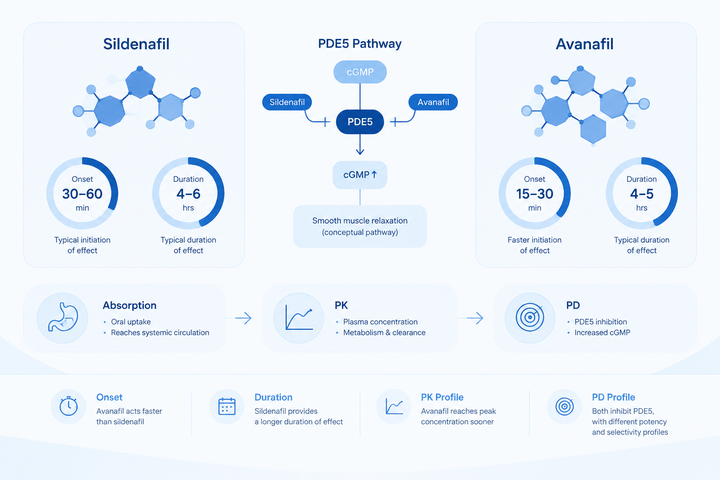
Drug comparison

Sildenafil and avanafil share the defining molecular mechanism of PDE5 inhibition. PDE5 normally hydrolyzes cGMP, while inhibition decreases this degradation and permits cGMP signaling generated through endogenous nitric oxide to persist. The mechanism therefore begins with enzyme inhibition and extends through intracellular second-messenger signaling. The PDE5 pathway describes the target-level event, while the NO/cGMP pathway describes downstream biochemical signaling. Their common target does not require identical pharmacokinetic or temporal profiles.

The physiological layer follows the biochemical pathway. Preserved cGMP signaling can facilitate smooth-muscle relaxation, connecting the NO/cGMP pathway with vascular relaxation. This downstream response remains conceptually distinct from the PDE5 inhibition event. Pharmacodynamics describes relationships between exposure and biological effects, whereas pharmacokinetics describes concentration over time. Sildenafil and avanafil consequently share a common mechanistic sequence while their different molecular characteristics and disposition profiles influence temporal exposure.

A neutral comparison preserves the hierarchy from molecular target through signaling and physiology. The mechanism and PDE5 pathway establish the shared pharmacological target, while PK comparison describes systemic exposure differences. The pharmacodynamics layer then considers how exposure relates to downstream response. Differences in peak timing, concentration decline, or exposure persistence can alter the temporal representation of target engagement without changing the primary PDE5-centered mechanism. This distinction is central to sildenafil-versus-avanafil interpretation.

Mechanistic Element Sildenafil Avanafil
Primary molecular target PDE5 inhibition PDE5 inhibition
cGMP handling Reduced PDE5-mediated cGMP hydrolysis Reduced PDE5-mediated cGMP hydrolysis
NO/cGMP relationship Preserves signaling generated through endogenous NO Preserves signaling generated through endogenous NO
Downstream physiology cGMP-associated smooth-muscle relaxation cGMP-associated smooth-muscle relaxation

PK Comparison: Exposure, Half-Life, Distribution

Sildenafil and avanafil both undergo oral absorption followed by systemic distribution, hepatic metabolism, and elimination. Absorption establishes the initial concentration trajectory, while distribution influences movement between plasma and tissues. Their pharmacokinetics can therefore be compared using peak concentration, time to peak, overall exposure, and terminal decline. Sildenafil typically reaches peak plasma concentration within approximately one hour, while avanafil generally reaches peak concentration within a similar early interval. Exact values depend on study conditions and formulation. The resulting PK curve provides a more complete representation than any single parameter.

Metabolic disposition contributes to the concentration decline of both compounds. Hepatic pathways involving CYP3A-associated metabolism are important for each agent, making CYP3A4 metabolism a relevant comparative layer. Elimination then contributes to the terminal phase. Sildenafil has a terminal half-life of roughly four hours, while avanafil has a shorter terminal half-life of roughly five hours, with reported values varying across pharmacokinetic studies. These differences should be interpreted as disposition parameters rather than direct measures of pharmacodynamic duration.

Distribution and elimination also influence the relationship between plasma concentration and biological effect. A PK comparison therefore considers the complete exposure profile, including absorption, peak concentration, decline, and terminal tail. Time to peak describes the location of maximum plasma concentration, whereas pharmacodynamics addresses exposure-response relationships. Sildenafil and avanafil have broadly rapid early exposure and relatively short terminal disposition, while specific PK parameters remain compound-dependent. The distinction between plasma PK and tissue-level pharmacodynamic response should remain explicit throughout comparative interpretation.

PK Parameter Sildenafil Avanafil
Time to peak Approximately 1 hour in typical oral PK studies Approximately 30–45 minutes in typical oral PK studies
Terminal half-life Approximately 4 hours Approximately 5 hours
Major metabolic pathway Hepatic metabolism including CYP3A-associated metabolism Hepatic metabolism including CYP3A-associated metabolism
Exposure profile Rapid early exposure followed by relatively short persistence Rapid early exposure followed by relatively short persistence

Onset Comparison: Time-to-Peak & Onset Curve

Onset should be distinguished from time to maximum plasma concentration. Sildenafil and avanafil both produce relatively rapid systemic exposure, but avanafil generally reaches peak plasma concentration earlier than sildenafil. Time to peak is nevertheless a pharmacokinetic metric, whereas onset represents emergence of pharmacodynamic activity. The onset curve can illustrate how rising exposure relates temporally to PDE5 engagement and downstream signaling without assuming that the concentration peak is identical to the first biological effect.

The sildenafil onset profile and avanafil profile are influenced by absorption rate, systemic exposure, distribution, target engagement, and effect-response characteristics. Avanafil's comparatively earlier peak concentration contributes to a distinct rising exposure trajectory, while sildenafil has a somewhat later typical peak. Onset variability remains possible for both agents because formulation, gastrointestinal conditions, and individual pharmacokinetic characteristics can alter exposure timing. These factors should be distinguished from differences in the shared molecular PDE5 mechanism.

The PK curve provides the concentration-time foundation for temporal comparison, while pharmacodynamics supplies the effect-response framework. A shorter time to peak can contribute to an earlier exposure milestone, but it does not independently establish the onset or magnitude of downstream effects. Sildenafil and avanafil therefore can be compared through absorption rate, time to peak, rising exposure, and pharmacodynamic emergence. This layered interpretation avoids reducing onset to one clock time and preserves the separation between PK and PD concepts.

Onset Metric Sildenafil Avanafil
Early systemic exposure Rapidly develops following oral absorption Rapidly develops following oral absorption
Typical time to peak Approximately 1 hour Approximately 30–45 minutes
Onset interpretation Related to rising exposure and downstream PDE5 signaling Related to rising exposure and downstream PDE5 signaling
Temporal variability Can reflect absorption and physiological PK factors Can reflect absorption and physiological PK factors

Duration Comparison: PD Window & Exposure Tail

Duration is a pharmacodynamic concept that describes persistence of biological influence, while half-life describes a specific aspect of drug disposition. Sildenafil and avanafil both have relatively short terminal half-lives, producing concentration-time profiles with comparatively limited terminal persistence. The duration comparison therefore considers the exposure tail together with target engagement and effect-response relationships. The half-life and PK curve provide important PK context but do not independently define the complete pharmacodynamic window.

Avanafil has a terminal half-life of approximately five hours, while sildenafil's terminal half-life is approximately four hours, although reported values vary according to study conditions. These disposition differences are quantitative rather than mechanistically categorical. Elimination contributes to the decline in circulating parent drug, while metabolism influences the overall exposure profile. Pharmacodynamics must remain separate because biological persistence depends on exposure-response characteristics, tissue relationships, target interaction, and downstream signaling as well as plasma concentration.

The shared pathway provides the mechanistic context for persistence. The PDE5 pathway describes inhibition of cGMP hydrolysis, while the NO/cGMP pathway describes downstream second-messenger signaling. Vascular relaxation represents a later physiological layer. Consequently, duration comparison should integrate concentration decline, terminal half-life, target engagement, and effect-time relationships. The exposure tail can help explain temporal differences between sildenafil and avanafil, but it should not be treated as a standalone definition of pharmacodynamic duration.

Duration Metric Sildenafil Avanafil
Terminal half-life Approximately 4 hours Approximately 5 hours
Exposure tail Relatively short terminal persistence Relatively short terminal persistence
PD temporal interpretation Depends on exposure and concentration-effect relationships Depends on exposure and concentration-effect relationships
Primary mechanism during exposure PDE5 inhibition with downstream cGMP signaling PDE5 inhibition with downstream cGMP signaling

Formulation Influence: Absorption & Onset Variability

Formulation characteristics can modify the early concentration-time profile without changing the intrinsic PDE5 target. Disintegration, dissolution, pharmaceutical release, and gastrointestinal absorption determine how rapidly active drug becomes systemically available. The absorption layer therefore provides a bridge between formulation and systemic exposure. A comparative absorption comparison should distinguish pharmaceutical factors from molecular pharmacology. Sildenafil and avanafil can both exhibit formulation-dependent differences in the rate or extent of exposure, even though the underlying PDE5-centered mechanism remains associated with the active molecules.

Changes in absorption can affect the rising limb of the PK curve, peak concentration, and apparent timing of systemic exposure. These changes may influence temporal interpretation of pharmacodynamic onset, while time to peak remains a PK descriptor rather than a complete effect endpoint. The form onset comparison framework therefore examines the interface between formulation and PK. Distribution is a separate layer because plasma concentration does not necessarily represent instantaneous tissue concentration or target-site exposure.

Observed onset variability can arise from formulation, absorption conditions, physiological variability, and other PK determinants. These sources should not be attributed automatically to differences in PDE5 inhibition. Pharmacokinetics describes the resulting concentration trajectory, while pharmacodynamics describes biological response. Thus, formulation influence is best treated as a pharmaceutical and exposure layer that can modify temporal characteristics without altering the shared NO/cGMP-centered mechanism of sildenafil and avanafil.

Formulation Factor Influence on Sildenafil Influence on Avanafil
Dissolution and release Can influence availability for gastrointestinal absorption Can influence availability for gastrointestinal absorption
Absorption rate Can modify rising exposure and peak timing Can modify rising exposure and peak timing
Peak exposure Formulation can influence observed concentration maximum Formulation can influence observed concentration maximum
Onset variability Can reflect formulation plus physiological PK variability Can reflect formulation plus physiological PK variability

Frequently Asked Questions

Sildenafil and avanafil share the principal molecular mechanism of PDE5 inhibition. Both reduce PDE5-mediated hydrolysis of cGMP, thereby preserving signaling generated through the nitric oxide and cGMP system. Their main comparative distinctions involve molecular characteristics, pharmacokinetic disposition, exposure, and temporal pharmacodynamic behavior rather than a fundamentally different primary target. Consequently, both can be represented through the same general sequence of PDE5 inhibition, cGMP signaling, smooth-muscle relaxation, and downstream pharmacodynamic effects.

Both agents have relatively rapid oral absorption and relatively short terminal half-lives. Sildenafil generally reaches peak plasma concentration at about one hour, while avanafil typically reaches peak concentration earlier, often around thirty to forty-five minutes. Sildenafil has a terminal half-life of approximately four hours, whereas avanafil is approximately five hours. These values can vary among studies. The overall comparison should therefore consider absorption, peak exposure, elimination, and the complete concentration-time profile rather than one parameter alone.

Avanafil generally reaches peak plasma concentration earlier than sildenafil, creating a different early concentration-time trajectory. However, time to peak is a pharmacokinetic measurement and should not be treated as identical to pharmacodynamic onset. Biological onset depends on absorption, distribution, target engagement, concentration-effect relationships, and downstream signaling. Sildenafil and avanafil therefore can have different temporal exposure profiles while sharing the same PDE5-centered mechanism. Onset interpretation should integrate PK and PD rather than relying exclusively on a single clock time.

Sildenafil and avanafil both have relatively short terminal elimination half-lives, with reported values around four and five hours respectively. Their exposure profiles therefore have broadly similar overall persistence compared with longer-acting PDE5 inhibitors. Duration nevertheless remains a pharmacodynamic concept rather than a direct synonym for half-life. The actual effect-time relationship depends on systemic exposure, tissue distribution, target engagement, concentration-effect behavior, and downstream signaling. A complete duration comparison should therefore consider the exposure tail together with pharmacodynamic characteristics.

Formulation can affect pharmaceutical release, dissolution, absorption rate, and the resulting early concentration-time profile for either agent. Changes in the rising phase of exposure may influence the temporal relationship between systemic concentration and pharmacodynamic onset. Such effects should be distinguished from the intrinsic PDE5 mechanism of the active drug. Observed onset variability can also arise from gastrointestinal conditions, physiological factors, distribution, and other pharmacokinetic characteristics. Formulation is therefore one component of a broader PK-based explanation for temporal variability.

Changes in administered amount can alter systemic exposure, peak concentration, and overall concentration-time behavior for both sildenafil and avanafil. The relationship is determined by absorption, distribution, metabolism, elimination, and the concentration-effect relationship, so dose is not equivalent to onset or pharmacodynamic magnitude. A mechanistic comparison therefore treats dose as an input to the PK system and examines the resulting exposure-response relationship. The underlying PDE5 mechanism remains shared even when quantitative PK or PD characteristics change.

The central PDE5 pathway is shared by sildenafil and avanafil. Both inhibit PDE5, reducing degradation of cGMP and allowing NO-dependent signaling to persist. The resulting downstream pathway can include cGMP-associated smooth-muscle relaxation. Differences between the agents are principally related to molecular properties, pharmacokinetic disposition, exposure, and temporal persistence rather than a fundamentally different PDE5 signaling sequence. Their pharmacodynamic profiles can therefore differ quantitatively or temporally while remaining based on the same core PDE5-to-cGMP mechanistic framework.