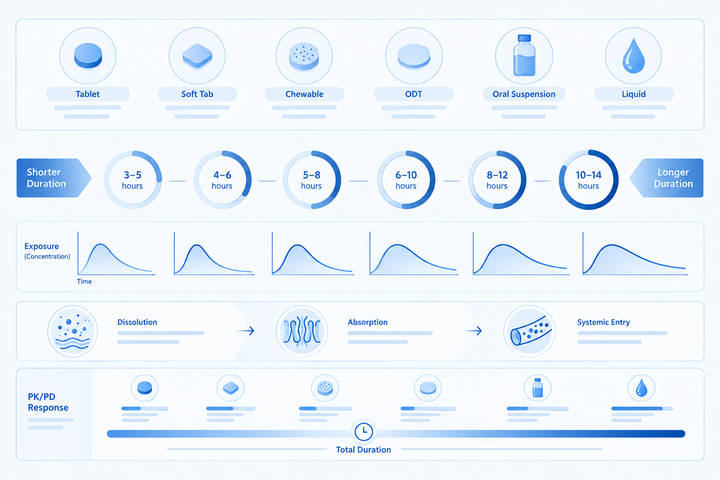
Sildenafil duration comparison is a PK/PD concept describing how systemic exposure and pharmacodynamic activity evolve across time. Duration does not correspond to a single laboratory value; it emerges from the relationship between absorption, distribution, metabolism, elimination, concentration-time behavior, half-life, exposure tail, and concentration-response relationships. The pharmacokinetics framework describes drug movement through the body, while pharmacodynamics describes biological effects associated with drug concentration and target engagement. A PK curve provides the temporal exposure framework, and half-life characterizes a specific phase of concentration decline. Duration therefore represents an integrated temporal interpretation rather than a direct synonym for half-life. Elimination, distribution, and CYP3A4 metabolism contribute to the disposition profile that shapes the exposure tail and its relationship with pharmacodynamic persistence.
Duration emerges through a sequential PK → exposure → PD process. Following administration, absorption determines systemic drug input, distribution establishes concentration relationships across compartments, and metabolic and elimination processes determine subsequent concentration decline. The resulting exposure profile interacts with PDE5 pharmacology, producing a concentration-response trajectory that can persist as concentrations decrease. Time to peak describes a PK landmark rather than a complete duration measure, while an onset curve describes the early temporal relationship between exposure and biological response. Duration comparison therefore examines the full temporal sequence, including the rising phase, peak region, declining phase, and residual exposure tail. This framework separates measurable PK parameters from PD persistence and avoids treating any single time point as a complete representation of pharmacological duration.
Formulation, dose, and physiological conditions can modify different portions of the temporal profile without changing the fundamental PDE5 mechanism of sildenafil. Formulation can influence disintegration, dissolution, gastrointestinal drug input, and early absorption characteristics; dose can influence systemic exposure and concentration-response relationships; physiological factors can modify absorption, distribution, metabolism, or elimination. Related concepts include form onset comparison, absorption comparison, and onset variability, which help distinguish early temporal behavior from subsequent persistence. Dose-specific exposure can also be considered through onset by dose and formulation-specific pages such as soft tabs onset. These distinctions allow duration to be described as a mechanistic property of changing exposure and pharmacodynamic response rather than as a single fixed interval.
PK/PD duration begins with the relationship between systemic concentration and biological response. Pharmacokinetics describes absorption, distribution, metabolism, and elimination, while pharmacodynamics describes PDE5 target engagement and downstream cGMP signaling. The PK curve supplies the temporal exposure framework, while half-life characterizes concentration decline during a defined terminal phase. Duration interpretation therefore integrates several descriptors rather than assigning duration to one parameter alone.
After systemic entry, sildenafil concentration changes over time as absorption, distribution, metabolism, and elimination interact. CYP3A4 metabolism contributes to hepatic disposition, while exposure persistence reflects the combined behavior of input and drug removal. The descending portion of the concentration-time profile creates an exposure tail that can remain pharmacologically relevant as concentration changes. Duration is consequently a temporal PK/PD interpretation linking exposure magnitude, concentration decline, receptor or enzyme interaction, and downstream biological signaling.
Duration should also remain distinct from onset and time to peak. Sildenafil onset concerns early development of pharmacodynamic response, while time to peak identifies a concentration-time landmark. An onset curve focuses on the beginning of response, whereas duration encompasses subsequent persistence and decline. Onset variability can influence interpretation of the complete temporal profile, but it does not itself define pharmacodynamic duration.
Duration Element
PK Layer
PD Layer
Absorption
Systemic drug input
Initiates concentration availability for target interaction
Exposure tail
Declining systemic concentration
Potential persistence of concentration-dependent effect
Half-life
Rate descriptor for concentration decline
Indirect temporal context for pharmacodynamic persistence
Elimination
Drug removal from systemic circulation
Contributes to decline of pharmacologically active exposure
Formulation-Based Duration Differences
Formulation influences the drug-input portion of the PK profile. Tablet, soft-tab, chewable, ODT, suspension, and liquid presentations can differ in physical disintegration, dissolution, and gastrointestinal availability. These characteristics primarily affect the early absorption phase, while later duration depends on systemic distribution, metabolism, and elimination. Form onset comparison provides a framework for separating dosage-form behavior from systemic exposure, and absorption comparison focuses specifically on differences in drug entry.
Formulation-driven temporal differences should therefore be interpreted across sequential PK layers rather than attributed to dosage form alone. Soft tabs onset, chewable onset, and ODT onset illustrate how formulation can modify disintegration and dissolution characteristics. Once sildenafil reaches systemic circulation, the concentration-time profile is governed by distribution, metabolism, and elimination processes that are not equivalent to formulation-specific dissolution behavior. Duration interpretation consequently requires separation of drug input from subsequent disposition.
Generic and branded formulations can also be compared through the same mechanistic framework. Generic onset and brand vs generic onset describe early temporal characteristics without implying a different molecular target. Formulation-related differences may affect the shape of the absorption phase or early exposure, while systemic disposition remains a separate layer. The resulting duration profile should therefore be interpreted through concentration-time behavior, exposure tail, half-life, and pharmacodynamic persistence rather than through formulation labels alone.
Physical disintegration and dissolution characteristics
Early input distinguished from later systemic disposition
Chewable formulation
Dosage-form processing and drug dissolution
Duration interpreted after systemic exposure is established
ODT formulation
Disintegration characteristics and subsequent absorption
Formulation effect separated from metabolism and elimination
Dose-Based Duration Differences
Dose-based duration analysis is an exposure-response concept rather than a dosing recommendation. Changing administered dose can alter systemic exposure, including concentration magnitude and the area represented under the concentration-time curve. The relationship between dose and duration depends on how exposure translates into pharmacodynamic response and how concentration declines through distribution, metabolism, and elimination. Onset by dose illustrates the early portion of this framework, while duration requires analysis of the subsequent exposure tail.
Dose categories such as onset 25 mg, onset 50 mg, and onset 100 mg can be understood as exposure strata for mechanistic comparison. A dose change can modify initial concentration and overall exposure without necessarily producing a proportional change in every temporal metric. Time to peak, terminal decline, and pharmacodynamic persistence represent different dimensions of the profile. Duration comparison therefore requires distinguishing exposure magnitude from the rate of concentration decline.
The dose-duration relationship is also influenced by the shape of the concentration-response curve. If concentrations remain within a pharmacologically active range for different portions of the descending phase, the observed PD persistence may not correspond directly to a simple dose-to-time conversion. PK curve analysis helps visualize this relationship, while half-life and elimination describe disposition processes contributing to the exposure tail. Dose remains an exposure determinant, not a standalone duration measurement.
Dose
Exposure Effect
Duration Interpretation
Lower exposure category
Lower systemic exposure under comparable conditions
Interpret through concentration-response and exposure-tail behavior
Intermediate exposure category
Intermediate exposure profile may occur
Temporal persistence depends on PK and PD relationships
Higher exposure category
Greater concentration and exposure may occur
Duration remains distinct from exposure magnitude alone
Dose comparison
Exposure-response relationship is evaluated
No fixed dose-to-duration conversion is implied
Condition-Based Duration Differences
Physiological conditions can influence sildenafil duration by modifying one or more PK layers. Changes in gastrointestinal function may affect absorption, while altered body composition can influence distribution. Hepatic metabolic capacity can influence CYP3A4 metabolism, and changes in drug removal can alter elimination. Duration therefore reflects the integrated disposition profile rather than a single condition-specific parameter. The mechanistic question is which PK process changes and how that change propagates into systemic exposure.
Physiological variability can alter concentration-time behavior through changes in absorption rate, distribution characteristics, metabolic turnover, or clearance. These changes may affect peak concentration, exposure magnitude, concentration decline, or the shape of the exposure tail. Onset variability concerns early temporal behavior, but the same upstream PK factors can influence subsequent exposure interpretation. A condition-driven duration comparison should consequently identify the affected PK layer before interpreting changes in pharmacodynamic persistence.
The distinction between PK and PD remains essential when examining physiological conditions. A change in systemic concentration is a PK observation, whereas a change in biological response at a given concentration belongs to PD. Pharmacokinetics, pharmacodynamics, and half-life provide complementary descriptors. A condition can alter exposure without changing the intrinsic PDE5 mechanism, so duration interpretation should preserve the separation between disposition, target interaction, concentration-response behavior, and temporal biological persistence.
Condition
PK Influence
Duration Interpretation
Altered gastrointestinal physiology
Potential modification of drug input and absorption
Early exposure changes interpreted separately from systemic persistence
Altered body composition
Potential distribution changes
Compartmental behavior may influence concentration-time interpretation
Altered hepatic function
Potential changes in metabolic disposition
Exposure tail may reflect modified drug removal
Physiological variability
Multiple PK layers may vary
Temporal profile interpreted from integrated PK/PD behavior
PK Curve Interpretation & Exposure Tail
The PK curve provides a visual framework for duration comparison by displaying systemic concentration across time. Its rising phase reflects net drug input, the peak region identifies maximum observed concentration, and the descending phase reflects the combined influence of distribution and elimination. Time to peak is therefore one landmark within the curve rather than a complete duration descriptor. The exposure tail represents the later concentration-time region and provides an important bridge between PK decline and pharmacodynamic persistence.
The terminal portion of a concentration-time curve can be described using half-life, but half-life should not be treated as synonymous with duration. Half-life quantifies the time associated with a defined proportional decline during a specified kinetic phase, whereas pharmacodynamic duration depends on concentration-response relationships and target-level biology. Elimination contributes to concentration decline, while distribution can shape earlier phases and multicompartment behavior. The resulting exposure tail is an integrated PK phenomenon.
Curve interpretation also requires attention to variability. Differences in absorption, metabolism, distribution, and elimination can change curve shape, peak concentration, area under the curve, or the persistence of measurable exposure. Absorption comparison helps isolate drug-input effects, while CYP3A4 metabolism provides context for hepatic disposition. Duration comparison should therefore use the complete concentration-time profile rather than one isolated curve feature.
PK Metric
Role in Duration
Interpretation
Cmax
Characterizes peak systemic concentration
Exposure magnitude, not duration by itself
Time to peak
Identifies peak timing
Temporal landmark distinct from duration
Half-life
Characterizes proportional concentration decline
Disposition descriptor that informs exposure persistence
Exposure tail
Describes later concentration-time behavior
Links PK decline with potential PD persistence
Mechanistic Interpretation of Duration Timing
Mechanistic duration interpretation separates drug input, systemic disposition, target engagement, and biological response. Absorption establishes systemic availability, distribution influences concentration relationships across compartments, and elimination contributes to concentration decline. CYP3A4 metabolism is part of the metabolic disposition pathway. These PK layers generate an exposure trajectory that can then be interpreted through pharmacodynamics, where sildenafil-mediated PDE5 inhibition influences cGMP signaling.
Duration timing is not defined solely by when sildenafil reaches maximum concentration. Time to peak identifies a PK event, while onset curve analysis addresses early development of biological response. The later exposure tail must be interpreted separately, because declining concentration and continuing target-level effects may have different temporal relationships. Sildenafil onset and onset variability therefore provide complementary context without replacing a full duration analysis.
Formulation and dose provide upstream determinants of exposure, while physiological conditions can affect disposition or response. Form onset comparison can distinguish formulation-specific input characteristics, and onset by dose frames dose as an exposure variable. Duration interpretation ultimately connects the concentration-time profile with concentration-response behavior and temporal PD persistence. This layered approach prevents absorption, time to peak, half-life, and duration from being treated as interchangeable concepts.
Mechanistic Layer
PK Role
PD Role
Drug input
Determines systemic availability over time
Provides concentration for target interaction
Disposition
Controls distribution, metabolism, and elimination
Shapes temporal concentration available for target engagement
Exposure-response
Links concentration with temporal exposure
Relates concentration to biological effect
PD persistence
Depends on continuing pharmacologically relevant exposure
Represents temporal evolution of biological response
Frequently Asked Questions
Sildenafil duration is a PK/PD terminology concept describing the temporal relationship between systemic exposure and pharmacodynamic response. It incorporates absorption, distribution, metabolism, elimination, concentration-time behavior, half-life, exposure tail, and concentration-response relationships. Duration is therefore not a single laboratory measurement and is not synonymous with time to peak or half-life. In mechanistic documentation, duration describes how exposure and biological response evolve across the post-administration time course.
PK provides the concentration-time framework, while PD describes the biological consequences associated with sildenafil concentration and PDE5 target interaction. Duration interpretation connects these layers by examining systemic exposure, concentration decline, the exposure tail, and the persistence of concentration-dependent pharmacodynamic activity. A PK parameter such as half-life can inform temporal disposition, but it does not independently establish PD duration. The complete interpretation therefore combines exposure metrics with concentration-response behavior.
Formulation can influence disintegration, dissolution, drug input, and absorption characteristics, particularly during the early portion of the concentration-time profile. These formulation effects are distinct from later systemic processes involving distribution, metabolism, and elimination. Consequently, formulation can alter the shape or timing of exposure without changing sildenafil's molecular PDE5 mechanism. Duration interpretation should separate dosage-form behavior from systemic disposition and subsequent pharmacodynamic persistence rather than attributing the complete temporal profile to formulation alone.
Dose influences systemic exposure and can change concentration magnitude and overall exposure under comparable pharmacokinetic conditions. However, dose is not itself a duration measurement. The temporal relationship depends on absorption, distribution, metabolism, elimination, and the concentration-response relationship. A change in exposure magnitude does not imply a fixed proportional change in every timing parameter. Mechanistic comparison therefore evaluates dose through exposure-response behavior, concentration-time curves, and pharmacodynamic persistence rather than converting dose directly into a duration interval.
Physiological factors can influence duration by modifying absorption, distribution, metabolism, elimination, or pharmacodynamic response. Changes in hepatic metabolic activity can affect drug disposition, while differences in body composition or gastrointestinal physiology can influence other PK layers. The resulting concentration-time profile may therefore vary across physiological states. Duration interpretation requires identifying which mechanism changes before connecting that change to exposure magnitude, concentration decline, or pharmacodynamic persistence. This preserves the distinction between PK variability and PD variability.
Duration variability can arise because several PK processes contribute to the final concentration-time profile. Differences in absorption, distribution, metabolic turnover, elimination, formulation, dose-related exposure, and physiological conditions can modify different portions of the curve. PD variability can add another layer when biological response differs at comparable concentrations. For this reason, duration should be interpreted as an integrated PK/PD property rather than inferred from one parameter. The exposure tail and concentration-response relationship are particularly important for temporal interpretation.
A sildenafil PK curve can be interpreted by separating its rising phase, peak region, and descending exposure tail. The rising phase reflects systemic drug input, time to peak identifies a concentration-time landmark, and the descending phase reflects disposition processes including distribution and elimination. Half-life can characterize a defined decline phase but does not equal pharmacodynamic duration. For duration comparison, the complete curve is evaluated alongside concentration-response behavior to determine how systemic exposure relates temporally to PD persistence.