Sildenafil vs Daily Tadalafil: PK/PD and Mechanistic Comparison
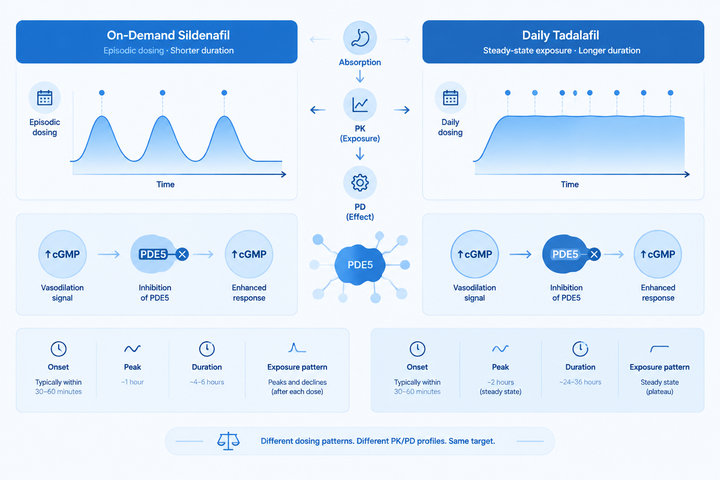
Sildenafil vs daily tadalafil comparison is best understood as a PK/PD distinction between an on-demand exposure pattern and the sustained exposure associated with repeated daily tadalafil administration. Both agents inhibit phosphodiesterase type 5, reducing PDE5-mediated hydrolysis of cyclic guanosine monophosphate and thereby modifying the NO/cGMP signaling environment. The shared pharmacological target can be described through the mechanism and PDE5 pathway, while downstream NO/cGMP pathway activity and vascular relaxation represent pharmacodynamic layers. The principal comparative distinction is therefore not a different PDE5 target, but the temporal pattern of drug exposure. Sildenafil commonly produces a discrete concentration-time profile after an individual administration, whereas repeated tadalafil administration produces accumulation toward steady-state exposure. These patterns influence interpretation of the pharmacokinetics, pharmacodynamics, and relationship between exposure and downstream response.
The on-demand versus steady-state distinction changes how onset, duration, and the PK curve should be interpreted. Sildenafil has a relatively rapid rise toward a concentration peak followed by distribution and elimination, creating a recognizable exposure pulse. Daily tadalafil, by contrast, produces overlapping concentration profiles from successive administrations until the rate of input and elimination approach a repeating steady-state pattern. Time to peak remains an absorption-related PK descriptor and should not be treated as a direct synonym for pharmacodynamic onset. Similarly, terminal half-life describes elimination kinetics rather than the complete duration of a biological effect. The distinction becomes particularly important when comparing sildenafil onset, time to peak, and onset curve behavior with the sustained exposure pattern generated by repeated tadalafil administration. Comparative interpretation therefore requires separation of concentration, target engagement, signal amplification, and observed pharmacodynamic response.
Mechanistically, sildenafil and tadalafil converge on PDE5 inhibition but can differ in their temporal exposure profiles because of differences in molecular disposition, elimination kinetics, and repeated-administration behavior. Sildenafil is metabolized through hepatic pathways that include CYP3A-associated metabolism, while tadalafil also undergoes hepatic oxidative metabolism, making CYP3A4 metabolism relevant to comparative PK interpretation. Differences in absorption, distribution, and elimination contribute to the shape and persistence of each exposure profile. Formulation characteristics can further influence early concentration-time behavior without changing the underlying PDE5 target. Accordingly, PK comparison, duration comparison, and onset variability should be treated as related but non-identical analytical domains. The resulting framework distinguishes molecular mechanism from exposure pattern and exposure pattern from pharmacodynamic timing, without converting those differences into treatment recommendations.
Mechanistic Comparison: Sildenafil vs Daily Tadalafil
Sildenafil and tadalafil share the central pharmacological mechanism of PDE5 inhibition. By inhibiting PDE5-mediated cGMP hydrolysis, both agents can preserve intracellular cGMP generated downstream of nitric oxide signaling. This common target can be mapped through the mechanism, PDE5 pathway, and NO/cGMP pathway. The comparative distinction arises primarily from pharmacokinetic behavior and temporal target exposure rather than from a fundamentally different PDE5 signaling architecture.
The downstream pharmacodynamic sequence includes PDE5 inhibition, altered cGMP availability, smooth-muscle signaling, and vascular relaxation. Sildenafil given intermittently produces a time-limited exposure profile, while repeated tadalafil administration generates overlapping concentrations that approach a steady-state pattern. Consequently, pharmacodynamics should be interpreted alongside exposure rather than inferred solely from the shared molecular target.
Mechanistic comparison therefore requires separation of target identity from temporal exposure. Both compounds act within the same PDE5-centered pathway, but the concentration-time environment surrounding that pathway differs. Concepts such as pharmacokinetics, PK curve, half-life, and elimination describe disposition, whereas PDE5 inhibition and downstream signaling describe pharmacodynamics. This layered distinction prevents exposure differences from being misclassified as mechanistic target differences.
Mechanistic Element
Sildenafil
Daily Tadalafil
Primary target
PDE5 inhibition
PDE5 inhibition
NO/cGMP relationship
Reduces PDE5-mediated cGMP hydrolysis during exposure
Reduces PDE5-mediated cGMP hydrolysis during sustained exposure
Exposure pattern
Discrete on-demand concentration profile
Accumulating profile approaching steady state with repeated administration
PD interpretation
Target engagement varies with time after administration
Target engagement occurs within a more sustained exposure environment
PK Comparison: On-Demand vs Steady-State Exposure
The central PK distinction is between an individual sildenafil exposure pulse and the repeated-administration profile of daily tadalafil. After sildenafil administration, concentration rises through absorption, reaches a peak, and subsequently declines through distribution and elimination. Daily tadalafil produces repeated input before the previous exposure has completely disappeared, so concentrations accumulate until successive administration intervals produce a repeating steady-state pattern. This difference is fundamental to pharmacokinetics and PK comparison.
A concentration-time profile can therefore be interpreted through peak concentration, exposure, trough concentration, accumulation, and terminal decline. Sildenafil's profile is typically characterized by a pronounced peak followed by a comparatively shorter exposure tail, while tadalafil's longer persistence allows concentrations from successive administrations to overlap. The PK curve consequently represents different temporal states: transient exposure for sildenafil versus repeated-dose steady-state behavior for daily tadalafil.
Metabolic and elimination processes also contribute to these patterns. Hepatic biotransformation, including pathways involving CYP3A4 metabolism, and subsequent elimination determine how quickly concentrations decline between administrations. The half-life provides a quantitative descriptor of terminal disposition and helps explain accumulation, but it does not independently define pharmacodynamic duration. These distinctions keep exposure, accumulation, and effect duration analytically separate.
PK Parameter
Sildenafil (On-Demand)
Daily Tadalafil (Steady-State)
Input pattern
Individual administration with a discrete exposure pulse
Repeated administration with overlapping exposure
Concentration profile
Rise toward a peak followed by decline
Accumulation toward a repeating steady-state profile
Accumulation
Limited to residual exposure from the individual administration context
Characteristic feature of repeated administration before steady state
Exposure interpretation
Primarily linked to the concentration-time profile after an administration
Includes average exposure and fluctuation across the dosing interval
Onset Comparison: Time-to-Peak & Onset Curve
Onset should be separated from time to peak because the two describe different phenomena. Time to peak is a PK measurement describing when plasma concentration reaches its maximum, whereas pharmacodynamic onset reflects when target engagement and downstream signaling become sufficiently established to produce an observable effect. Sildenafil can therefore show a defined time to peak within an individual exposure profile without that value constituting a universal onset boundary.
Daily tadalafil introduces a different temporal context because repeated administration maintains background exposure between successive administration events. The concentration-time profile becomes progressively less dependent on a single peak, while the pharmacodynamic environment reflects ongoing drug presence. An onset curve comparison must therefore distinguish initial exposure after an administration from the pre-existing steady-state concentration. This makes onset interpretation a combined PK/PD concept rather than a simple peak-time comparison.
Factors affecting early exposure include absorption, formulation characteristics, gastrointestinal conditions, and interindividual PK variation. These factors can contribute to onset variability without changing the underlying PDE5 mechanism. The sildenafil onset profile is consequently best analyzed using concentration rise, target engagement, and downstream PD together, while tadalafil's daily profile requires consideration of both the initial post-administration phase and the steady-state baseline.
Onset Metric
Sildenafil
Daily Tadalafil
Time to peak
Defined by the post-administration concentration profile
Occurs within each repeated-administration profile but against an established exposure baseline
Initial exposure
Primarily generated by the individual administration
Superimposed on residual steady-state exposure
Onset interpretation
Linked to rising concentration and subsequent target engagement
Linked to new exposure added to an existing concentration-time environment
Onset variability
Can reflect absorption and PK variability
Can reflect absorption and variability around an established steady-state profile
Duration Comparison: PD Window & Exposure Tail
Duration is not synonymous with terminal half-life. Pharmacodynamic duration depends on the relationship between concentration, PDE5 target engagement, NO/cGMP signaling, and downstream physiological response. Sildenafil's concentration generally declines after its post-administration peak, creating a discrete exposure tail. Daily tadalafil, because of its longer persistence and repeated administration, maintains a more continuous concentration environment. This distinction is central to duration comparison and pharmacodynamics.
The exposure tail can be examined through concentration remaining after the peak, elimination kinetics, and the interval between successive administrations. Sildenafil therefore provides a comparatively pulse-like PK/PD framework, whereas daily tadalafil produces a repeating steady-state framework with less pronounced separation between individual exposure events. The PK curve illustrates this difference, while half-life and elimination explain important components of the terminal phase.
Downstream duration remains a pharmacodynamic interpretation rather than a direct reading of plasma concentration alone. PDE5 inhibition can alter cGMP handling while drug concentrations remain within the relevant exposure range, but observed response also depends on the biological signaling environment. The NO/cGMP pathway and vascular relaxation therefore provide mechanistic layers between exposure and effect. This framework distinguishes exposure persistence from the duration of downstream pharmacodynamic expression.
Duration Metric
Sildenafil
Daily Tadalafil
Exposure pattern
Discrete peak followed by terminal decline
Persistent overlapping exposure across repeated administrations
Exposure tail
Defined by post-administration elimination
Extends across successive intervals because of accumulation and persistence
PD window
Corresponds to the period of relevant target exposure after an administration
Occurs within a sustained steady-state exposure environment
Half-life interpretation
Describes terminal disposition and decline
Supports interpretation of persistence and steady-state accumulation
Formulation characteristics influence the early stages of pharmacokinetics by affecting disintegration, dissolution, and the rate at which active drug becomes available for absorption. This makes absorption an important component of comparative interpretation. Sildenafil's on-demand profile is particularly dependent on the concentration rise following an individual administration, whereas daily tadalafil is evaluated within a background of repeated exposure. The formulation layer therefore modifies early PK without altering the shared PDE5 target.
An absorption comparison separates formulation-dependent input from distribution, metabolism, and elimination. Changes in the rate of absorption can shift the shape of the early concentration-time curve and influence apparent time to peak. These changes can be represented through form onset comparison and onset variability, while preserving the distinction between PK timing and pharmacodynamic response.
Distribution also contributes to the transition from plasma exposure to tissue-level pharmacology. The distribution phase and subsequent metabolism determine how the concentration profile evolves after absorption. For daily tadalafil, repeated input means each new absorption event occurs against residual drug exposure, while sildenafil generally presents a more isolated post-administration profile. Formulation analysis should therefore remain a PK layer rather than being interpreted as a change in PDE5 inhibition, NO/cGMP signaling, or downstream mechanism.
Formulation Factor
Influence on Sildenafil
Influence on Daily Tadalafil
Dissolution
Can influence the early concentration rise after an individual administration
Can influence the early concentration rise within repeated exposure
Absorption rate
Can shift early PK and apparent time to peak
Can shift each administration's contribution to the steady-state profile
Onset variability
May reflect differences in absorption and early exposure
May reflect absorption superimposed on residual steady-state exposure
Dose-related interpretation is a pharmacometric concept describing how changes in administered amount can alter exposure and potentially shift the concentration-time and exposure-response relationships. For sildenafil, dose changes can modify the magnitude of an individual exposure pulse, while daily tadalafil dose changes occur within a repeated-administration framework in which accumulation and steady-state exposure are relevant. The concepts of dose selection, dose adjustment, and dose titration are therefore best treated here as analytical terminology rather than prescribing guidance.
PK/PD scaling requires separation of concentration from effect. A larger exposure does not automatically translate into a proportionally larger observed response because target occupancy, nonlinear biological relationships, baseline signaling, and physiological response functions can influence the exposure-response curve. For sildenafil, the comparison centers on changes in the amplitude and temporal characteristics of an individual exposure profile. For daily tadalafil, the same question includes average concentration, peak-to-trough fluctuation, accumulation, and steady-state behavior.
Onset-by-dose analysis similarly should not equate administered amount with a fixed onset interval. Changes in dose can alter concentration magnitude, but apparent onset also depends on pharmacokinetics, pharmacodynamics, time to peak, and the underlying exposure-response relationship. The resulting comparison is mechanistic and pharmacometric: sildenafil is interpreted through discrete exposure scaling, whereas daily tadalafil is interpreted through repeated-dose accumulation and steady-state scaling.
Dose Factor
Sildenafil Response
Daily Tadalafil Response
Exposure scaling
Changes magnitude of an individual concentration-time profile
Changes repeated-exposure and steady-state concentration characteristics
Accumulation context
Primarily interpreted around an individual administration
Important component of repeated-administration PK
PD interpretation
Exposure-response relationship evaluated over a discrete profile
Exposure-response relationship evaluated within sustained exposure
Onset interpretation
Dose-related concentration changes do not define a fixed onset time
Dose-related exposure changes occur against a steady-state background
Frequently Asked Questions
The primary molecular mechanism is shared: both sildenafil and tadalafil inhibit PDE5 and thereby reduce PDE5-mediated hydrolysis of cGMP. The major comparative distinction is temporal rather than target-based. Sildenafil is commonly interpreted as producing an individual, on-demand exposure profile, whereas daily tadalafil produces repeated overlapping exposures that approach a steady-state concentration pattern. Consequently, mechanistic interpretation should distinguish PDE5 target inhibition from the different pharmacokinetic environments surrounding that shared target.
Sildenafil PK after an individual administration is characterized by absorption, a concentration peak, distribution, metabolism, and subsequent elimination. Daily tadalafil introduces repeated administration before the previous exposure has fully disappeared, producing accumulation toward steady state. The resulting profile is therefore characterized by residual concentrations between administrations and a repeating exposure pattern. This distinction affects interpretation of peak concentration, trough concentration, average exposure, fluctuation, and terminal decline without implying a different primary pharmacological target.
Onset should not be equated directly with time to peak concentration. Sildenafil has a recognizable post-administration concentration rise, so onset can be analyzed alongside its early exposure curve and target engagement. Daily tadalafil is interpreted against an existing steady-state exposure environment, meaning each administration adds to residual concentration. Comparative onset analysis therefore considers absorption, concentration rise, PDE5 engagement, downstream signaling, and baseline exposure rather than treating a single time-to-peak value as the complete definition of onset.
Duration is a pharmacodynamic concept influenced by exposure persistence and the relationship between concentration and biological effect. Sildenafil generally produces a discrete concentration pulse followed by a declining exposure tail. Daily tadalafil produces overlapping exposure from repeated administrations, creating a more sustained concentration environment. Terminal half-life contributes to these profiles but does not independently define pharmacodynamic duration. A complete duration comparison therefore separates elimination kinetics, residual exposure, PDE5 target engagement, downstream signaling, and observed pharmacodynamic expression.
Formulation can influence disintegration, dissolution, absorption rate, and the resulting early concentration-time profile for either compound. With sildenafil, these effects occur primarily within the concentration profile generated by an individual administration. With daily tadalafil, formulation-related changes occur within a repeated-exposure system in which residual concentrations are already present. Formulation therefore belongs to the absorption and input layer of PK. It does not change the shared PDE5 target or fundamentally redefine the NO/cGMP signaling mechanism.
Dose-related differences are best analyzed through exposure scaling and exposure-response relationships rather than assuming a fixed proportional change in pharmacodynamic response. Sildenafil can be evaluated through changes in the magnitude and temporal characteristics of an individual exposure pulse. Daily tadalafil requires consideration of repeated administration, accumulation, average exposure, and steady-state concentrations. Changes in administered amount may alter concentration metrics, but onset and downstream response also depend on absorption, disposition, target engagement, and the pharmacodynamic response function.
Both agents act through PDE5 inhibition within the same broad NO/cGMP pharmacological pathway. Their shared action reduces PDE5-mediated cGMP hydrolysis, allowing cGMP signaling to persist during relevant drug exposure. The principal difference in this comparison is the temporal pattern of exposure rather than a fundamentally separate pathway. Sildenafil produces a more discrete exposure environment after an individual administration, while daily tadalafil creates sustained repeated exposure. PDE5 inhibition, exposure, signaling, and downstream physiology should therefore remain separate analytical layers.