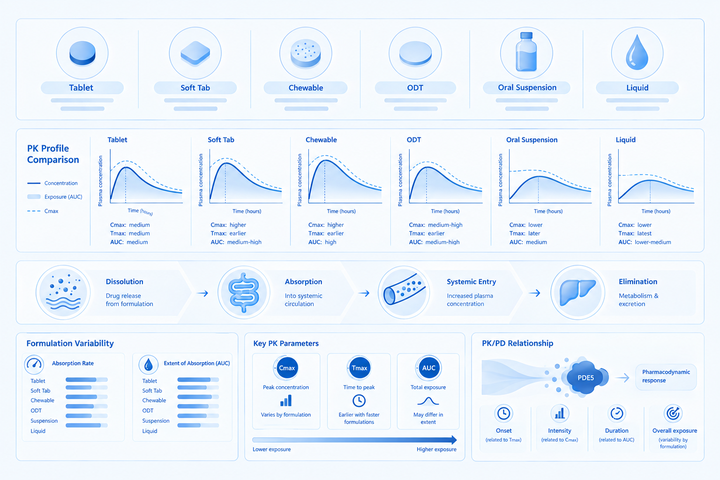
Sildenafil PK comparison is a pharmacokinetic framework for interpreting differences in systemic drug exposure across defined conditions. The pharmacokinetics sequence is commonly organized through absorption, distribution, metabolism, and elimination, collectively describing how sildenafil enters, moves through, and is removed from the body. Absorption establishes systemic drug input, distribution describes movement among physiological compartments, CYP3A4 metabolism contributes to biotransformation, and elimination describes drug removal. The resulting exposure can be visualized with a PK curve, while half-life characterizes concentration decline during a defined kinetic phase. PK comparison therefore focuses on concentration-time behavior, exposure magnitude, temporal landmarks, and disposition processes rather than treating one parameter as a complete representation of sildenafil pharmacokinetics.
Sildenafil PK emerges from the interaction of drug input and disposition processes. Absorption contributes to the rising concentration phase, while distribution and elimination influence subsequent concentration behavior. Time to peak identifies the point of maximum observed concentration, but it does not independently describe absorption or the complete PK profile. The relationship between exposure and biological response can be considered through sildenafil onset and an onset curve, while duration comparison examines temporal exposure and pharmacodynamic persistence. Absorption comparison isolates the input phase from downstream disposition. These distinctions are important because formulation, dose, and physiological conditions can affect different components of the concentration-time trajectory. A PK comparison therefore evaluates the complete ADME sequence rather than assigning observed variability to one mechanism without examining the underlying layer.
Formulation, dose, and physiological conditions can produce distinct PK profiles through different mechanisms. Formulation may influence dissolution, drug input, and early absorption characteristics; dose can influence systemic exposure and concentration magnitude; physiological conditions can modify absorption, distribution, metabolism, or elimination. Related formulation concepts include form onset comparison, soft tabs onset, chewable onset, and ODT onset. Product-category comparisons can be examined through generic onset and brand vs generic onset. Dose-associated exposure can be contextualized with onset by dose. These concepts remain mechanistically distinct from PD response and should be interpreted as components of concentration-time variability rather than as clinical recommendations.
The ADME sequence provides the foundation for sildenafil PK comparison. Absorption describes systemic drug input, distribution describes movement between physiological compartments, CYP3A4 metabolism contributes to biotransformation, and elimination describes removal from the body. Together, these processes determine the observed concentration-time profile. Pharmacokinetics integrates these layers into a temporal exposure model rather than treating them as isolated events.
Each ADME layer can contribute differently to concentration-time behavior. Absorption influences the input phase, distribution can affect early and intermediate concentration patterns, and metabolism and elimination contribute to declining exposure. The PK curve represents the combined result of these processes. Half-life describes concentration decline during a specified kinetic phase and therefore provides disposition context rather than a complete description of every PK feature.
PK terminology also requires separation between concentration measurements and pharmacodynamic observations. Time to peak is a PK landmark, whereas sildenafil onset describes temporal development of biological response. An onset curve connects exposure with PD timing, but does not replace ADME analysis. This separation allows PK comparisons to remain focused on measurable drug disposition characteristics.
| PK Element | Role | Interpretation |
|---|---|---|
| Absorption | Provides systemic drug input | Shapes the initial exposure phase |
| Distribution | Describes movement among compartments | Influences concentration behavior after systemic entry |
| Metabolism | Transforms sildenafil through metabolic pathways | Contributes to systemic disposition |
| Elimination | Removes drug from the body | Contributes to concentration decline and exposure persistence |
Formulation is an upstream determinant of oral PK because dosage-form properties can influence disintegration, dissolution, and systemic drug input. Form onset comparison helps distinguish formulation characteristics from later disposition. Soft tabs onset, chewable onset, and ODT onset represent dosage-form concepts that may alter the early input phase. These characteristics do not change sildenafil's underlying molecular identity or pharmacological target.
Once systemic exposure is established, formulation-specific effects become intertwined with distribution, CYP3A4 metabolism, and elimination. The PK curve can therefore be examined for differences in the rising phase, peak concentration, and subsequent decline. Absorption remains the primary PK layer for interpreting dosage-form input, while downstream disposition determines additional features of the complete concentration-time trajectory.
Generic and branded product categories can also be interpreted through formulation-related PK concepts. Generic onset and brand vs generic onset concern temporal characteristics associated with product formulations. Differences in excipients or physical dosage-form properties may affect early drug input, whereas systemic metabolism and elimination represent separate PK mechanisms. PK comparison should therefore distinguish formulation effects from intrinsic disposition characteristics.
| Formulation | PK Influence | Interpretation |
|---|---|---|
| Standard oral tablet | Disintegration, dissolution, gastrointestinal drug input | Early concentration profile reflects formulation and absorption processes |
| Soft-tab formulation | Dosage-form processing and dissolution | Input-phase characteristics are separated from later disposition |
| Chewable formulation | Physical processing and drug availability | Potential differences are interpreted within the absorption layer |
| ODT formulation | Disintegration and subsequent systemic availability | Early PK behavior is distinguished from metabolism and elimination |
Dose-based PK comparison examines how administered sildenafil amount relates to systemic exposure. Dose is distinct from absorption rate, distribution, metabolism, and elimination, although it interacts with each layer by determining the amount of drug entering the disposition system. Onset by dose provides related temporal context, while onset 25 mg, onset 50 mg, and onset 100 mg can function as exposure categories for mechanistic comparison.
Dose-related PK differences can be examined through concentration magnitude, exposure measures, and concentration-time curve shape. The PK curve shows the resulting systemic concentration trajectory, while time to peak provides a temporal landmark. Absorption determines systemic input, followed by distribution, CYP3A4 metabolism, and elimination. These layers should be considered separately when comparing dose-associated exposure profiles.
A change in administered amount does not necessarily produce a proportional change in every PK parameter. Exposure magnitude, peak concentration, area under the curve, time to peak, and terminal decline represent different aspects of pharmacokinetics. Sildenafil onset and an onset curve add a PD interpretation that should remain separate from PK measurements. Dose comparison therefore focuses on exposure-response and concentration-time relationships rather than converting dose into a fixed temporal outcome.
| Dose | Exposure Effect | PK Interpretation |
|---|---|---|
| Lower dose category | Lower administered amount | Exposure magnitude can be compared independently from absorption rate |
| Intermediate dose category | Intermediate administered amount | Concentration-time behavior is interpreted across ADME layers |
| Higher dose category | Higher administered amount | Exposure magnitude remains distinct from disposition rate |
| Dose comparison | Changes the amount available for systemic exposure | Requires separate analysis of concentration, exposure, and temporal metrics |
Physiological conditions can influence sildenafil PK by modifying absorption, distribution, metabolism, or elimination. Gastrointestinal conditions can affect absorption, while body-composition differences can influence distribution. Hepatic metabolic processes involve CYP3A4 metabolism, and systemic drug removal involves elimination. Condition-based PK comparison therefore requires identifying which ADME layer is altered before interpreting the resulting concentration-time profile.
Food-related conditions can influence temporal drug input and can be considered alongside absorption. Related concepts include onset with food, onset with fatty food, and onset with alcohol. Physiological contexts such as onset in older adults, onset in diabetes, and onset in obesity may involve multiple PK layers, so temporal observations should not automatically be assigned to absorption.
The pharmacokinetics framework integrates condition-related changes into the overall exposure profile. PK curve analysis can reveal alterations in peak concentration, exposure magnitude, rising-phase behavior, or concentration decline. Onset variability may provide related context, but onset timing is not equivalent to a single PK parameter. Condition-based comparison therefore separates altered drug disposition from pharmacodynamic response.
| Condition | PK Influence | Interpretation |
|---|---|---|
| Food-associated state | May modify gastrointestinal drug input | Early concentration changes are considered within the absorption layer |
| Altered gastrointestinal physiology | May affect absorption conditions | Input rate and extent require separate analysis |
| Altered physiological state | May influence multiple ADME processes | Observed PK variability requires identification of the affected layer |
| Body-composition differences | May influence distribution characteristics | Distribution effects should be separated from absorption and elimination |
The PK curve provides a graphical representation of sildenafil concentration over time. Its rising phase reflects net systemic input, the peak region identifies maximum observed concentration, and the declining phase reflects combined disposition processes. Time to peak identifies the timing of maximum concentration but does not independently identify the mechanism producing that timing. Absorption comparison can help isolate input-phase differences from subsequent disposition.
Exposure variability can arise from formulation, dose, food state, physiological conditions, absorption, distribution, metabolism, and elimination. Form onset comparison addresses dosage-form contributions, while onset variability provides related temporal context. Half-life describes a specific concentration-decline characteristic, but it does not summarize peak exposure, absorption behavior, or every feature of the PK curve.
A complete curve interpretation therefore considers multiple PK metrics together. Pharmacokinetics provides the ADME framework, while duration comparison examines temporal persistence as a related but distinct concept. Sildenafil onset and the onset curve connect exposure with PD timing. This layered approach avoids treating one curve feature as a complete description of sildenafil PK.
| PK Metric | Role in PK | Interpretation |
|---|---|---|
| Cmax | Describes maximum observed plasma concentration | Represents peak exposure magnitude |
| Time to peak | Describes timing of maximum observed concentration | Temporal landmark influenced by input and disposition |
| AUC | Represents systemic exposure over a defined interval | Integrates concentration across time |
| Half-life | Describes concentration decline during a defined phase | Provides disposition context rather than a complete PK profile |
PK timing emerges from the interaction of systemic drug input and disposition. Absorption establishes the initial concentration trajectory, distribution affects movement among compartments, and CYP3A4 metabolism contributes to biotransformation. Elimination contributes to subsequent concentration decline. These processes collectively determine the temporal profile represented by the PK curve. No single ADME layer completely describes the observed timing.
Time to peak is a PK landmark that should be distinguished from pharmacodynamic onset. Time to peak describes concentration timing, whereas sildenafil onset describes development of biological response. An onset curve integrates concentration and response over time. Onset variability may therefore reflect upstream PK differences as well as downstream PD differences. This separation is central to mechanistic interpretation.
Formulation and dose can influence the early exposure trajectory, while physiological conditions may affect several ADME layers simultaneously. Form onset comparison helps isolate dosage-form input, and onset by dose provides dose-associated temporal context. Absorption comparison focuses on systemic drug input, while duration comparison addresses temporal persistence. Together, these frameworks support a layered interpretation of sildenafil PK without converting pharmacokinetic observations into clinical guidance.
| Mechanistic Layer | PK Role | PD Role |
|---|---|---|
| Absorption | Produces systemic sildenafil exposure | Provides concentration available for target interaction |
| Distribution | Determines movement among physiological compartments | Shapes concentration available across tissues |
| Metabolism and elimination | Control drug transformation and removal | Influence temporal availability for pharmacodynamic activity |
| Exposure-response | Connects concentration with time | Relates sildenafil concentration to biological response |
Sildenafil PK comparison refers to comparing pharmacokinetic characteristics across defined formulations, doses, physiological conditions, or other experimental variables. The framework examines absorption, distribution, metabolism, elimination, concentration-time behavior, exposure metrics, and temporal parameters. Common descriptors include maximum concentration, time to peak, area under the curve, and half-life. PK comparison focuses on how sildenafil exposure changes across conditions rather than interpreting those differences as clinical recommendations or treatment instructions.
ADME represents absorption, distribution, metabolism, and elimination. Absorption describes systemic drug input, distribution describes movement among physiological compartments, metabolism describes biochemical transformation, and elimination describes removal from the body. These processes interact to produce the observed sildenafil concentration-time profile. A complete PK interpretation keeps each layer conceptually distinct while recognizing that they operate within the same temporal system. This approach helps identify which mechanism contributes to an observed exposure difference.
Formulation can influence sildenafil pharmacokinetics primarily through dosage-form properties affecting disintegration, dissolution, and systemic drug input. These effects occur within the absorption phase and can influence the early concentration-time trajectory. Later distribution, metabolism, and elimination remain separate PK processes. Consequently, a formulation-related difference in the early profile should not automatically be interpreted as a change in intrinsic sildenafil disposition. Mechanistic comparison separates dosage-form effects from downstream systemic pharmacokinetic behavior.
Dose influences the amount of sildenafil introduced into the pharmacokinetic system and can consequently affect systemic exposure and concentration magnitude. However, dose is distinct from absorption rate, distribution, metabolism, elimination, and time-to-peak characteristics. The relationship between dose and exposure is interpreted through concentration-time data and exposure metrics rather than assuming proportional changes in every PK parameter. Dose-based PK comparison is therefore an analytical framework describing exposure behavior, not a recommendation about how sildenafil should be administered.
Physiological conditions can affect sildenafil PK through changes in gastrointestinal input, distribution characteristics, metabolic activity, elimination, or other disposition determinants. Food-related conditions may influence absorption, while differences in physiological state can involve multiple ADME layers simultaneously. Because these mechanisms are distinct, an observed exposure difference should be examined to identify the affected process before assigning it to absorption or another component. Condition-based PK interpretation therefore focuses on mechanism, concentration-time behavior, and exposure variability.
Sildenafil PK variability can result from differences in formulation, dose, absorption, distribution, metabolism, elimination, food state, and physiological characteristics. Each factor can influence a different region or parameter of the concentration-time profile. Variability may therefore appear as differences in peak concentration, exposure magnitude, time to peak, or concentration decline. Interpreting variability requires separating upstream drug-input effects from downstream disposition processes and distinguishing pharmacokinetic measurements from pharmacodynamic observations.
A sildenafil PK curve displays systemic concentration as a function of time. The rising phase reflects net drug input, the peak identifies maximum observed concentration, and the descending phase reflects the combined influence of distribution and drug removal. Time to peak provides a temporal landmark, while exposure measures summarize concentration across defined intervals. Half-life characterizes concentration decline during a specified kinetic phase. Complete interpretation therefore considers multiple curve features rather than treating one metric as a complete representation of PK.