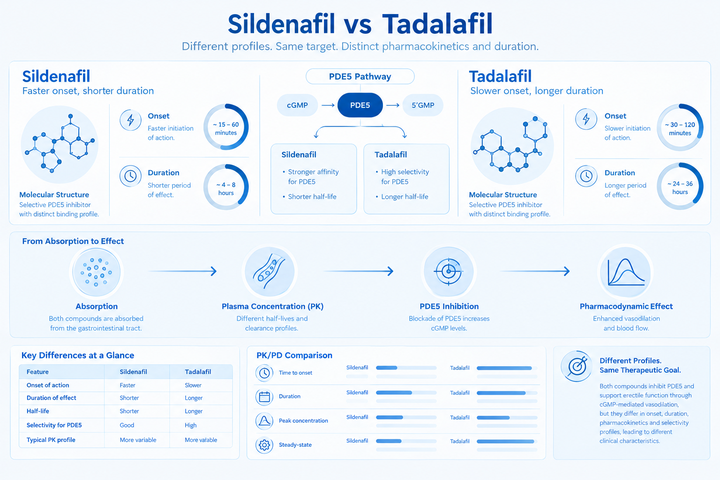
Sildenafil vs Tadalafil — PK/PD and Mechanistic Comparison
Sildenafil vs tadalafil can be interpreted as a comparative pharmacokinetic and pharmacodynamic framework rather than as a simple product-to-product ranking. Both agents inhibit phosphodiesterase type 5, thereby reducing PDE5-mediated hydrolysis of cyclic guanosine monophosphate within the NO/cGMP signaling system. The shared molecular target creates substantial mechanistic overlap, while differences in molecular disposition influence exposure-time behavior and the persistence of pharmacodynamic effects. A structured mechanism comparison therefore separates target interaction from downstream physiology, while the PDE5 pathway and NO/cGMP pathway provide the signaling context. The resulting comparison connects pharmacokinetics with pharmacodynamics, without treating either profile as inherently preferable. This framework also distinguishes vascular relaxation from the molecular inhibition event itself, allowing exposure, target engagement, tissue physiology, and observed pharmacodynamic timing to remain conceptually separate.
The principal PK distinction between sildenafil and tadalafil concerns the shape and persistence of their concentration-time profiles. Absorption determines entry into systemic circulation, distribution influences the relationship between plasma exposure and tissue compartments, metabolism contributes to concentration decline, and elimination determines the terminal disposition pattern. These layers can be examined through absorption, distribution, CYP3A4 metabolism, and elimination. The resulting PK curve provides a visual representation of concentration over time, including rising exposure, peak concentration, and the subsequent exposure tail. Half-life is particularly relevant to the comparative interpretation of persistence, but it is not itself equivalent to pharmacodynamic duration. Similarly, time to peak describes a PK metric rather than a complete definition of pharmacodynamic onset. These distinctions prevent concentration-time behavior from being treated as a direct surrogate for every downstream effect.
Onset and duration represent related but distinct temporal dimensions within sildenafil-versus-tadalafil interpretation. The onset profile reflects the emergence of pharmacodynamic activity as exposure develops and PDE5 inhibition becomes functionally relevant, whereas duration reflects persistence of pharmacodynamic influence as concentrations decline. A comparative sildenafil onset framework can therefore be considered alongside onset curve characteristics, onset variability, and duration comparison. Formulation and administration-related factors can modify absorption behavior, while dose-related exposure changes can alter the concentration-time trajectory. The mechanistic interpretation remains layered: drug concentration is a PK observation, PDE5 inhibition is a target-level event, NO/cGMP signaling is a biochemical pathway, vascular relaxation is a physiological response, and onset or duration describes temporal pharmacodynamic behavior. This separation provides a neutral basis for comparing the two agents without clinical recommendations.
Sildenafil and tadalafil share the defining pharmacological mechanism of selective PDE5 inhibition, but mechanistic comparison should distinguish target binding from the downstream signaling cascade. PDE5 normally contributes to cGMP hydrolysis, whereas inhibition preserves cGMP generated through NO-dependent signaling. The mechanism therefore begins at enzyme inhibition and extends through the PDE5 pathway toward intracellular signaling. Both compounds can be situated within the same mechanistic architecture, while their molecular and disposition characteristics produce different exposure patterns that influence temporal pharmacodynamic interpretation.
The NO/cGMP system provides the principal biochemical bridge between PDE5 inhibition and vascular physiology. Increased persistence of cGMP signaling can facilitate smooth-muscle relaxation when endogenous NO signaling is present, linking the NO/cGMP pathway with vascular relaxation. This does not mean that PDE5 inhibition directly creates NO; rather, inhibition modifies degradation of a downstream second messenger. Consequently, pharmacodynamics should be distinguished from the molecular target event. Sildenafil and tadalafil share this pathway-level relationship, while differing PK profiles influence when and how long target-related pharmacodynamic effects can be represented.
Comparative interpretation is therefore most precise when molecular pharmacology, PK, and PD are kept as separate analytical layers. Pharmacokinetics describes systemic concentration behavior, whereas pharmacodynamics describes effects associated with target engagement and downstream signaling. The same PDE5 mechanism can coexist with different concentration-time trajectories, creating different temporal profiles without implying a categorical hierarchy. PK comparison can consequently be integrated with mechanism, while the distinction between enzyme inhibition, cGMP preservation, vascular smooth-muscle response, and observed timing remains central to a neutral sildenafil-versus-tadalafil framework.
Mechanistic Element
Sildenafil
Tadalafil
Primary molecular target
PDE5 inhibition
PDE5 inhibition
Second-messenger context
Reduced PDE5-mediated cGMP hydrolysis
Reduced PDE5-mediated cGMP hydrolysis
NO/cGMP relationship
Preserves signaling downstream of endogenous NO
Preserves signaling downstream of endogenous NO
Physiological layer
cGMP-associated smooth-muscle relaxation
cGMP-associated smooth-muscle relaxation
PK Comparison: Exposure, Half-Life, Distribution
The PK comparison begins with systemic exposure and the concentration-time profile produced after administration. Absorption governs the initial rise in circulating drug concentration, while distribution determines movement between plasma and tissue compartments. These processes can be examined through absorption and distribution. Sildenafil and tadalafil both generate measurable systemic exposure, but their concentration-time trajectories differ in peak timing, decline characteristics, and persistence. A comparative PK comparison therefore evaluates multiple parameters rather than relying on a single numerical descriptor.
Metabolic disposition contributes substantially to the divergence between the two profiles. Both sildenafil and tadalafil undergo hepatic metabolism involving CYP3A-associated pathways, although the relative contribution and resulting disposition characteristics are drug-specific. The CYP3A4 metabolism layer should therefore remain conceptually distinct from absorption and distribution. Following metabolic transformation, elimination contributes to concentration decline. The resulting exposure trajectory can be represented through the PK curve, which integrates absorption, distribution, metabolism, and elimination into a time-dependent concentration profile.
Half-life provides one important descriptor of the terminal concentration decline, but it should not be interpreted as synonymous with pharmacodynamic duration. Half-life characterizes the time-related disposition of drug concentration under defined conditions, whereas pharmacodynamic persistence depends on exposure, target interaction, signaling, tissue relationships, and effect-response behavior. Consequently, sildenafil and tadalafil can be compared using half-life alongside exposure, peak concentration, and curve shape. This layered approach links pharmacokinetics to downstream pharmacodynamics without collapsing distinct physiological and disposition concepts into one metric.
PK Parameter
Sildenafil
Tadalafil
Exposure profile
Systemic exposure with comparatively shorter persistence
Systemic exposure with comparatively longer persistence
Time to peak
Typically earlier peak concentration
Typically later peak concentration
Terminal half-life
Shorter terminal half-life
Longer terminal half-life
Exposure tail
More rapidly declining concentration profile
More persistent concentration profile
Onset Comparison: Time-to-Peak & Onset Curve
Onset interpretation starts with the rising portion of the concentration-time curve. As systemic exposure increases, drug reaches relevant compartments and interacts with PDE5, producing downstream changes in cGMP signaling. Time to peak is a pharmacokinetic marker describing when maximum observed plasma concentration occurs, whereas onset represents a pharmacodynamic temporal concept. The distinction matters because maximum concentration and first detectable effect do not necessarily occur simultaneously. A comparative onset curve therefore connects exposure kinetics with, but does not equate them to, pharmacodynamic emergence.
Sildenafil and tadalafil can display different onset-related profiles because absorption rate, peak exposure, distribution, and subsequent concentration behavior differ. The sildenafil onset concept is therefore best represented through a concentration-time framework rather than a single universal time point. Tadalafil has a distinct disposition profile that changes the relationship between peak concentration and subsequent exposure. Comparative interpretation can incorporate onset variability to acknowledge that formulation, administration conditions, absorption processes, and interindividual PK characteristics can shift observed timing without changing the underlying PDE5 target mechanism.
An onset comparison should consequently separate three concepts: exposure appearance, target-level pharmacology, and observed pharmacodynamic response. PK curve analysis describes the concentration trajectory, while pharmacodynamics describes effect-related behavior. The form onset comparison layer can further examine how formulation characteristics influence absorption and temporal exposure. This framework prevents time-to-peak from being used as a substitute for onset and avoids interpreting onset timing as a standalone measure of the overall pharmacological profile. Sildenafil and tadalafil remain mechanistically related despite their different temporal PK patterns.
Onset Metric
Sildenafil
Tadalafil
Rise in systemic exposure
Relatively rapid early exposure phase
Rapid systemic exposure with a distinct time course
Time to peak
Generally earlier peak
Generally later peak
Onset interpretation
Linked to rising exposure and PDE5 engagement
Linked to rising exposure and PDE5 engagement
Curve interpretation
Earlier peak followed by declining exposure
Later peak with more persistent subsequent exposure
Duration Comparison: PD Window & Exposure Tail
Duration represents the persistence of pharmacodynamic influence over time and should not be reduced to a direct reading of plasma half-life. Sildenafil and tadalafil both inhibit PDE5, but their different disposition profiles create different exposure tails. Duration comparison therefore examines how long relevant exposure persists after the concentration peak. The half-life provides a useful disposition descriptor, while PK curve shape illustrates the relationship between peak concentration and subsequent decline. These measures together establish the temporal PK foundation for PD interpretation.
Tadalafil is characterized by a longer terminal disposition phase than sildenafil, producing a more persistent concentration tail. Sildenafil generally shows a comparatively shorter terminal disposition profile. These differences affect the temporal opportunity for PDE5 target engagement, but pharmacodynamic duration remains a separate construct. Elimination describes removal of drug-related material from the body, while pharmacodynamics describes the relationship between exposure and biological effect. Thus, the exposure tail informs duration interpretation without constituting a complete effect model.
The downstream pathway remains shared: PDE5 inhibition modifies cGMP degradation, and preserved cGMP signaling can influence smooth-muscle physiology in the presence of endogenous NO signaling. The PDE5 pathway, NO/cGMP pathway, and vascular relaxation layers therefore provide the mechanistic context for interpreting different exposure durations. A longer concentration tail does not represent a different primary target; it represents a different temporal PK environment surrounding the same general PDE5-centered mechanism. Comparative duration analysis should preserve this distinction.
Duration Metric
Sildenafil
Tadalafil
Terminal disposition
Relatively shorter
Relatively longer
Exposure tail
Declines comparatively sooner
Persists comparatively longer
PD temporal interpretation
More closely associated with shorter systemic persistence
More closely associated with longer systemic persistence
Formulation characteristics can modify the early portion of a concentration-time profile without changing the underlying PDE5 target. Disintegration, dissolution, gastrointestinal release, and absorption collectively influence the appearance of systemic exposure. The absorption layer therefore precedes interpretation of peak concentration and onset. A formulation comparison should also distinguish product-specific pharmaceutical properties from the intrinsic molecular pharmacology of sildenafil or tadalafil. The absorption comparison framework allows differences in exposure timing to be examined without attributing every observed variation to PDE5 inhibition itself.
The temporal consequences of formulation can be represented through changes in the rising limb of the PK curve, including altered apparent absorption rate and peak timing. These changes may influence the relationship between systemic concentration and pharmacodynamic onset. Form onset comparison therefore focuses on the interface between pharmaceutical formulation and PK behavior. Distribution remains a separate layer, because the concentration measured in plasma does not necessarily represent instantaneous concentration in every tissue compartment. These distinctions help preserve mechanistic clarity when comparing sildenafil and tadalafil.
Variability in observed onset can arise from multiple sources, including absorption conditions, formulation characteristics, physiological variability, and differences in systemic disposition. Onset variability consequently represents a broader temporal concept than formulation alone. The time to peak metric can provide a quantitative PK descriptor, but it does not independently establish the onset of every downstream pharmacodynamic response. Sildenafil and tadalafil retain their shared PDE5-centered mechanism even when formulation or administration factors alter the shape, timing, or variability of the concentration-time trajectory.
Formulation Factor
Influence on Sildenafil
Influence on Tadalafil
Dissolution behavior
Can influence rate of drug availability for absorption
Can influence rate of drug availability for absorption
Absorption rate
Can alter rising limb and peak timing
Can alter rising limb and peak timing
Peak exposure
Formulation can influence observed peak concentration
Formulation can influence observed peak concentration
Onset variability
May reflect formulation plus physiological PK variability
May reflect formulation plus physiological PK variability
Dose-related interpretation concerns how changes in administered amount translate into systemic exposure and pharmacodynamic behavior. A dose change can modify concentration-time characteristics, although the relationship between dose and exposure depends on absorption, distribution, metabolism, and elimination. Onset by dose therefore describes a PK/PD relationship rather than a fixed temporal rule. Dose selection, dose adjustment, and dose titration are distinct clinical concepts and are not addressed here; the comparison remains limited to mechanistic scaling.
For sildenafil, dose-related exposure can be examined by comparing changes in systemic concentration, peak exposure, and overall exposure under defined pharmacokinetic conditions. Tadalafil can be analyzed using the same conceptual framework, while its longer disposition profile influences the resulting exposure tail. The PK comparison therefore asks how concentration changes propagate through time rather than assuming proportional changes in every PK or PD endpoint. The onset curve provides a useful visualization of how altered exposure can affect the rising concentration phase and temporal pharmacodynamic interpretation.
The pharmacodynamic layer remains anchored to PDE5 inhibition and downstream cGMP signaling. Greater systemic exposure can increase target-site exposure within the relevant concentration range, but the relationship between concentration and effect is governed by pharmacodynamic response characteristics rather than dose alone. Pharmacodynamics should therefore remain distinct from administered dose. The PDE5 pathway and NO/cGMP pathway explain the shared mechanism, while time to peak and half-life contextualize temporal exposure. This produces a neutral dose-scaling interpretation without clinical direction.
Dose Factor
Sildenafil Response
Tadalafil Response
Administered amount
Changes systemic exposure within the relevant PK range
Changes systemic exposure within the relevant PK range
Peak concentration
May increase with greater systemic exposure
May increase with greater systemic exposure
Onset-related interpretation
Related to absorption and rising exposure
Related to absorption and rising exposure
PD scaling
Depends on exposure-response relationship and PDE5 engagement
Depends on exposure-response relationship and PDE5 engagement
Frequently Asked Questions
The principal mechanism is shared: both sildenafil and tadalafil inhibit PDE5, reducing enzymatic breakdown of cGMP and thereby modifying NO/cGMP signaling. Their important differences are primarily pharmacokinetic and temporal rather than a change in the fundamental PDE5 target. Differences in molecular disposition, exposure, concentration-time behavior, and persistence can alter the timing and duration of pharmacodynamic influence while leaving the core PDE5-centered signaling mechanism substantially similar.
Sildenafil and tadalafil have distinct concentration-time profiles, particularly in peak timing and terminal persistence. Sildenafil generally reaches peak plasma concentration earlier and has a shorter terminal half-life, whereas tadalafil reaches peak concentration later and has a substantially longer terminal half-life. These disposition differences influence the shape of each PK curve and the duration of systemic exposure. PK interpretation should nevertheless remain separate from pharmacodynamic effect, because plasma concentration does not directly represent every downstream physiological event.
Onset is a pharmacodynamic concept, whereas time to peak is a pharmacokinetic measurement. Sildenafil generally has an earlier concentration peak, while tadalafil has a later peak within its characteristic PK profile. The emergence of pharmacodynamic activity depends on absorption, systemic exposure, distribution, target engagement, and downstream signaling rather than on peak concentration alone. Consequently, differences in time to peak can inform onset interpretation but should not be treated as a complete or universal definition of pharmacodynamic onset.
Tadalafil has a substantially longer terminal elimination half-life than sildenafil, producing a more persistent systemic exposure tail. This difference in disposition creates a broader temporal environment in which PDE5 target engagement may remain pharmacologically relevant. Duration, however, is not identical to half-life. Pharmacodynamic persistence also depends on exposure-response relationships, target interaction, tissue distribution, and downstream signaling. The longer tadalafil exposure profile therefore represents a PK distinction that contributes to, but does not completely define, pharmacodynamic duration.
Formulation can influence the early concentration-time profile by affecting pharmaceutical availability, dissolution, absorption rate, and the timing of systemic exposure. Changes in these processes can alter the rising limb of the PK curve and the relationship between exposure and pharmacodynamic onset. Formulation effects should be distinguished from the intrinsic PDE5 mechanism, which remains a molecular property of the active drug. Observed onset variability can also reflect physiological and pharmacokinetic factors beyond formulation alone.
Changes in administered amount can alter systemic exposure, peak concentration, and overall exposure, but the resulting PK/PD relationship depends on absorption, distribution, metabolism, elimination, and the concentration-effect relationship. Dose therefore should not be treated as a direct surrogate for onset or pharmacodynamic magnitude. For both sildenafil and tadalafil, dose-related interpretation is most informative when concentration-time behavior is considered alongside PDE5 target engagement and downstream NO/cGMP signaling rather than as an isolated numerical relationship.
The core PDE5 pathway is fundamentally shared because both agents inhibit PDE5 and reduce degradation of cGMP. This preserves signaling generated through the NO/cGMP system rather than creating NO independently. Differences between sildenafil and tadalafil arise principally from molecular properties, systemic disposition, concentration-time behavior, and persistence of exposure. Thus, their pharmacodynamic interpretation can differ temporally even though the central enzyme target and downstream cGMP-centered mechanism remain closely related.