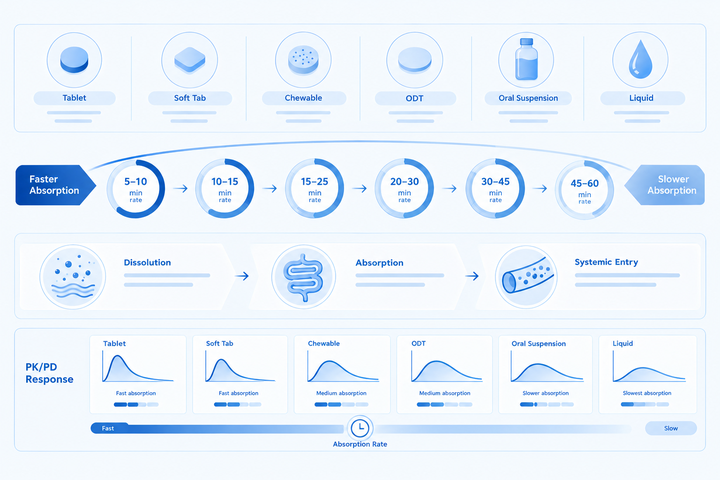
Sildenafil absorption comparison is a pharmacokinetic framework for examining how drug input from the administered formulation produces the early systemic exposure profile. The absorption process connects administration with entry into systemic circulation and influences the rising portion of the concentration-time curve. Within pharmacokinetics, absorption is distinct from distribution, CYP3A4 metabolism, and elimination, which describe subsequent disposition layers. An PK curve can display the resulting exposure trajectory, while time to peak identifies a specific concentration-time landmark. Absorption comparison therefore focuses on the input phase rather than treating the entire PK profile as an absorption event. Formulation characteristics, administered dose, food-related conditions, and physiological variability can each modify aspects of drug input and consequently alter the shape or timing of early systemic exposure.
Absorption influences the exposure rise that precedes peak concentration and provides an upstream determinant of temporal pharmacodynamic interpretation. A change in absorption rate can alter the shape of the rising concentration phase without necessarily changing later metabolic or elimination processes. The relationship with sildenafil onset is therefore indirect and sequential: absorption generates systemic exposure, exposure produces concentration at the pharmacological target, and PD response develops according to the concentration-response relationship. An onset curve integrates these processes but should not be treated as an absorption curve. Onset variability can reflect differences in upstream drug input as well as downstream biological factors. Food-related pages such as onset with food and onset with fatty food provide related temporal context while preserving the distinction between absorption and pharmacodynamic response.
Formulation, dose, and physiological conditions represent separate variables within absorption comparison. Dosage-form characteristics can influence disintegration, dissolution, and gastrointestinal drug input, while dose can influence the amount entering the absorption process and the resulting exposure magnitude. Physiological factors can modify gastrointestinal conditions, body composition, hepatic disposition, or other PK determinants that affect the observed profile. Formulation-specific concepts such as soft tabs onset, chewable onset, and ODT onset illustrate dosage-form distinctions, while generic onset and brand vs generic onset address product-category comparisons. Form onset comparison helps separate formulation-driven input characteristics from later systemic disposition. These layers support a neutral interpretation of absorption variability without converting PK observations into clinical guidance.
Absorption is the PK process through which sildenafil moves from its administration site into systemic circulation. Within pharmacokinetics, it precedes distribution, CYP3A4 metabolism, and elimination. The resulting systemic drug input contributes to the rising phase of the PK curve. Absorption comparison therefore examines input rate, extent of systemic availability, and temporal exposure rather than downstream disposition alone. The absorption layer is mechanistically distinct from pharmacodynamic response.
The early concentration-time profile reflects the balance between drug entering systemic circulation and processes removing or redistributing drug after entry. Time to peak provides a measurable landmark within this trajectory, but it does not independently describe absorption. Distribution begins to influence concentration behavior after systemic entry, while elimination and CYP3A4 metabolism contribute to subsequent disposition. Consequently, a change in time to peak cannot automatically be attributed to absorption alone.
The relationship between absorption and pharmacodynamic timing is sequential. Sildenafil onset describes development of biological response, whereas an onset curve integrates exposure and response over time. Onset variability can arise from absorption differences but can also reflect PD or physiological factors. This distinction allows absorption comparison to remain focused on the PK input phase while recognizing its contribution to the complete PK/PD sequence.
Absorption Element
PK Role
Interpretation
Drug input
Introduces sildenafil into systemic circulation
Defines the initial exposure process
Absorption rate
Controls temporal pattern of systemic input
Influences the rising concentration phase
Absorption extent
Contributes to systemic exposure magnitude
Influences overall exposure under defined conditions
Time to peak
Marks maximum observed concentration timing
Provides a temporal landmark rather than a complete absorption measure
Formulation-Based Absorption Differences
Formulation is an upstream determinant of oral drug input because physical dosage-form properties can influence disintegration, dissolution, and availability for gastrointestinal absorption. Form onset comparison provides a framework for separating formulation characteristics from systemic PK. Soft tabs onset, chewable onset, and ODT onset represent different dosage-form concepts. These distinctions concern the input phase and do not establish a different sildenafil molecular mechanism.
Formulation comparisons can modify the shape of the early concentration-time profile through differences in dissolution or drug availability. Absorption comparison focuses on this input phase, while absorption provides the underlying PK terminology. Once systemic entry occurs, distribution, CYP3A4 metabolism, and elimination become distinct disposition processes. Formulation should therefore not be treated as an explanation for every feature of the complete PK curve.
Product-category comparisons can also be interpreted through the same mechanistic sequence. Generic onset and brand vs generic onset address temporal characteristics associated with product formulations. Differences in excipients, physical properties, or dosage-form design may influence early drug input, while later exposure depends on systemic disposition. The PK curve can be used to distinguish changes in the rising phase from subsequent concentration behavior.
Formulation
Absorption Influence
Interpretation
Standard oral tablet
Disintegration, dissolution, and gastrointestinal drug input
Early systemic exposure reflects formulation and physiological input factors
Soft-tab formulation
Dosage-form disintegration and dissolution characteristics
Input-phase differences remain distinct from later disposition
Chewable formulation
Physical processing and dissolution characteristics
Absorption interpretation follows formulation-dependent drug input
ODT formulation
Disintegration and subsequent availability for absorption
Dosage form is separated from downstream distribution and elimination
Dose-Based Absorption Differences
Dose-based absorption comparison examines how the administered amount relates to systemic drug input and resulting exposure. Dose is distinct from absorption rate because changing the amount administered does not automatically identify a change in the underlying absorption process. Onset by dose provides related temporal context, while onset 25 mg, onset 50 mg, and onset 100 mg can represent exposure categories for mechanistic comparison. These concepts do not constitute dosing guidance.
The PK effect of dose can be evaluated through concentration magnitude, exposure metrics, and the shape of the rising concentration-time phase. The PK curve shows how systemic concentration changes following drug input, while time to peak identifies the timing of maximum observed concentration. Absorption determines how drug enters circulation, whereas distribution, CYP3A4 metabolism, and elimination influence later exposure.
Dose and absorption should remain analytically separate because a change in exposure magnitude does not necessarily indicate a proportional change in absorption timing. Sildenafil onset represents a downstream PK/PD interpretation, and onset curve analysis incorporates biological response in addition to drug input. A dose comparison therefore considers the amount administered, systemic availability, concentration-time behavior, and concentration-response relationships as connected but distinct variables.
Dose
Exposure Effect
Absorption Interpretation
Lower dose category
Lower administered drug amount
Exposure magnitude may differ without implying a different absorption mechanism
Intermediate dose category
Intermediate administered amount
Interpret through systemic input and resulting concentration-time profile
Higher dose category
Higher administered drug amount
Exposure magnitude remains distinct from absorption rate
Dose comparison
Changes amount available for systemic exposure
Requires separation of amount, rate, extent, and downstream disposition
Condition-Based Absorption Differences
Physiological conditions can modify sildenafil absorption by changing gastrointestinal environment, gastric emptying, intestinal processes, food-related conditions, or other determinants of drug input. Onset with food and onset with fatty food provide context for food-associated temporal differences. Onset with alcohol addresses another administration-context variable. These factors should be distinguished from downstream distribution, CYP3A4 metabolism, and elimination.
Age, metabolic state, and body composition can contribute to physiological variability across the complete PK profile. Onset in older adults, onset in diabetes, and onset in obesity provide condition-oriented temporal contexts. Their mechanistic interpretation should identify whether the relevant change concerns absorption, systemic distribution, hepatic disposition, or PD response. Onset variability therefore cannot automatically be assigned to absorption.
Condition-based absorption comparison is strongest when the affected PK layer is explicitly identified. A gastrointestinal factor primarily concerns drug input, whereas altered hepatic function may primarily concern metabolism and systemic clearance. The pharmacokinetics framework connects these processes, and the PK curve shows their combined temporal consequence. This layered approach prevents condition-associated changes in exposure from being interpreted as a single absorption phenomenon.
Condition
Absorption Influence
Interpretation
Food-associated state
Can modify gastrointestinal drug input
Early concentration-time changes are interpreted as input-phase effects
Altered gastrointestinal physiology
May change drug dissolution or absorption conditions
Input rate and extent require separate consideration
Older physiological state
May affect multiple PK processes
Absorption should be separated from distribution and elimination
Metabolic or body-composition differences
May influence PK beyond absorption
Observed variability requires identification of the affected layer
PK Curve Interpretation & Input-Phase Variability
The PK curve provides a visual representation of systemic concentration over time and allows the absorption phase to be separated from later disposition. The rising portion reflects net systemic drug input, although distribution and elimination processes can occur concurrently. Time to peak identifies the point of maximum observed concentration, while absorption describes the process generating systemic availability. Curve shape therefore reflects multiple simultaneous PK processes.
Input-phase variability can involve differences in dissolution, gastrointestinal transit, absorption rate, absorption extent, and food-related conditions. Absorption comparison focuses on these differences, while form onset comparison examines dosage-form contributions. Onset with food and onset with fatty food provide related examples of administration-context effects. Subsequent distribution and elimination can reshape the curve after systemic input.
A change in the rising curve should not automatically be interpreted as a change in pharmacodynamic onset. Sildenafil onset integrates exposure with biological response, while an onset curve describes temporal response development. Onset variability may originate in PK input or downstream PD factors. Pharmacokinetics therefore supplies the input-phase framework, while PD provides a separate response layer.
PK Metric
Role in Absorption
Interpretation
Absorption rate
Describes temporal systemic drug input
Influences the rising concentration phase
Absorption extent
Describes amount reaching systemic circulation
Contributes to exposure magnitude
Time to peak
Marks maximum observed concentration timing
Temporal landmark influenced by input and disposition
Rising PK curve
Displays net early concentration increase
Reflects combined input and concurrent disposition processes
Mechanistic Interpretation of Absorption Timing
Absorption timing represents the temporal pattern through which sildenafil becomes systemically available. It begins with dosage-form behavior and continues through dissolution and gastrointestinal drug input before producing measurable systemic concentration. Absorption is therefore upstream of distribution, CYP3A4 metabolism, and elimination. The pharmacokinetics framework connects these processes, while the PK curve displays their combined temporal behavior.
Timing of systemic concentration and timing of pharmacodynamic response should remain separate concepts. Time to peak describes a PK event, whereas sildenafil onset concerns development of biological response. An onset curve incorporates the relationship between exposure and PD, so its timing cannot be reduced to absorption alone. Onset variability may therefore include both PK input differences and biological response differences.
Formulation, dose, and physiological conditions can each modify the observed absorption profile through distinct mechanisms. Form onset comparison addresses dosage-form input, while onset by dose provides dose-related temporal context. Food-related factors can be considered through onset with food, and formulation categories through generic onset. Mechanistic interpretation is strongest when drug input, systemic exposure, disposition, and PD response are maintained as separate analytical layers.
Mechanistic Layer
PK Role
PD Role
Dosage-form input
Controls physical drug availability before systemic entry
No direct target-level role
Absorption
Produces systemic sildenafil exposure
Supplies concentration available for target interaction
Systemic disposition
Determines distribution, metabolism, and elimination
Shapes temporal concentration available for PD activity
Exposure-response
Links concentration with time
Relates sildenafil concentration to PDE5-mediated biological response
Frequently Asked Questions
Sildenafil absorption refers to the pharmacokinetic process by which administered sildenafil becomes available in systemic circulation. For oral administration, this includes dosage-form disintegration, dissolution, gastrointestinal drug input, and transfer into systemic blood. Absorption is distinct from distribution, metabolism, and elimination, which describe later disposition processes. It is also distinct from pharmacodynamic response. In documentation, absorption can be characterized by the rate and extent of systemic drug input.
Within PK, sildenafil absorption is interpreted as the input phase connecting administration with systemic exposure. Important concepts include absorption rate, absorption extent, concentration-time behavior, and the rising portion of the PK curve. Time to peak is a related temporal landmark but is not a direct synonym for absorption because distribution and elimination can occur concurrently. A complete interpretation therefore separates drug input from downstream disposition and from pharmacodynamic response.
Formulation can influence absorption through physical characteristics such as disintegration, dissolution, and the availability of sildenafil for gastrointestinal uptake. Different dosage forms may therefore produce different input-phase profiles. These formulation effects should be separated from subsequent distribution, metabolism, and elimination. A formulation distinction does not represent a change in sildenafil's molecular target. Mechanistic comparison focuses on how dosage-form properties affect systemic drug input and the resulting concentration-time trajectory.
Dose describes the amount of sildenafil administered, whereas absorption describes the process by which that drug becomes systemically available. Changing dose can alter exposure magnitude, but it does not automatically indicate a proportional change in absorption rate or extent. Dose-based interpretation therefore considers administered amount, systemic availability, concentration-time behavior, and downstream disposition separately. This distinction prevents dose from being treated as a direct measurement of absorption timing or as a clinical dosing instruction.
Physiological conditions can influence sildenafil absorption when they alter gastrointestinal environment, gastric emptying, intestinal processes, food-related conditions, or other determinants of drug input. However, physiological changes can also affect distribution, metabolism, elimination, or pharmacodynamic response. Consequently, an observed change in systemic exposure should not automatically be attributed to absorption. Mechanistic interpretation first identifies the affected PK layer, then evaluates how that change contributes to the observed concentration-time profile.
Absorption variability can arise from differences in dosage-form characteristics, dissolution, gastrointestinal conditions, food state, absorption rate, and absorption extent. Physiological differences can add further variability, while later distribution, metabolism, and elimination may also alter the measured concentration-time profile. For this reason, variability in an observed PK curve is not necessarily equivalent to variability in absorption. Mechanistic analysis separates input-phase effects from downstream disposition and pharmacodynamic factors.
A sildenafil PK curve can be examined by focusing on its rising phase, peak region, and subsequent decline. The rising phase provides information about net systemic drug input, while time to peak identifies a concentration-time landmark. However, concurrent distribution and elimination can influence the curve, so the rising phase is not a pure measurement of absorption. Absorption comparison therefore considers curve shape alongside formulation, dose, physiological conditions, and other PK processes affecting systemic exposure.