PK/PD Comparison • Route Differentiation

Sildenafil vs Injections: PK/PD and Administration-Route Comparison

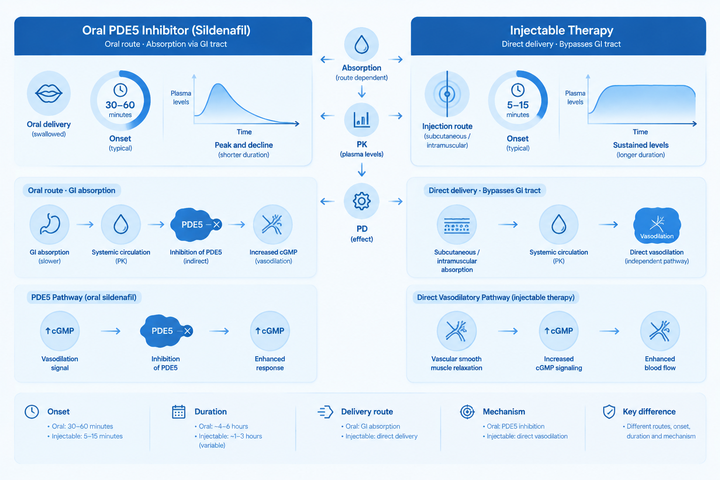
Sildenafil vs injections is best understood as a comparison between an oral administration route and a generic parenteral administration framework rather than as a direct comparison of two equivalent active ingredients. Sildenafil is a PDE5 inhibitor whose standard oral formulation requires disintegration, dissolution, gastrointestinal absorption, and systemic entry before distribution and target exposure occur. An injection bypasses gastrointestinal absorption and introduces an active substance directly into a systemic or tissue compartment, depending on the parenteral route. The resulting pharmacokinetics can therefore differ substantially in input rate, bioavailability, peak concentration, and concentration-time shape. The shared mechanistic framework applies only when the injectable comparator has a relevant PDE5-mediated mechanism; injections as a category do not inherently share sildenafil's target. For sildenafil, the mechanism, PDE5 pathway, and NO/cGMP pathway describe molecular pharmacology, while administration route describes how exposure is established.

Route-dependent PK differences become especially visible during the absorption phase. Oral sildenafil depends on formulation dissolution and gastrointestinal transport before systemic concentration rises, whereas many parenteral routes introduce active substance without a gastrointestinal absorption step. This can alter the early PK curve, apparent time to peak, and concentration slope. However, faster systemic entry should not be equated automatically with pharmacodynamic onset because onset depends on concentration, target engagement, signal transduction, and downstream physiology. Sildenafil onset and the onset curve therefore represent PK/PD concepts rather than simple measures of administration speed. Similarly, route-dependent changes in peak exposure do not independently establish duration. Distribution, metabolism, and elimination shape the subsequent exposure tail. Comparative interpretation therefore separates administration, absorption, systemic exposure, target pharmacology, and observed pharmacodynamic timing rather than collapsing them into a single onset or duration metric.

The downstream pharmacodynamic framework is also distinct from the route of administration. Sildenafil inhibits PDE5, reducing enzymatic hydrolysis of cGMP and modifying NO-dependent signaling, which can influence smooth-muscle physiology and vascular relaxation. A generic injection may produce an entirely different pharmacological mechanism, so route comparison alone cannot establish equivalent PDE5, NO/cGMP, or vascular effects. When an injectable comparator does act through the same pathway, the principal analytical differences arise from exposure kinetics and tissue delivery rather than a different pathway identity. Pharmacodynamics, distribution, and half-life help distinguish systemic concentration from biological persistence. Duration comparison consequently requires examination of exposure tails and downstream response independently of the initial route. This framework provides a neutral PK/PD interpretation of oral sildenafil versus parenteral administration without treating route, onset, exposure, or mechanism as interchangeable concepts.

Mechanistic Comparison: Sildenafil vs Injections
Injection comparison

Sildenafil has a defined molecular mechanism: inhibition of PDE5 with consequent reduction in cGMP hydrolysis. This mechanism can be represented through the mechanism, PDE5 pathway, and NO/cGMP pathway. An injection, however, describes an administration route rather than a molecular target. Its mechanism depends on the injected active substance. Therefore, route comparison should not assume that a generic injection produces PDE5 inhibition or shares sildenafil's downstream signaling.

When an injectable active substance does share the PDE5 mechanism, comparison can proceed at the target level. Both agents would then affect PDE5-mediated cGMP hydrolysis, with downstream effects represented through pharmacodynamics and vascular relaxation. If the injectable substance has another target, the mechanistic comparison instead separates molecular pharmacology from administration-route effects.

The administration route primarily determines how systemic exposure is established. Oral sildenafil requires formulation processing and absorption, while parenteral administration can bypass gastrointestinal absorption. Subsequent distribution and elimination shape exposure. Thus, the pharmacokinetics layer should remain separate from PDE5 target identity and downstream biological response.

Mechanistic Element Sildenafil (Oral) Injections (Parenteral)
Primary definition PDE5-inhibiting active drug administered orally Administration route; molecular mechanism depends on injected substance
PDE5 relationship Direct PDE5 inhibition Present only when the injected active substance targets PDE5
NO/cGMP signaling PDE5 inhibition modifies cGMP hydrolysis within NO-dependent signaling Depends on the pharmacological target of the injected substance
Route contribution Oral formulation precedes gastrointestinal absorption Parenteral route can bypass gastrointestinal absorption

PK Comparison: Oral vs Parenteral Exposure

Oral sildenafil requires a sequence of formulation disintegration, dissolution, gastrointestinal absorption, and systemic entry. Parenteral administration can place active substance directly into a systemic or tissue compartment, depending on route. This changes the input component of pharmacokinetics and can alter bioavailability, absorption rate, and the initial concentration-time slope. These route differences precede the later processes of distribution, metabolism, and elimination.

The PK curve integrates input and disposition. Oral sildenafil typically shows a recognizable absorption phase followed by peak concentration and subsequent decline. Parenteral routes may show a shorter or route-specific input phase, although the precise profile depends on whether administration is intravenous, intramuscular, subcutaneous, or another parenteral approach. Distribution begins after systemic or compartmental entry and contributes to the later concentration profile.

Terminal exposure depends on molecular disposition rather than route alone. Metabolic pathways, including CYP3A4 metabolism where relevant, and elimination determine subsequent decline. The half-life describes terminal disposition but does not define the absorption phase or pharmacodynamic duration. A complete PK comparison therefore separates route-dependent input from drug-specific distribution and elimination.

PK Parameter Sildenafil (Oral) Injections (Parenteral)
Systemic entry Occurs after gastrointestinal absorption Can occur without gastrointestinal absorption
Bioavailability Influenced by oral absorption and first-pass processes Depends on the specific parenteral route and formulation
Early concentration profile Includes an absorption phase before systemic peak May have a shorter or route-specific input phase
Terminal phase Determined by distribution, metabolism, and elimination Determined by the injected substance's distribution, metabolism, and elimination

Onset Comparison: Absorption vs Direct Systemic Entry

The principal onset-related PK distinction is the presence or absence of gastrointestinal absorption. Oral sildenafil must pass through formulation release and absorption before systemic concentrations rise. A parenteral route can introduce active substance directly into systemic circulation or another compartment, depending on route. This can alter the early concentration slope and time to peak, but the exact effect depends on the parenteral route and formulation.

Pharmacodynamic onset remains separate from administration speed. A rising plasma concentration must reach a relevant exposure range, interact with the molecular target, and initiate downstream signaling before an observable response is represented. For sildenafil, sildenafil onset therefore reflects more than oral absorption alone. For an injectable substance, the absence of gastrointestinal absorption does not independently define its pharmacodynamic onset.

The onset curve combines early PK and PD behavior. Formulation, administration route, absorption rate, distribution, and target engagement can each influence its shape. Onset variability therefore remains a multidimensional concept. Absorption comparison is especially relevant for distinguishing oral input from parenteral entry without treating either route as a direct proxy for pharmacodynamic timing.

Onset Metric Sildenafil (Oral) Injections (Parenteral)
Absorption requirement Requires gastrointestinal absorption before systemic exposure Can bypass gastrointestinal absorption
Early concentration rise Governed initially by formulation release and oral absorption Governed by the specific parenteral route, formulation, and tissue entry
Time to peak Reflects oral absorption and subsequent disposition Depends on parenteral route, absorption from injection site when applicable, and disposition
Pharmacodynamic onset Depends on exposure and PDE5 target engagement Depends on the injected substance, exposure, target, and downstream pharmacodynamics

Duration Comparison: PD Window & Exposure Tail

Duration should be distinguished from onset and from the initial administration route. After sildenafil enters systemic circulation, its concentration declines through distribution, metabolism, and elimination. An injectable substance follows its own disposition profile, which may include immediate systemic distribution or absorption from an injection site depending on the parenteral route. The resulting exposure tail is therefore determined by both route-specific input and the molecular characteristics of the active substance.

The half-life is a terminal PK descriptor that helps characterize persistence but does not independently establish the duration of pharmacodynamic response. For sildenafil, the PK curve shows the transition from absorption through peak exposure and terminal decline. For injections, the corresponding curve depends on the route and formulation, including whether drug enters systemic circulation directly or is released gradually from a tissue depot.

Downstream pharmacodynamics must be analyzed separately from the exposure tail. Sildenafil's PDE5 inhibition influences cGMP handling within the NO/cGMP pathway, with downstream effects involving vascular relaxation. An injectable comparator may share this pathway or act through another mechanism. Thus, duration comparison requires explicit identification of both the drug mechanism and the administration route.

Duration Metric Sildenafil (Oral) Injections (Parenteral)
Exposure tail Determined by sildenafil distribution, metabolism, and elimination after oral absorption Determined by injected substance and route-specific input and disposition
Half-life Describes terminal sildenafil disposition Depends on the injected active substance and its disposition
PD window Related to sustained PDE5-relevant exposure and downstream signaling Depends on the injected substance, target engagement, and exposure persistence
Route effect Oral route primarily affects initial input Parenteral route can alter initial entry and, for some routes, release kinetics

Formulation Influence: Absorption & Onset Variability

Formulation is an important determinant of how an administered substance becomes available for systemic exposure. Standard oral sildenafil requires tablet disintegration, dissolution, and gastrointestinal absorption. Parenteral formulations may instead be solutions, suspensions, emulsions, or depot preparations, each producing different input characteristics. These differences belong to the formulation and administration layers of pharmacokinetics rather than directly changing molecular target identity.

For oral sildenafil, formulation properties can influence dissolution and the early concentration-time profile. For injections, formulation can determine whether systemic entry is immediate or follows release from the administration site. These differences can affect the PK curve, apparent time to peak, and early exposure. Form onset comparison therefore evaluates pharmaceutical input rather than pharmacodynamic mechanism.

Observed timing can also vary because absorption and distribution are not identical across routes. Onset variability may reflect formulation, route, absorption rate, tissue delivery, and systemic disposition. Distribution becomes particularly relevant after systemic entry. A neutral comparison therefore treats formulation as one determinant of exposure rather than assuming that administration route alone determines onset or downstream pharmacodynamic duration.

Formulation Factor Influence on Sildenafil Influence on Injections
Dosage-form input Standard oral tablet disintegration and dissolution precede absorption Parenteral formulation determines route-specific drug release and entry
Absorption Gastrointestinal absorption is required for systemic availability May be bypassed or may occur from an injection site depending on route
Early PK Dissolution and absorption influence concentration rise Formulation and route can determine systemic entry rate
Onset variability Can reflect formulation and oral absorption differences Can reflect route, formulation, tissue absorption, and systemic disposition

Frequently Asked Questions

Sildenafil is a specific PDE5-inhibiting active drug, whereas injection is an administration route rather than a molecular mechanism. Sildenafil therefore has a defined relationship with PDE5 inhibition, cGMP hydrolysis, and NO-dependent signaling. An injected substance may act through PDE5 or through an entirely different target, depending on its identity. Consequently, mechanistic comparison requires separating the active substance's pharmacology from the route used to establish systemic exposure.

Oral sildenafil requires formulation disintegration, dissolution, gastrointestinal absorption, and systemic entry before its concentration rises in plasma. Parenteral administration can bypass gastrointestinal absorption and introduce active substance directly into a systemic or tissue compartment, depending on the route. This changes the input portion of the concentration-time profile and can affect bioavailability, peak timing, and early concentration slope. Later distribution, metabolism, and elimination remain dependent on the molecular characteristics of the active substance.

The main PK reason is that parenteral administration can bypass gastrointestinal absorption. Oral sildenafil must pass through formulation release and gastrointestinal absorption before systemic concentrations increase, whereas some parenteral routes establish systemic exposure more directly. However, administration speed is not identical to pharmacodynamic onset. Target engagement, concentration, distribution, signal transduction, and biological response all contribute. Therefore, route can alter the early PK profile without independently defining a fixed pharmacodynamic onset.

Duration depends on systemic exposure persistence, molecular disposition, target engagement, and downstream pharmacodynamics. Sildenafil has its own distribution, metabolism, elimination, and terminal half-life characteristics after oral absorption. An injectable substance follows disposition determined by its molecular properties and the specific parenteral route or formulation. Some routes may produce direct systemic entry, while others include absorption from an administration site. Consequently, duration cannot be inferred from route alone and should be separated from onset and time to peak.

Formulation determines how an active substance becomes available for systemic exposure. Oral sildenafil requires tablet disintegration, dissolution, and gastrointestinal absorption. Injectable formulations can be solutions, suspensions, emulsions, or depot-type preparations, producing different release and input characteristics. These properties can alter the early concentration-time curve and apparent time to peak. Formulation therefore belongs to the pharmaceutical and pharmacokinetic layers. It does not inherently change the molecular target or establish a different pharmacodynamic mechanism.

Dose-related differences should be interpreted through exposure and exposure-response relationships rather than assuming that an administered amount has identical meaning across routes. Oral sildenafil includes gastrointestinal absorption and first-pass processes, while parenteral administration can bypass gastrointestinal absorption. Consequently, the same nominal amount can produce different systemic exposure depending on route and formulation. Pharmacokinetic concentration, pharmacodynamic target engagement, and downstream response should remain separate analytical layers when comparing route-dependent dose scaling.

Not necessarily. Sildenafil specifically inhibits PDE5, reducing PDE5-mediated cGMP hydrolysis and modifying the NO/cGMP signaling environment. An injection describes how a substance is administered, not what molecular target it affects. An injectable substance could share the PDE5 mechanism, act on another enzyme or receptor, or influence a different physiological pathway. Therefore, a valid comparison must identify the injected active substance before assigning any PDE5, NO/cGMP, vascular, or downstream pharmacodynamic interpretation.