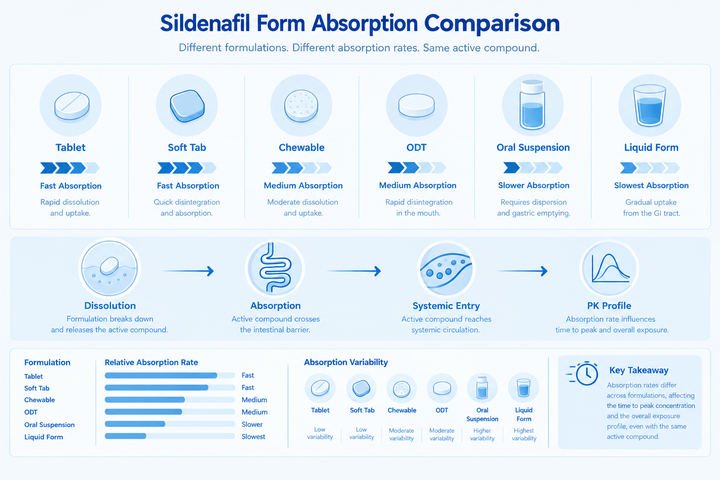
Sildenafil absorption comparison examines how pharmaceutical form can influence the sequence from dosage-form behavior and dissolution to gastrointestinal absorption and systemic exposure. The comparison is mechanistic rather than preferential, using tablets, soft tabs and chewable forms as examples of different formulation environments that may affect the early pharmacokinetic profile.
After dissolution and absorption, sildenafil undergoes distribution, hepatic metabolism and elimination, producing an integrated exposure-time profile. The resulting pharmacokinetics framework includes the rising concentration phase, peak exposure and subsequent decline. Formulation-related changes at the absorption stage may therefore influence exposure, time to peak, onset interpretation and the temporal characteristics of the overall PK curve.
Pharmacodynamic interpretation connects systemic sildenafil exposure with PDE5 inhibition and downstream NO/cGMP signaling rather than assigning a distinct mechanism to each formulation. The mechanism remains pharmacologically related to PDE5 inhibition, while differences in absorption can alter when exposure develops. Thus, form, absorption, PK and PD should be interpreted as connected but distinct layers of a temporal model.
Absorption comparison represents a mechanistic analysis of how sildenafil moves from a pharmaceutical formulation into systemic circulation. The sequence begins with dosage-form characteristics, disintegration or dispersion, dissolution and subsequent gastrointestinal availability for uptake. Tablets, soft tabs, chewable, ODT, oral suspension and liquid form can therefore be compared according to formulation-stage processes without assuming that a particular physical form necessarily produces a predetermined systemic outcome.
The absorption stage is only one layer of sildenafil pharmacokinetics. Following entry into the systemic circulation, distribution, hepatic CYP3A4 metabolism, half-life and elimination contribute to the measured concentration-time profile. Consequently, an observed difference in early absorption does not automatically indicate a corresponding difference in total exposure, because systemic disposition can modify both the magnitude and persistence of circulating sildenafil.
Absorption also connects formulation characteristics with temporal pharmacodynamics. An altered early exposure profile may influence the timing of sildenafil availability for PDE5 target engagement, while the molecular mechanism, PDE5 pathway and NO/cGMP pathway remain the same. The resulting pharmacodynamics relationship is therefore an exposure-response question. Absorption comparison describes this sequence mechanistically rather than establishing clinical superiority among forms.
Formulation differences occur before and during the earliest stages of sildenafil systemic pharmacokinetics. Tablets generally require disintegration and dissolution before absorption, while soft tabs, chewable products and ODT formulations have different physical presentation characteristics. Oral suspension and liquid form introduce dispersed or liquid formulation environments. These differences can affect the formulation-to-absorption transition, but gastrointestinal physiology remains an important determinant of actual systemic availability.
Once absorbed, sildenafil enters the systemic PK sequence. Distribution describes movement between circulating and tissue compartments, while hepatic CYP3A4 metabolism contributes substantially to systemic clearance. Half-life and elimination characterize later disposition. Generics, brand names and brand vs generic comparisons should similarly distinguish formulation attributes from measured systemic PK characteristics and bioequivalence concepts.
The absorption layer is most relevant to the initial concentration-time trajectory, whereas distribution and elimination contribute increasingly to later portions of the profile. A formulation can therefore influence the rate at which sildenafil becomes systemically available without independently determining every PK parameter. The resulting PK curve integrates absorption, distribution, metabolism and elimination. This distinction is essential when interpreting formulation-related exposure differences without converting pharmacokinetic observations into clinical recommendations.
| Form | Absorption Influence | Exposure Effect |
|---|---|---|
| Tablets and soft tabs | Disintegration and dissolution characteristics precede gastrointestinal absorption | Can influence the early concentration-time trajectory |
| Chewable and ODT | Dispersion, disintegration and dissolution characteristics may alter formulation-stage availability | Potentially affects the rate of early systemic exposure |
| Oral suspension and liquid form | Drug is presented in dispersed or liquid form before gastrointestinal uptake | Exposure depends on formulation behavior together with absorption and systemic disposition |
| Generics and brand names | Formulation composition can differ while systemic absorption remains subject to physiological and PK determinants | Exposure is interpreted from measured PK characteristics rather than product naming alone |
The sildenafil exposure-time profile represents the combined result of formulation behavior, absorption and systemic disposition. The rising limb reflects net absorption relative to ongoing distribution and elimination, making it particularly relevant to formulation comparisons. Across tablets, soft tabs, chewable, ODT, oral suspension and liquid form, formulation characteristics may therefore affect the timing and shape of early systemic exposure.
Exposure rate and exposure extent are separate pharmacokinetic concepts. Changes in dissolution or absorption rate can modify the ascending concentration phase and potentially time to peak, whereas total exposure is commonly characterized through the area under the concentration-time curve. Pharmacokinetics consequently distinguishes how quickly exposure develops from how much drug reaches systemic circulation. These distinctions prevent an early profile difference from being interpreted automatically as a proportional difference in overall exposure.
The later exposure profile is shaped by systemic disposition rather than formulation alone. Distribution, CYP3A4 metabolism, half-life and elimination contribute to the descending phase. Accordingly, formulation-related absorption differences can influence onset interpretation without necessarily determining duration. The PK curve provides an integrated representation in which formulation, absorption and disposition are interpreted together rather than as isolated determinants.
A sildenafil PK curve converts formulation and absorption processes into a measurable concentration-time representation. Its initial rising limb reflects the net result of drug becoming available for absorption and entering systemic circulation. Formulations such as tablets, soft tabs, chewable and ODT may have different dosage-form characteristics, but the resulting curve must be interpreted from observed PK parameters rather than from the formulation label itself.
The peak region incorporates absorption rate together with simultaneous distribution and elimination processes. Time to peak describes the timing of maximum measured concentration, while peak concentration describes magnitude. These are distinct from total exposure and from pharmacodynamic effect. After the peak, distribution, CYP3A4 metabolism, half-life and elimination contribute to the descending profile.
Comparisons involving generics, brand names and brand vs generic products require the same PK principles. Similarly, oral suspension and liquid form comparisons should distinguish formulation-stage properties from measured systemic exposure. A PK curve is descriptive of concentration over time; interpreting it requires attention to absorption, exposure extent, peak behavior and study conditions rather than assuming that curve shape alone establishes pharmacodynamic significance.
| PK Phase | Form Influence | Absorption Relationship |
|---|---|---|
| Dissolution | Dosage-form properties determine how sildenafil becomes available in solution | Precedes and can influence the availability of drug for gastrointestinal uptake |
| Absorption and rising phase | Formulation characteristics can influence the rate of systemic entry | Most directly associated with the ascending concentration-time trajectory |
| Peak exposure | Absorption rate interacts with distribution and elimination | Time to peak provides a temporal marker of the integrated PK process |
| Post-peak disposition | Distribution, metabolism and elimination increasingly shape concentration decline | Less directly governed by initial dissolution and absorption characteristics |
Pharmacodynamic interpretation begins after considering how formulation characteristics influence systemic sildenafil exposure. The underlying mechanism remains PDE5 inhibition, with effects connected to the PDE5 pathway and NO/cGMP pathway. Consequently, tablets, soft tabs, chewable, ODT, oral suspension and liquid form do not require separate molecular mechanisms to explain formulation-related PK differences.
A formulation can potentially alter the temporal development of exposure, creating differences in when sildenafil becomes available for target interaction. Pharmacodynamics then describes the exposure-response relationship through target engagement and downstream biological signaling. Vascular relaxation represents a downstream physiological process, but its timing cannot be inferred from dosage form alone. Plasma concentration, tissue distribution, receptor or enzyme interaction and biological responsiveness all contribute to the observed response profile.
This separation between PK and PD prevents an absorption difference from being interpreted as a change in intrinsic pharmacological activity. A formulation-related change in the early exposure curve may influence temporal target engagement while sildenafil's PDE5 inhibitory action remains fundamentally unchanged. The relationship between pharmacodynamics, exposure and the onset curve is therefore an integrated interpretation. The framework is descriptive and mechanistic rather than a basis for selecting one formulation over another.
Integrated interpretation follows sildenafil from formulation through dissolution, absorption, systemic exposure and pharmacodynamic response. Tablets, soft tabs, chewable, ODT, oral suspension and liquid form can differ at the formulation stage, but absorption must be interpreted within the broader pharmacokinetics sequence. The resulting exposure profile connects formulation characteristics with, but does not independently determine, pharmacodynamic timing.
The temporal sequence includes dissolution, gastrointestinal absorption, systemic concentration, distribution and target-site exposure, followed by PDE5 inhibition and downstream signaling. Pharmacodynamics describes the exposure-response component, while time to peak remains a PK descriptor. Sildenafil onset should therefore not be treated as synonymous with time to peak. The onset curve represents an integrated temporal relationship influenced by both exposure and biological response.
Duration interpretation requires a separate view of later disposition. Half-life, elimination and continuing pharmacodynamic signaling influence persistence after the absorption-dominated phase. Generics, brand names and brand vs generic comparisons use the same conceptual framework. Dose strengths such as 25 mg, 50 mg and 100 mg can be treated as separate exposure variables, but this page does not use them to provide dosing guidance.
| Form Factor | Influence on PK/PD Absorption Timing |
|---|---|
| Conventional solid forms | Disintegration and dissolution precede absorption and contribute to the early systemic exposure trajectory |
| Rapidly dispersing oral forms | Dispersion or disintegration characteristics may alter formulation-stage availability before systemic absorption |
| Liquid or suspension forms | Pre-dissolved or dispersed presentation can modify the formulation-to-absorption transition, while physiology remains influential |
| Brand and generic formulations | Formulation composition may vary, but absorption and PD timing are interpreted through measured systemic PK and exposure-response relationships |
Sildenafil absorption comparison is a mechanistic examination of how different pharmaceutical forms can influence the transition from formulation characteristics and dissolution to gastrointestinal absorption and systemic exposure. It does not establish that one formulation is universally faster, better or clinically preferable. The analysis separates absorption rate from exposure extent and then considers distribution, metabolism and elimination. Pharmacodynamic interpretation is added afterward to describe how changes in systemic concentration may influence the timing of PDE5 target engagement and downstream signaling.
Sildenafil formulations can differ in physical characteristics such as disintegration, dispersion and dissolution. These properties determine how rapidly drug becomes available in solution for subsequent gastrointestinal uptake. Conventional tablets, chewable products, orally disintegrating forms, suspensions and liquids can therefore create different formulation-stage environments. However, dissolution is not equivalent to systemic absorption. Gastrointestinal physiology, formulation composition, drug solubility and other biological processes influence actual absorption. Consequently, a theoretical dissolution difference does not by itself establish a predictable difference in systemic exposure.
Formulations can influence the early pharmacokinetic profile by affecting how sildenafil becomes available for absorption. A change in absorption rate may alter the rising concentration-time phase or time to peak, while distribution, metabolism and elimination shape later exposure. These systemic processes are not determined solely by pharmaceutical form. Pharmacokinetic comparisons therefore distinguish formulation-dependent absorption effects from downstream disposition. Measurements such as peak concentration, time to peak and total exposure provide complementary information and should be interpreted together rather than treating one parameter as a complete description of formulation performance.
Exposure describes both the magnitude and temporal pattern of sildenafil in systemic circulation. Formulation characteristics may affect absorption rate and therefore influence the early concentration-time profile, including the rising phase and peak timing. Total systemic exposure represents a different dimension and is commonly assessed through the area under the concentration-time curve. A formulation that changes the speed of absorption does not necessarily produce a proportional change in total exposure. Exposure interpretation therefore requires separation of absorption rate, peak concentration, peak timing and overall systemic drug availability.
The pharmacodynamic mechanism of sildenafil remains centered on PDE5 inhibition and its relationship with the NO/cGMP signaling system across pharmaceutical forms. Formulation differences may influence the timing of systemic exposure and therefore the temporal relationship between concentration and pharmacodynamic response. This does not imply that the intrinsic molecular mechanism changes between tablets, liquids, chewable forms or other presentations. Pharmacodynamic interpretation considers exposure-response relationships, distribution, target engagement and downstream physiological signaling. A formulation-associated PK difference should therefore be distinguished from a change in intrinsic pharmacological potency.
Absorption is particularly relevant to the early portion of the sildenafil exposure-time profile and can influence when systemic concentrations begin to rise. Onset, however, is not identical to absorption or time to peak because pharmacodynamic response depends on exposure, distribution and biological signaling. Duration is influenced more strongly by systemic disposition, including metabolism, clearance and elimination. Consequently, an absorption difference does not automatically imply a longer or shorter duration. Mechanistic interpretation separates early formulation and absorption processes from later PK and PD determinants.