Formulation comparison • Mechanistic PK/PD

Sildenafil Brand vs Generic: Formulation Differences and PK/PD Interpretation

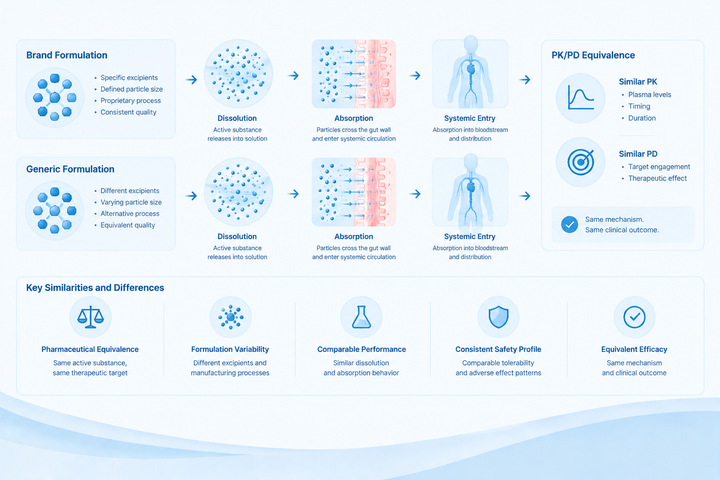
Brand versus generic sildenafil describes two formulation categories containing the same active pharmaceutical ingredient, distinguished by product composition, excipients, manufacturing characteristics, and regulatory formulation requirements. Mechanistically, formulation consistency or variability can influence disintegration and dissolution, which can affect the availability of sildenafil for absorption. These input differences are then interpreted through systemic pharmacokinetics rather than assuming a different molecular mechanism.

The comparison therefore follows a sequence from formulation characteristics through dissolution and gastrointestinal absorption to systemic exposure. Once sildenafil reaches circulation, distribution, metabolism, and elimination become the dominant PK layers. The resulting concentration-time profile can be evaluated as a PK curve, while formulation-related differences remain conceptually separate from intrinsic sildenafil pharmacology and its downstream PDE5-mediated pharmacodynamic effects.

Mechanistic PD interpretation connects systemic sildenafil exposure with PDE5 inhibition, cyclic GMP signaling, and pharmacodynamics. Brand and generic products can also be compared with tablets, soft tabs, chewable, ODT, oral suspension, and liquid presentations by examining how dosage-form characteristics may influence PK input. This framework addresses onset and duration as exposure-time relationships, not as prescribing guidance.

What Brand vs Generic Represents
Brand comparison

Brand versus generic sildenafil represents a formulation-level comparison involving products that contain sildenafil as the active pharmaceutical ingredient. A proprietary brand and a generic product may differ in excipients, manufacturing processes, physical characteristics, and dosage-form design while retaining the same active molecular entity. Mechanistically, these distinctions are relevant because formulation properties can influence the transition from solid or dispersed dosage form to dissolved drug. The concepts of brand names and generics therefore describe product categories rather than inherently different PDE5 pharmacology.

Formulation consistency concerns whether pharmaceutical characteristics remain controlled within the specifications established for a particular product, whereas formulation variability describes potential differences between products or batches. These characteristics can influence disintegration, wetting, dissolution, and subsequent absorption. Comparisons among tablets, soft tabs, chewable presentations, and ODT forms should therefore focus on the physical pathway by which sildenafil becomes systemically available rather than treating dosage-form terminology as evidence of a different drug mechanism.

After systemic entry, formulation identity becomes less central to the intrinsic mechanisms governing distribution, CYP3A4 metabolism, and elimination. The pharmacodynamic pathway remains sildenafil-specific, involving the mechanism of PDE5 inhibition and downstream signaling. Alternative presentations including oral suspension and liquid form can be compared using the same formulation-to-PK framework, while avoiding assumptions that brand or generic status independently changes molecular target activity.

Brand vs Generic → PK Layers

Absorption is the PK layer most directly connected to formulation characteristics. Brand and generic products can differ in excipient systems, particle properties, dosage-form architecture, and manufacturing attributes, all of which may influence disintegration and dissolution before gastrointestinal uptake. The resulting input into pharmacokinetics can therefore differ in rate or extent under particular formulation conditions. The central mechanistic link is formulation consistency or variability leading to dissolution behavior and then to absorption.

Once sildenafil is systemically available, distribution reflects movement between plasma and tissues and is governed principally by physicochemical properties, protein binding, and physiological factors rather than by the generic or brand label. The subsequent metabolic layer involves substantial hepatic biotransformation, including CYP3A4 metabolism. Formulation-dependent changes in systemic input can modify the concentration profile presented to these processes, but they do not inherently create different sildenafil metabolic pathways.

Elimination contributes to the declining portion of systemic concentration. Half-life describes the time course of concentration decline, while elimination encompasses the underlying removal processes. Thus, brand versus generic differences are primarily interpreted through the input and bioavailability components of the PK system, followed by distribution and clearance. The integrated result appears in the PK curve, where early formulation effects can be distinguished from later disposition characteristics.

PK Layer Brand vs Generic Influence Effect on Exposure
Absorption Formulation characteristics can affect disintegration, dissolution, and drug availability for uptake. May influence the rate or extent of systemic entry.
Distribution Primarily determined by sildenafil properties and physiological factors rather than product category. Shapes tissue distribution after systemic availability.
Metabolism Brand or generic status does not inherently create a different sildenafil metabolic pathway. Metabolic clearance contributes to systemic concentration decline.
Elimination Intrinsic disposition predominates after systemic input. Determines the declining and terminal portions of exposure.

Brand vs Generic → Exposure-Time Profile

The exposure-time profile describes systemic sildenafil concentration as it changes after administration and integrates formulation input with distribution and clearance. Brand versus generic formulation characteristics can influence the initial input phase through disintegration, dissolution, and gastrointestinal absorption. The resulting profile can be interpreted using time to peak and the broader pharmacokinetics framework. These measures describe exposure behavior rather than directly establishing a pharmacodynamic response.

During the ascending portion of the concentration-time profile, systemic input is relatively prominent compared with concurrent removal. Formulation characteristics may affect this trajectory by changing the availability of dissolved sildenafil. This provides a mechanistic basis for comparing tablets, soft tabs, chewable products, and ODT presentations. Oral suspension and liquid form comparisons similarly center on dosage-form input rather than assuming a distinct pharmacological mechanism.

Following the peak region, distribution and elimination increasingly shape systemic concentration. Half-life provides a quantitative description of concentration decline, while elimination represents the processes responsible for drug removal. Differences between brand and generic products in early exposure do not automatically imply differences in terminal disposition. The overall PK curve therefore needs to be interpreted as the combined product of formulation-dependent input and intrinsic systemic handling.

Brand vs Generic → PK Curve Interpretation

A sildenafil PK curve provides a concentration-time representation that can separate formulation-dependent input from later systemic disposition. The ascending limb reflects the balance between absorption and concurrent loss, while the peak region reflects the point at which systemic concentration reaches its observed maximum. Brand versus generic formulation characteristics can influence this early trajectory through dissolution and absorption, whereas distribution, CYP3A4 metabolism, and elimination shape the subsequent profile.

PK curve interpretation distinguishes rate-related behavior from total exposure. A formulation difference may theoretically alter how rapidly sildenafil enters systemic circulation without producing a proportional change in overall exposure, or may affect both rate and extent depending on the underlying pharmaceutical characteristics. Concepts such as time to peak, half-life, and pharmacokinetics therefore provide complementary perspectives. The comparison remains formulation-focused rather than treating brand or generic status as a direct determinant of molecular pharmacology.

The terminal portion of the curve is increasingly governed by systemic disposition once absorption has substantially declined. This makes it important to distinguish formulation-related changes in the early concentration profile from intrinsic clearance characteristics. The same analytical framework can be applied across tablets, soft tabs, chewable, and ODT forms. Alternative oral suspension and liquid form presentations can likewise be interpreted according to which phase of the PK curve their formulation characteristics plausibly influence.

PK Phase Brand vs Generic Influence Exposure Effect
Early absorption Differences in formulation architecture or dissolution can alter systemic input. May change the initial rate of concentration increase.
Peak region Differences in input kinetics can influence peak timing or magnitude. May shift observed peak concentration or time to peak.
Post-peak phase Formulation influence becomes less directly related to dissolution. Distribution and clearance increasingly shape concentration decline.
Terminal phase Intrinsic systemic disposition predominates after absorption wanes. Reflects elimination-related concentration decline.

Brand vs Generic → PD Interpretation

Pharmacodynamic interpretation begins by relating systemic sildenafil concentration to its molecular target. Sildenafil inhibits phosphodiesterase type 5, reducing enzymatic degradation of cyclic GMP in relevant signaling environments. The PDE5 pathway therefore provides the target-level framework, while pharmacodynamics addresses relationships among exposure, target engagement, and biological response. Brand versus generic status does not itself establish a separate pharmacodynamic mechanism because the active molecular entity remains sildenafil.

Downstream signaling involves the NO/cGMP pathway, in which nitric oxide stimulates cyclic GMP formation and PDE5 regulates its degradation. Sildenafil-mediated PDE5 inhibition can preserve cGMP signaling, contributing to smooth-muscle signaling and vascular relaxation under relevant physiological conditions. Formulation differences can matter indirectly by changing systemic concentration over time, but the mechanistic chain remains formulation, dissolution, absorption, exposure, target interaction, and downstream response.

A neutral brand versus generic comparison should therefore distinguish pharmaceutical equivalence concepts from PK and PD interpretation. Differences in formulation characteristics can potentially influence exposure without implying a different mechanism or altered PDE5 target. The same distinction applies when comparing generics with brand names or when examining alternative oral presentations. Pharmacodynamic interpretation is consequently exposure-linked, whereas product category is primarily a formulation descriptor.

Brand vs Generic → PK/PD Integration & Timing

Integrated PK/PD interpretation connects formulation characteristics to systemic sildenafil exposure and then to target engagement. The sequence begins with dosage-form disintegration and dissolution, followed by gastrointestinal absorption. Systemic concentrations are then influenced by distribution, CYP3A4 metabolism, and elimination. The resulting exposure provides the concentration context for PDE5 inhibition and downstream pharmacodynamic signaling. Brand versus generic differences are therefore interpreted primarily through this sequential pathway.

Timing analysis separates formulation-dependent input from systemic persistence. Sildenafil onset, time to peak, and the onset curve describe temporal relationships between absorption, concentration, and biological signaling. Formulation characteristics may influence the early portion of this sequence, whereas distribution and elimination contribute substantially to later exposure. This distinction is important when comparing dosage forms because an earlier change in dissolution does not automatically imply a different terminal disposition or molecular PD mechanism.

Mechanistic comparison can encompass tablets, soft tabs, chewable products, ODT, oral suspension, and liquid form. It can also distinguish dose amount from formulation architecture when examining 25 mg, 50 mg, and 100 mg product concepts. The analytical objective is to identify how formulation variables map onto PK input, exposure, target engagement, and timing without converting those relationships into clinical recommendations.

Formulation Factor Influence on PK/PD
Dosage-form architecture Can affect disintegration and the physical transition toward dissolved sildenafil.
Dissolution characteristics Can influence the rate and extent of drug availability for gastrointestinal absorption.
Systemic exposure Provides the concentration-time context for PDE5 target engagement and pharmacodynamic signaling.
Temporal exposure profile Links formulation-dependent input with mechanistic interpretation of onset and persistence.

Frequently Asked Questions

Brand versus generic sildenafil represents a formulation-level comparison involving products that contain sildenafil as the active pharmaceutical ingredient. The products may differ in excipients, manufacturing characteristics, physical architecture, and other formulation attributes while retaining sildenafil as the pharmacologically active molecule. Mechanistically, the important distinction is between pharmaceutical presentation and molecular pharmacology. Product category can therefore be relevant to dissolution and absorption behavior without implying a separate PDE5 target, different fundamental mechanism, or independently defined pharmacodynamic pathway.

Brand and generic formulations can influence dissolution and absorption through characteristics such as dosage-form architecture, excipient composition, particle properties, disintegration, wetting, and manufacturing attributes. These factors determine how efficiently and rapidly sildenafil becomes dissolved and available for gastrointestinal uptake. Mechanistically, formulation variability therefore acts primarily at the transition from dosage form to systemic input. Any resulting difference in absorption can affect the early concentration-time profile, while later distribution, metabolism, and elimination remain separate PK processes.

Brand versus generic status can influence pharmacokinetic interpretation primarily through formulation-dependent effects on the absorption input. Differences in dissolution or bioavailability characteristics may influence the rate or extent of systemic sildenafil entry. Once systemic exposure is established, distribution, metabolism, and elimination are governed largely by sildenafil's intrinsic properties and physiological conditions rather than the product label. Consequently, brand and generic formulations may be compared through concentration-time behavior while distinguishing formulation effects from systemic disposition mechanisms.

Systemic exposure reflects both the amount of sildenafil entering circulation and its concentration over time. Formulation characteristics can influence exposure by modifying the rate or extent of absorption, potentially affecting early concentration, peak timing, peak magnitude, or overall exposure depending on the specific pharmaceutical characteristics. However, brand or generic status alone does not determine exposure independently. Mechanistic interpretation therefore considers dissolution, absorption, bioavailability, distribution, metabolism, and elimination together rather than assigning a unique exposure profile solely from product category.

Brand versus generic formulation differences can influence pharmacodynamics indirectly when they modify the systemic concentration-time profile of sildenafil. Pharmacodynamics concerns the relationship between drug exposure and biological effects, including PDE5 inhibition and downstream cyclic GMP signaling. The underlying molecular mechanism remains associated with sildenafil itself rather than with whether a product is branded or generic. A formulation that changes absorption kinetics can alter the temporal context of target engagement, but that does not establish a distinct pharmacodynamic mechanism or imply that product category independently determines biological response.

Onset and duration can be interpreted mechanistically as temporal relationships among formulation input, systemic sildenafil concentration, target engagement, and downstream response. Brand or generic formulation characteristics may influence early dissolution and absorption, potentially affecting the timing of rising systemic exposure. Duration-related interpretation depends more heavily on persistence and decline of systemic concentrations, including distribution and elimination. Thus, formulation differences can participate in onset or duration analysis through PK behavior, but brand or generic status alone does not define a unique onset or duration mechanism.