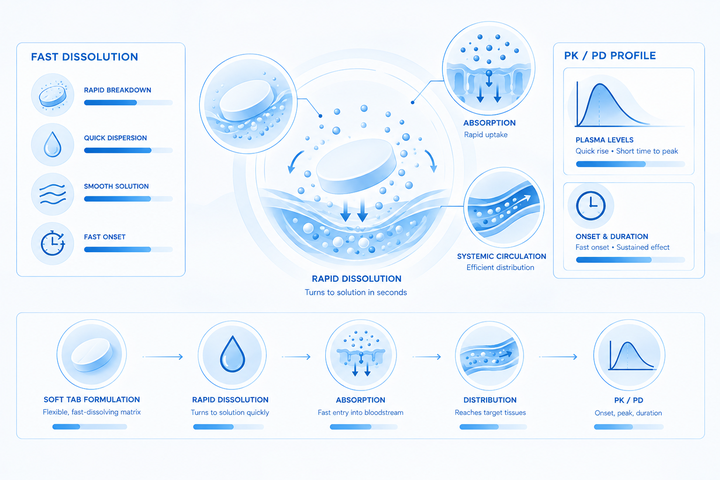
Sildenafil soft tabs represent oral formulations in which the physical dosage form is engineered to facilitate disintegration or dissolution compared with conventional solid formulations. Mechanistically, formulation behavior precedes gastrointestinal uptake, connecting the soft-tab structure with absorption and subsequent pharmacokinetics. The formulation itself is not the pharmacodynamic mechanism and does not establish a clinical recommendation or predetermined response.
Following dissolution, sildenafil becomes available for gastrointestinal absorption and enters the systemic PK sequence. Subsequent distribution, metabolism, and elimination shape the concentration-time profile independently of the formulation's physical properties. The resulting exposure can be interpreted through the PK curve and time to peak, distinguishing early formulation-related input from later systemic disposition processes.
Systemic sildenafil exposure provides the concentration signal underlying pharmacodynamic interpretation. Sildenafil inhibits PDE5 and modifies cyclic GMP handling within the NO/cGMP signaling network, linking exposure with downstream biological activity. The mechanism and PDE5 pathway therefore sit downstream of formulation, while onset and duration represent evolving PK/PD relationships rather than fixed properties of a soft tab.
Sildenafil soft tabs are oral dosage forms whose formulation architecture is intended to modify physical handling of the active ingredient before systemic absorption. Depending on the specific product, a soft formulation may facilitate rapid wetting, disintegration, dispersion, or dissolution. These processes precede absorption and therefore influence the initial input phase of pharmacokinetics. Mechanistically, the formulation should be distinguished from sildenafil's molecular target and downstream pharmacology.
The key distinction between a soft tab and a conventional tablet is primarily formulation behavior rather than a different active pharmacological mechanism. A soft formulation can alter the physical pathway through which sildenafil becomes dissolved and available for gastrointestinal uptake. Comparisons with chewable formulations and ODT products similarly concern dosage-form characteristics. Brand vs generic interpretation requires separating product formulation attributes from the common active-drug pharmacology.
After systemic absorption, soft-tab sildenafil enters the same broader disposition sequence involving distribution, CYP3A4 metabolism, and elimination. These biological processes are not simply determined by whether the drug originated from a soft tab or another oral formulation. Consequently, soft-tab interpretation is best framed as a formulation-to-exposure question, followed by a separate PK-to-PD analysis involving sildenafil target engagement and downstream signaling.
| Concept | Mechanistic Meaning | PK/PD Relevance |
|---|---|---|
| Soft tab | Oral formulation with formulation characteristics intended to facilitate rapid disintegration or dissolution | Defines the physical state preceding gastrointestinal absorption |
| Dissolution | Transfer of sildenafil from the dosage form into gastrointestinal solution | Creates dissolved drug available for absorption |
| Systemic exposure | Circulating sildenafil concentration after absorption | Provides the PK signal underlying subsequent PD interpretation |
The soft-tab relationship with PK begins at the formulation interface, where disintegration, wetting, dispersion, and dissolution can establish how quickly sildenafil becomes available for gastrointestinal uptake. This connects directly with absorption, while subsequent distribution determines movement between plasma and tissues. These layers collectively shape the early concentration trajectory without implying that formulation alone determines systemic exposure.
Once absorbed, sildenafil undergoes hepatic biotransformation, with CYP3A4 metabolism representing a major metabolic pathway. Systemic clearance and elimination then contribute to concentration decline. The half-life provides a descriptor of terminal disposition behavior, whereas the formulation primarily concerns events occurring before or around systemic input. Thus, soft-tab properties should not be conflated with metabolic or elimination mechanisms.
The integrated pharmacokinetics sequence connects dosage-form behavior with absorption, distribution, metabolism, and elimination. A soft tab may influence the early input characteristics of sildenafil, but later exposure depends on the combined physiological disposition processes. The resulting profile can be visualized using the PK curve, which integrates formulation-related input with systemic distribution and clearance rather than representing formulation behavior alone.
| PK Layer | Soft Tab Influence | Effect on Exposure |
|---|---|---|
| Absorption | Rapid disintegration or dissolution can affect availability of dissolved sildenafil | May influence the early systemic input profile |
| Distribution | Primarily follows systemic entry and is not directly defined by soft-tab structure | Contributes to plasma and tissue concentration dynamics |
| Metabolism | Occurs after absorption and is governed by biological disposition | Contributes to sildenafil clearance and exposure |
| Elimination | Occurs during systemic disposition rather than tablet dissolution | Drives subsequent concentration decline |
A soft-tab exposure profile develops from the sequence connecting formulation behavior with gastrointestinal absorption and systemic disposition. Faster dissolution can conceptually alter the availability of dissolved sildenafil for uptake, but the observed concentration-time trajectory remains the integrated result of absorption, distribution, metabolism, and elimination. The PK curve therefore represents the combined system, while time to peak describes one specific feature of that profile.
The rising portion of the concentration-time curve reflects net systemic input relative to concurrent disposition. Soft-tab characteristics may influence this early phase by changing the physical availability of sildenafil for absorption. However, absorption cannot be isolated completely from distribution or elimination. As systemic input diminishes, metabolic and elimination processes increasingly shape the declining exposure profile.
Comparative formulation interpretation can distinguish soft tabs from conventional tablets, chewable formulations, and ODT products. Brand vs generic analysis additionally separates product-specific formulation characteristics from the shared sildenafil active ingredient. Such comparisons should be expressed in terms of dissolution, absorption, exposure, and measured PK behavior rather than assuming that every formulation difference produces an equivalent systemic effect.
| Profile Feature | Relevant Process | Interpretive Meaning |
|---|---|---|
| Early rise | Dissolution and absorption contribute to systemic input | Increasing sildenafil concentration in the systemic compartment |
| Peak region | Input and disposition approach relative balance | Observed maximum concentration region |
| Post-peak decline | Distribution, metabolism, and elimination increasingly dominate | Progressive reduction in circulating sildenafil exposure |
The soft-tab PK curve depicts systemic sildenafil concentration as a function of time after the formulation has undergone its physical dissolution processes and absorption has begun. Its shape integrates absorption, distribution, CYP3A4 metabolism, and elimination. Soft-tab characteristics are most conceptually relevant to the input phase, while later curve behavior increasingly reflects systemic disposition.
Peak concentration and time to peak describe different properties of the exposure profile. Peak concentration addresses the magnitude of observed plasma exposure, whereas time to peak identifies when the maximum occurs. The PK curve also contains the post-peak decline, which reflects distribution and elimination processes. These PK descriptors should remain distinct from pharmacodynamic effect, because concentration and biological response are related but not identical variables.
The terminal component of the curve can be considered alongside half-life, while the complete profile is interpreted through pharmacokinetics. Soft-tab formulation may modify the early input pattern without necessarily changing the fundamental systemic disposition mechanisms. Therefore, a formulation comparison should distinguish differences in dissolution or absorption from differences attributable to hepatic metabolism, distribution, clearance, or other biological PK determinants.
| PK Phase | Soft Tab Influence | Exposure Effect |
|---|---|---|
| Pre-absorption | Formulation characteristics govern disintegration and dissolution | Establishes availability of dissolved sildenafil for uptake |
| Ascending phase | Early systemic input can reflect dissolution and absorption behavior | Shapes the developing concentration profile |
| Peak region | Influence is mediated through preceding absorption | Determines observed peak concentration and its timing |
| Terminal decline | Limited direct influence after systemic entry | Primarily reflects systemic disposition and elimination |
The pharmacodynamic effects associated with sildenafil arise downstream of systemic exposure. Once sildenafil reaches relevant biological compartments, it inhibits phosphodiesterase type 5, influencing cyclic GMP degradation. The mechanism is therefore connected to the PDE5 pathway and the NO/cGMP pathway. Soft-tab formulation is upstream of this target interaction and does not create a distinct pharmacodynamic mechanism.
PK-to-PD interpretation considers how changing sildenafil concentrations relate to target engagement and downstream biological signaling. Plasma concentration provides an exposure measure, whereas pharmacodynamics describes the relationship between drug exposure and biological response. Downstream vascular relaxation is part of the physiological context associated with the relevant signaling cascade. Consequently, formulation effects should be interpreted through their influence on exposure rather than assumed to directly alter target pharmacology.
As soft-tab-derived concentrations rise and fall, pharmacodynamic activity can evolve in parallel with systemic exposure, although the two trajectories need not be perfectly synchronized. The sildenafil onset concept can therefore be connected to the onset curve, while time to peak remains a distinct PK descriptor. This framework separates formulation-dependent dissolution from the downstream molecular and physiological processes responsible for sildenafil pharmacodynamics.
| PD Layer | Relationship to Soft Tabs | Interpretive Meaning |
|---|---|---|
| Systemic exposure | Soft-tab formulation can influence the upstream input process | Provides circulating sildenafil available for target interaction |
| PDE5 inhibition | Occurs downstream of absorption and systemic distribution | Represents the principal molecular pharmacology |
| NO/cGMP signaling | Follows PDE5 inhibition within the signaling network | Connects molecular target activity with downstream physiology |
Integrated interpretation begins with soft-tab formulation behavior and follows sildenafil through dissolution, absorption, systemic distribution, metabolism, and elimination. The formulation may influence the initial availability of dissolved drug, while absorption, distribution, CYP3A4 metabolism, and elimination shape systemic exposure. The resulting PK signal provides the foundation for pharmacodynamics.
Onset should be understood as an evolving PK/PD transition rather than a fixed property of a soft tab. The sildenafil onset concept relates to developing systemic and target-site exposure, while time to peak identifies a PK landmark that does not inherently define onset. The onset curve can therefore be used conceptually to connect changing exposure with changing pharmacodynamic activity.
Duration likewise reflects persistence of relevant exposure and biological activity rather than a single formulation attribute. The half-life and PK curve help describe systemic decline, but neither is synonymous with pharmacodynamic duration. Comparisons with tablets, chewable products, ODT formulations, and brand vs generic products should therefore distinguish early formulation behavior from downstream PK and PD mechanisms.
| Soft Tab Factor | Influence on PK/PD |
|---|---|
| Rapid disintegration or dissolution | Can influence how quickly sildenafil becomes available for gastrointestinal absorption |
| Absorption characteristics | Can shape the early systemic concentration trajectory and timing |
| Formulation comparison | Provides a basis for distinguishing early input behavior from shared sildenafil pharmacology |
| Systemic disposition | Controls later exposure persistence through distribution, metabolism, and elimination |
Sildenafil soft tabs are oral dosage forms designed with formulation characteristics that can facilitate disintegration, dispersion, or dissolution of sildenafil. Their principal mechanistic distinction from conventional solid tablets concerns the physical pathway through which the active ingredient becomes available for gastrointestinal absorption. Once sildenafil enters systemic circulation, its pharmacokinetic and pharmacodynamic mechanisms remain governed by absorption, distribution, metabolism, elimination, PDE5 inhibition, and downstream signaling. Thus, a soft tab represents a formulation state upstream of systemic drug exposure rather than a separate pharmacological mechanism.
Soft-tab formulations can be designed to promote rapid interaction between the dosage form and gastrointestinal fluid, potentially facilitating disintegration, dispersion, or dissolution. Dissolution converts sildenafil from the formulated state into dissolved drug that can become available for gastrointestinal absorption. The absorption process then determines systemic input, while physiological factors and disposition mechanisms continue to shape the resulting concentration-time profile. Therefore, soft-tab characteristics are mechanistically relevant to the early formulation-to-absorption pathway, but they do not independently determine total systemic exposure or pharmacodynamic response.
Soft tabs influence pharmacokinetics primarily through the formulation and absorption stages that precede systemic disposition. Their physical characteristics can affect how sildenafil becomes dissolved and available for gastrointestinal uptake, potentially influencing the early portion of the concentration-time profile. After absorption, sildenafil undergoes distribution, hepatic metabolism, and elimination according to biological disposition processes. Consequently, soft-tab formulation is most directly connected with systemic input, while later PK behavior reflects the combined effects of distribution, metabolic clearance, elimination, and other physiological determinants.
Exposure after a sildenafil soft tab represents an integrated outcome of formulation behavior, absorption, distribution, metabolism, and elimination. The formulation can influence the availability and timing of dissolved sildenafil during the initial absorption process, which may affect the early concentration trajectory. Peak concentration, time to peak, and the subsequent decline are then determined by the interaction of systemic input with disposition. Thus, exposure should be interpreted as a concentration-time phenomenon resulting from the complete PK sequence rather than as a direct measurement of soft-tab dissolution alone.
The pharmacodynamic relationship begins after sildenafil becomes systemically available from the formulation. Sildenafil inhibits phosphodiesterase type 5, reducing enzymatic degradation of cyclic GMP and influencing signaling within the NO/cGMP pathway. The soft tab does not directly produce this molecular activity; instead, its formulation characteristics participate in the upstream process that establishes systemic exposure. Pharmacodynamic interpretation therefore connects changing sildenafil concentrations with target engagement and downstream biological signaling. Concentration and effect can be related without assuming that every formulation difference creates a distinct pharmacodynamic mechanism.
Onset and duration are integrated PK/PD concepts rather than fixed properties of a soft-tab formulation. Dissolution and absorption influence the early development of systemic exposure, which can contribute to the temporal emergence of pharmacodynamic activity. Duration subsequently reflects the persistence and decline of relevant exposure together with target and downstream biological processes. Time to peak is a separate PK descriptor and should not automatically be equated with onset. Similarly, terminal half-life describes a disposition parameter rather than a direct measure of pharmacodynamic duration.