Mechanistic PK/PD • Clinically Neutral

Sildenafil Form Stability

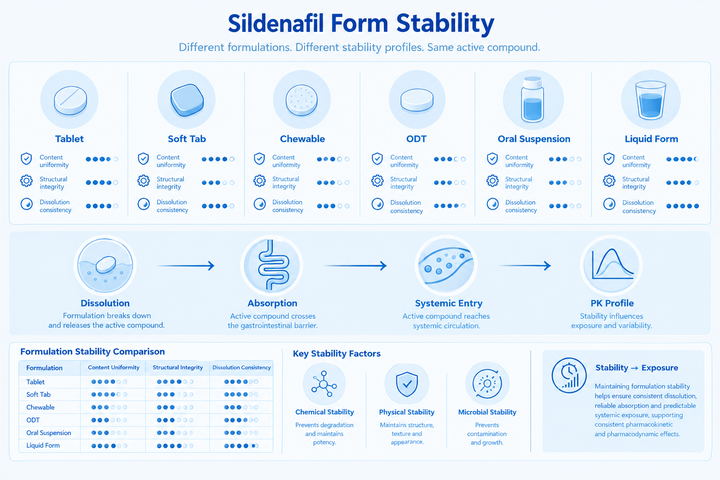
Sildenafil formulation stability describes the capacity of a pharmaceutical form to maintain relevant physical and chemical characteristics over time and under defined environmental conditions. Mechanistically, stability can influence whether formulation properties remain consistent enough to support predictable dissolution and subsequent absorption. The framework applies across tablets, soft tabs, chewable forms, ODTs, suspensions and liquid formulations without implying therapeutic preference.

Stability connects an upstream formulation property with downstream pharmacokinetic behavior. If relevant characteristics change, dissolution and absorption can potentially change, influencing systemic exposure and the resulting pharmacokinetics profile. Distribution, metabolism, half-life and elimination then shape later exposure. Accordingly, stability can be considered alongside concentration-time behavior, PK curve characteristics and temporal exposure interpretation.

Pharmacodynamic interpretation remains downstream of systemic exposure. Sildenafil's mechanism involves PDE5 inhibition and modulation of NO/cGMP signaling, while formulation stability does not create a separate pharmacological mechanism. Stability-related changes in dissolution or absorption could alter exposure timing, potentially affecting interpretation of onset and duration, but the PD relationship must remain distinct from formulation quality and PK observations.

What Form Stability Represents
Form stability

Formulation stability represents maintenance of the physical, chemical and performance characteristics of a sildenafil dosage form under defined storage and environmental conditions. Relevant attributes can include chemical integrity, physical structure, moisture sensitivity, particle or dispersion characteristics and the ability to undergo appropriate dissolution. These concepts apply differently across tablets, soft tabs, chewable, ODT, oral suspension and liquid form, because dosage-form architecture influences how stability is expressed.

Stability is an upstream pharmaceutical property rather than a direct pharmacodynamic variable. If a formulation undergoes meaningful physical or chemical change, its dissolution characteristics may potentially change, which can alter the amount and rate of sildenafil available for absorption. Subsequent distribution, CYP3A4 metabolism, half-life and elimination are systemic processes that cannot be attributed solely to formulation stability.

The stability-to-PK pathway therefore requires several analytical steps. A formulation change must first affect a measurable pharmaceutical attribute, then dissolution or availability, and subsequently absorption before a systemic PK consequence can occur. Generics, brand names and brand vs generic comparisons can use the same framework. Stability itself does not establish a change in sildenafil's molecular mechanism or intrinsic pharmacological activity.

Stability Differences → PK Layers

Different sildenafil dosage forms can have different stability considerations because their physical and chemical structures are not identical. Tablets may depend on solid-state integrity and excipient behavior, while soft tabs, chewable and ODT forms have distinct matrix and disintegration characteristics. Oral suspension and liquid form introduce dispersion or solution stability considerations. These properties can influence dissolution if they change materially.

The primary PK consequence of altered formulation stability, when present, would generally be expected at the dissolution and absorption interface. Changes in drug integrity, particle characteristics, dispersion or excipient performance can potentially affect the amount or rate of drug becoming available for absorption. Once sildenafil enters systemic circulation, distribution, CYP3A4 metabolism, half-life and elimination contribute to subsequent concentration-time behavior independently of the formulation's physical stability.

For generics and brand names, stability assessment is distinct from branding and must be considered within pharmaceutical quality and systemic PK concepts. A brand vs generic comparison therefore should not infer instability from formulation differences alone. The downstream PK curve is determined by the combined effects of absorption and disposition, meaning a stability difference has to propagate through these layers before a measurable systemic exposure difference would be expected.

Form Stability Influence Exposure Effect
Tablets and soft tabs Solid-state integrity, excipient behavior and physical structure can influence dissolution if stability changes Potential alteration of early systemic exposure if dissolution or drug integrity is affected
Chewable and ODT Matrix, moisture and disintegration characteristics may affect formulation performance Potential change in the absorption-related portion of the exposure profile
Oral suspension and liquid form Chemical integrity, dispersion, sedimentation or solution characteristics can be relevant stability attributes Exposure may be affected if stability changes drug availability for absorption
Generics and brand names Stability depends on the specific formulation and its validated pharmaceutical characteristics Systemic exposure is interpreted from measured PK rather than product naming alone

Stability Differences → Exposure-Time Profile

The sildenafil exposure-time profile represents the net result of drug availability, absorption and systemic disposition. Formulation stability becomes relevant when instability changes a property that controls dissolution, chemical integrity or physical availability. Such a change could theoretically modify the early concentration-time trajectory. Across tablets, soft tabs, chewable and ODT forms, the specific stability mechanism depends on dosage-form composition and the attribute being evaluated.

Exposure rate and exposure extent remain separate pharmacokinetic concepts. A stability-related alteration in dissolution could affect absorption rate and the ascending portion of the concentration-time profile, while total exposure depends on systemic availability and disposition. Pharmacokinetics therefore distinguishes changes in the rate of exposure development from changes in overall exposure. Time to peak can provide a temporal marker, but it does not independently establish the extent of systemic exposure.

Later portions of the exposure profile depend increasingly on systemic disposition. Distribution, CYP3A4 metabolism, half-life and elimination shape the descending phase after absorption. Consequently, formulation stability is most directly connected to the upstream dissolution and absorption stages. A stability-associated change does not automatically imply a corresponding change in duration, because duration reflects the integrated PK and PD profile rather than formulation stability alone.

Stability Differences → PK Curve Interpretation

The sildenafil PK curve provides a concentration-time representation through which potential stability effects can be examined. If formulation stability changes dissolution or drug availability, the earliest visible consequence may occur in the rising phase, where absorption contributes strongly to the concentration trajectory. For tablets, soft tabs, chewable and ODT forms, interpretation therefore begins with the specific pharmaceutical attribute affected by stability.

Peak concentration and time to peak reflect the interaction of absorption with ongoing distribution and elimination. A stability change that affects dissolution may shift the absorption-related portion of the curve, but the magnitude and persistence of any resulting PK change depend on the entire disposition system. Oral suspension and liquid form require the same principle: formulation stability is upstream, while the measured PK curve is an integrated systemic observation.

The descending curve is increasingly shaped by processes occurring after systemic absorption. Distribution, CYP3A4 metabolism, half-life and elimination influence this later phase. Generics, brand names and brand vs generic formulations should therefore be compared using measured stability and PK evidence rather than assuming that differences in formulation architecture necessarily produce different systemic profiles.

PK Phase Form Stability Influence Absorption Relationship
Dissolution Chemical integrity and physical formulation characteristics can affect drug availability if stability changes Determines the amount and rate of dissolved drug available for subsequent absorption
Absorption and rising phase Stability-related changes may alter the formulation-to-gastrointestinal availability transition Most direct potential connection between stability and the early PK curve
Peak exposure Any upstream stability effect is integrated with absorption and systemic disposition Peak concentration and time to peak reflect combined processes rather than stability alone
Post-peak disposition Stability generally has less direct influence after systemic entry Distribution, metabolism and elimination increasingly determine concentration decline

Stability Differences → PD Interpretation

Pharmacodynamic interpretation remains downstream of formulation stability and systemic exposure. Sildenafil's mechanism involves inhibition of PDE5, with downstream relationships involving the PDE5 pathway and NO/cGMP pathway. Formulation stability does not create a distinct pharmacological mechanism. Instead, if stability altered drug availability sufficiently to change systemic exposure, the resulting concentration-time pattern could become relevant to the temporal exposure-response relationship.

The relationship between concentration and effect is described through pharmacodynamics. Stability-related formulation changes can only influence PD indirectly through an upstream chain involving drug integrity, dissolution, absorption and systemic concentration. Vascular relaxation is a downstream physiological response associated with sildenafil pharmacology, but its timing cannot be inferred from a formulation's stability profile alone. Target engagement, distribution and biological responsiveness also contribute to observed pharmacodynamic behavior.

This distinction prevents formulation stability from being treated as a direct determinant of intrinsic pharmacological potency. A formulation that maintains its validated characteristics supports the intended pharmaceutical performance framework, while observed PD remains an exposure-response phenomenon. The same reasoning applies to generics, brand names, oral suspension and liquid form. Stability, PK and PD should therefore be interpreted as sequential but distinct analytical layers.

Stability Differences → PK/PD Integration & Timing

Integrated stability interpretation follows the sequence from formulation integrity to dissolution, absorption, systemic exposure and pharmacodynamic response. Tablets, soft tabs, chewable, ODT, oral suspension and liquid form can have different stability attributes, but any PK consequence requires a plausible propagation pathway from the affected formulation property to drug availability and absorption.

The timing framework separates formulation stability from downstream disposition. An upstream change can potentially modify dissolution and the absorption-related rising phase, while distribution, CYP3A4 metabolism, half-life and elimination shape later exposure. Sildenafil onset therefore cannot be inferred directly from stability alone. Similarly, time to peak is a PK descriptor rather than a direct measure of pharmacodynamic onset.

Duration interpretation requires consideration of the complete exposure-response system. A stability-associated change in absorption could alter early exposure timing, but later persistence remains influenced by systemic disposition and pharmacodynamic processes. Pharmacodynamics provides the response framework, while the onset curve can illustrate temporal exposure-response relationships. Formulation comparisons should remain mechanistic, including distinctions among generics, brand names and brand vs generic products.

Stability Factor Influence on PK/PD Timing
Chemical integrity If chemical degradation alters active drug availability, downstream dissolution, absorption and systemic exposure may be affected
Physical dosage-form integrity Changes in matrix, structure, dispersion or disintegration can potentially modify dissolution and early absorption timing
Moisture or environmental sensitivity Environmental effects can alter formulation characteristics, with downstream consequences possible only if drug availability or dissolution changes
Dispersion or solution stability Changes in suspension or liquid characteristics can influence formulation performance before absorption and therefore potentially affect early exposure timing

Frequently Asked Questions

Sildenafil formulation stability refers to the ability of a pharmaceutical product to maintain relevant chemical, physical and performance characteristics under specified conditions over time. Mechanistically, stability can involve maintenance of drug integrity, dosage-form structure, dispersion characteristics and dissolution behavior. These properties matter because a meaningful stability change could alter drug availability for absorption. Stability is not itself a pharmacodynamic effect and does not establish therapeutic superiority. Any systemic consequence must be understood through the sequential relationship between formulation performance, absorption, pharmacokinetics and pharmacodynamics.

Stability characteristics can differ because pharmaceutical forms use different physical structures, excipients, matrices and presentation systems. Tablets, soft tabs, chewable forms and orally disintegrating forms may have different sensitivities to moisture, physical stress or matrix changes. Suspensions and liquids can involve additional dispersion or solution stability considerations. The specific stability profile depends on the formulation and validated product characteristics. A difference in dosage form does not inherently mean greater or lesser stability, because stability must be evaluated through appropriate pharmaceutical quality measurements.

Formulation stability can influence pharmacokinetics if a stability change affects a pharmaceutical attribute that controls drug availability, dissolution or absorption. The most direct potential effect would therefore occur in the early absorption phase of systemic exposure. Once sildenafil enters circulation, distribution, hepatic metabolism and elimination become increasingly important. A stability change does not automatically alter these downstream processes. Pharmacokinetic interpretation consequently requires evidence that an upstream formulation change propagated into measurable differences in concentration-time behavior rather than assuming a PK consequence from stability considerations alone.

Stability can potentially influence sildenafil exposure when chemical or physical changes alter the amount or rate of drug available for absorption. Such an effect would most directly involve the early concentration-time profile, potentially affecting the rising phase or peak timing. Total systemic exposure is a separate concept and depends on the overall amount absorbed and subsequent disposition. Distribution, metabolism and elimination also shape measured exposure. Therefore, stability should not be equated automatically with increased or decreased exposure without corresponding pharmacokinetic evidence.

Formulation stability influences pharmacodynamics only indirectly when it produces a meaningful change in systemic sildenafil exposure. The molecular pharmacodynamic mechanism remains PDE5 inhibition and its relationship with NO/cGMP signaling. If stability alters dissolution or absorption, the resulting concentration-time profile could change the timing of target exposure and therefore the temporal exposure-response relationship. However, stability does not independently change intrinsic PDE5 inhibitory activity. Pharmacodynamic interpretation must distinguish formulation performance, systemic pharmacokinetics, target engagement and downstream physiological response.

Stability is an upstream formulation property that can potentially affect onset if a stability change alters dissolution or absorption and consequently changes the early systemic exposure profile. It is not equivalent to onset itself. Duration is influenced more strongly by the integrated PK and PD profile, including distribution, metabolism, clearance, elimination and persistence of pharmacodynamic signaling. Therefore, a formulation stability difference does not automatically predict earlier onset, later onset, longer duration or shorter duration. Such interpretations require corresponding pharmaceutical, PK and PD evidence.

Mayo Clinic — Sildenafil Overview NHS — Sildenafil Information MedlinePlus — Sildenafil Drugs.com — Sildenafil Monograph PubMed — Sildenafil Studies