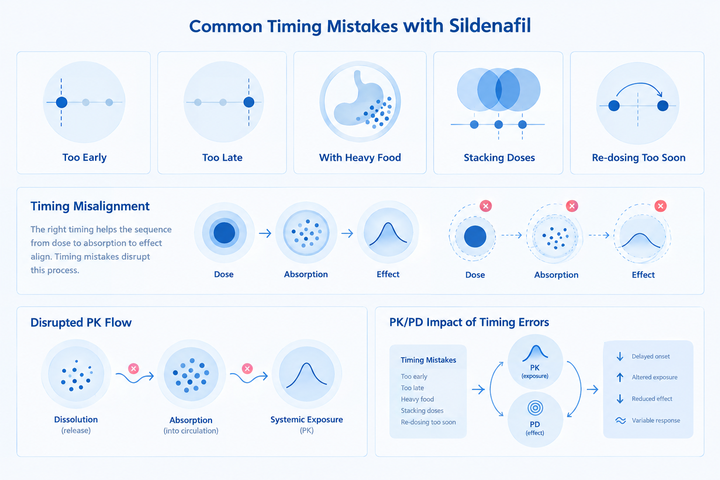
Sildenafil Timing Mistakes: PK/PD Misalignment and Temporal Physiology
Timing mistakes represent mechanistic PK/PD mismatches between sildenafil exposure, onset, peak concentration and the subsequent tissue response. The concept describes situations in which these temporal processes are interpreted as though they occur simultaneously, despite having distinct kinetics. The pharmacokinetics framework establishes exposure over time, while sildenafil onset and pharmacodynamic response describe downstream temporal relationships.
The sequence can be represented as PK, systemic exposure, pharmacodynamic target engagement, vascular and tissue physiology, followed by the observed response. Absorption determines initial systemic availability, while distribution, metabolism and elimination shape later concentrations. Sildenafil's molecular mechanism operates through PDE5 inhibition, connecting exposure with downstream signaling. A timing mismatch therefore reflects separation between these layers rather than a single pharmacological event occurring at one instant.
Concentration-time behavior provides the temporal framework for distinguishing onset from peak and response kinetics. The time to peak describes a concentration milestone, whereas the onset curve represents an effect-related temporal pattern. Gastric conditions, absorption kinetics, systemic disposition and tissue responsiveness can all influence how these timelines align. This page interprets those relationships mechanistically, without converting temporal patterns into clinical instructions.
The PK/PD basis of timing mismatch begins with oral sildenafil entering the gastrointestinal tract and becoming available for systemic absorption. The resulting exposure then undergoes distribution, hepatic metabolism and elimination. Each process has its own temporal characteristics, so the time of administration, initial concentration rise, peak exposure and declining concentration are separate pharmacokinetic landmarks. The pharmacokinetics framework therefore establishes a sequence rather than a single moment of drug action.
At the molecular level, sildenafil inhibits PDE5 after systemic exposure reaches relevant tissues. The PDE5 pathway and NO/cGMP pathway connect drug concentration with intracellular signaling, while vascular relaxation represents a downstream physiological process. Because signaling and tissue responses require their own kinetics, maximum plasma concentration does not necessarily represent an identical point of maximum physiological response. This distinction is central to interpreting temporal PK/PD relationships.
The concentration-time profile can consequently be viewed alongside PK curve characteristics, time to peak and pharmacodynamics. A mismatch can occur conceptually when an exposure milestone is treated as equivalent to an effect milestone, even though absorption, distribution and intracellular signaling operate sequentially. The resulting interpretation separates drug concentration from target engagement and separates target engagement from tissue physiology, preserving the mechanistic hierarchy between PK and PD.
PK Layers → Timing Mismatch Conditions
Timing mismatches can be mapped across the individual PK layers that shape sildenafil exposure. Early absorption determines the initial rise in systemic concentration, while distribution influences movement between plasma and tissues. Subsequent CYP3A4 metabolism and elimination contribute to the later concentration trajectory. These layers create a continuous exposure profile rather than a single discrete event, making temporal interpretation dependent on the relationship among multiple PK processes.
The half-life describes the decline of sildenafil concentration during the elimination phase, whereas time to peak describes a point within the exposure profile. Neither parameter alone represents the complete timing of pharmacodynamic activity. The PK curve integrates absorption and disposition, while the pharmacodynamics framework addresses what occurs after drug reaches its molecular target. This distinction prevents concentration milestones from being equated directly with tissue-response milestones.
Dose-related exposure pages such as 25 mg, 50 mg and 100 mg describe different administered drug inputs, whereas timing interpretation concerns the temporal relationship between exposure and effect. The administered amount, absorption trajectory and subsequent disposition all contribute to the concentration-time profile. Timing analysis therefore remains a PK/PD relationship rather than a simple association between a dose label and an immediate physiological response.
PK Layer
Physiological Influence
Timing Mismatch Relationship
Absorption
Determines the initial appearance of sildenafil in systemic circulation.
The onset of measurable exposure can precede or differ from downstream pharmacodynamic response timing.
Distribution
Controls movement of sildenafil between circulating plasma and tissues.
Tissue exposure can have temporal characteristics distinct from the plasma concentration milestone.
Metabolism
CYP3A4-mediated biotransformation contributes to systemic disposition.
Metabolic processing shapes the later exposure profile rather than defining the initial onset event.
Elimination
Determines the declining portion and persistence of systemic sildenafil concentration.
The duration of measurable exposure can extend beyond the initial onset and peak-response transitions.
Exposure-Time Profile → Onset vs Peak Misalignment
The exposure-time profile distinguishes several temporal landmarks that are frequently compressed into the general concept of onset. The rising concentration phase follows gastrointestinal input and absorption, while time to peak identifies the point of maximum measured plasma concentration. Sildenafil onset, by contrast, is an effect-related temporal concept. These landmarks can occur at different points because concentration and pharmacodynamic response follow related but non-identical kinetics.
The PK curve represents systemic concentration over time, whereas the onset curve represents an evolving response relationship. Distribution into relevant tissues, PDE5 target engagement and downstream intracellular signaling can introduce temporal separation between plasma concentration and observed physiology. Consequently, a peak concentration is a PK milestone rather than an automatic synonym for peak pharmacodynamic effect. This separation is fundamental to mechanistic temporal interpretation.
Food-related gastrointestinal conditions and food interactions can modify the input phase, while alcohol interactions can introduce additional physiological variables alongside sildenafil exposure. These factors can influence the temporal context in which exposure and response are observed. The resulting pattern can be interpreted through pharmacokinetics and pharmacodynamics without treating every temporal shift as evidence of altered molecular target activity.
PK Curve Interpretation → Timing Mistake Patterns
A sildenafil PK curve provides a visual representation of concentration changing across time. Its ascending phase reflects the balance between drug input and absorption, its peak represents the maximum measured concentration, and its declining phase reflects distribution and elimination processes. Interpreting these phases alongside absorption, distribution and elimination helps distinguish different temporal mechanisms rather than treating the entire curve as one undifferentiated exposure event.
The relationship between the PK curve and physiological response becomes more complex after sildenafil reaches tissues. PDE5 inhibition influences cyclic GMP signaling through the PDE5 pathway and NO/cGMP pathway, while vascular relaxation represents a downstream tissue process. These stages can introduce temporal separation between plasma concentration, molecular target engagement and observable physiology. A timing mismatch therefore reflects differences between sequential kinetic layers.
The sildenafil onset concept focuses on emergence of pharmacodynamic activity, whereas time to peak identifies a concentration milestone. The onset curve can consequently have a different shape from the PK curve. Mechanistic interpretation requires comparing these trajectories while accounting for half-life and ongoing disposition, rather than assuming that one curve directly reproduces the other.
PK Phase
Exposure Influence
Timing Outcome
Absorption phase
Systemic sildenafil concentration rises as drug becomes available from the gastrointestinal tract.
Initial exposure can precede measurable downstream pharmacodynamic response.
Peak concentration
The concentration-time profile reaches its measured maximum.
Peak plasma concentration represents a PK landmark that can differ temporally from peak tissue response.
Distribution phase
Sildenafil moves between circulating and tissue compartments.
Tissue exposure and target engagement can evolve after plasma concentration has begun changing.
Elimination phase
Systemic concentration progressively declines through disposition processes.
Pharmacodynamic activity can have temporal characteristics that do not mirror the concentration decline exactly.
Pharmacodynamic timing begins after sildenafil reaches its molecular target. Sildenafil inhibits PDE5, influencing the PDE5 pathway and reducing cyclic GMP degradation within relevant signaling environments. The NO/cGMP pathway connects this molecular action with smooth-muscle signaling, while vascular relaxation represents a downstream physiological process. Each stage introduces a potential temporal interval between circulating concentration and tissue-level response.
The relationship between concentration and effect is therefore not necessarily instantaneous. Pharmacodynamics incorporates target occupancy, intracellular signaling, tissue responsiveness and physiological feedback, while PK determines the concentration available to initiate these processes. A temporal mismatch can consequently reflect delayed downstream kinetics rather than delayed systemic absorption. The distinction is especially important when comparing the onset curve with the PK curve.
Downstream physiological domains can also be conceptually separated from the PK/PD timing mechanism. Pages addressing side effects, common side effects, rare side effects, vision risks and hearing risks describe outcome categories rather than exposure landmarks. Similarly, priapism represents a physiological outcome concept. These domains can be temporally related to drug exposure while remaining distinct from PK parameters.
PK/PD Integration → Variability in Timing Mistakes
Integrated timing interpretation combines sildenafil absorption, systemic exposure, tissue distribution, target engagement and physiological response. Pharmacokinetics determines the concentration-time trajectory, while pharmacodynamics describes the relationship between exposure and effect. CYP3A4 metabolism and half-life influence later exposure, whereas time to peak identifies a specific concentration milestone. These variables collectively establish the temporal framework for interpreting apparent timing discrepancies.
Variability can arise at several points in the sequence. Gastrointestinal conditions represented by food interactions can influence drug input, while physiological conditions represented by alcohol interactions can modify the surrounding vascular and systemic environment. Concurrent pharmacological factors such as CYP3A4 interactions can influence sildenafil disposition. The resulting timing pattern therefore reflects the interaction of multiple kinetic and physiological variables rather than one universal temporal relationship.
At the final integration level, the sildenafil mechanism connects exposure to PDE5 inhibition and downstream NO/cGMP signaling. Vascular relaxation represents one tissue-level consequence, while the onset curve provides a temporal representation of response emergence. Timing analysis therefore compares exposure, target engagement and physiological response as sequential processes. This approach preserves the distinction between administered drug input, plasma concentration, molecular pharmacology and tissue-response kinetics.
PK/PD Factor
Influence on Timing Pattern
Absorption kinetics
Determines how rapidly sildenafil enters systemic circulation and establishes the early exposure trajectory.
Peak concentration
Provides a plasma exposure landmark that may be temporally distinct from maximal downstream pharmacodynamic response.
Target and signaling kinetics
PDE5 inhibition and NO/cGMP signaling introduce downstream temporal processes between exposure and tissue physiology.
Physiological responsiveness
Tissue and vascular response kinetics can produce temporal relationships that differ from the plasma concentration curve.
Frequently Asked Questions
Sildenafil timing mistakes represent PK/PD mismatches in which exposure, onset, peak concentration and downstream physiological response are treated as though they occur at the same time. Mechanistically, these are separate temporal landmarks. Absorption establishes systemic drug availability, concentration changes according to pharmacokinetic processes, PDE5 inhibition follows target engagement, and tissue signaling produces downstream effects. A timing mismatch therefore describes a difference between these sequential processes rather than a single discrete pharmacological event.
Pharmacokinetics establishes the concentration-time profile that precedes and accompanies pharmacodynamic activity. Absorption determines the initial rise in systemic sildenafil concentration, distribution affects tissue exposure, and metabolism and elimination shape later concentrations. The time to peak represents a concentration milestone within this profile. Because pharmacodynamic signaling and tissue response occur downstream from systemic exposure, these PK landmarks can have different temporal relationships from the emergence or progression of physiological effects.
Pharmacodynamics connects sildenafil concentration with PDE5 inhibition and downstream cellular and tissue responses. The relationship is sequential rather than necessarily instantaneous: sildenafil must reach relevant tissues, interact with PDE5 and influence cyclic GMP signaling before downstream physiological effects develop. Consequently, changes in systemic concentration provide the exposure signal, while target engagement and tissue responsiveness determine the subsequent effect trajectory. This distinction explains why a pharmacodynamic response curve does not necessarily duplicate the plasma concentration curve.
The exposure-time profile contains multiple landmarks, including the initial concentration rise, peak plasma concentration and subsequent decline. Onset is an effect-related concept, whereas time to peak describes a concentration milestone. These events can be separated because absorption, distribution, target engagement and downstream signaling have different kinetics. Consequently, the point at which sildenafil reaches peak plasma concentration does not inherently represent the exact point at which the physiological response reaches its maximum.
Concentration-time behavior provides the quantitative foundation for understanding temporal relationships between sildenafil exposure and pharmacodynamic activity. The ascending curve reflects systemic input and absorption, the peak represents maximum measured concentration, and the declining phase reflects subsequent disposition. Pharmacodynamic processes operate on this changing concentration background and can introduce additional temporal characteristics. Examining the complete concentration-time trajectory therefore helps distinguish absorption timing, peak exposure, persistence and downstream response kinetics rather than reducing timing to one isolated point.
PK/PD variability can produce different timing patterns because absorption, distribution, metabolism, elimination, target engagement and tissue responsiveness each contribute distinct temporal processes. Gastrointestinal conditions can alter drug input, while metabolic interactions can change systemic exposure. Downstream signaling and vascular physiology can further modify the relationship between concentration and response. Differences across these layers can therefore create apparent timing mismatches even when the underlying sildenafil molecular mechanism remains unchanged. Temporal interpretation is consequently a multidimensional PK/PD problem.