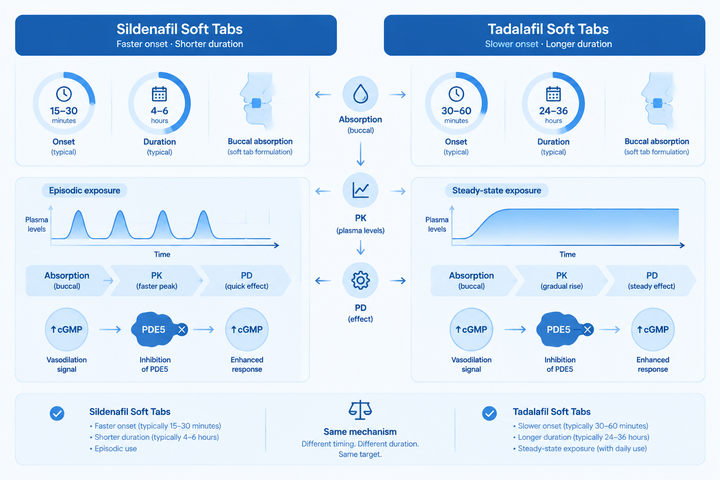
Sildenafil vs Cialis Soft can be analyzed as a PK/PD comparison combined with a formulation comparison. Both sildenafil and tadalafil are phosphodiesterase type 5 inhibitors, so their core mechanism converges on inhibition of PDE5-mediated cyclic GMP hydrolysis. This preserves NO-dependent cGMP signaling and can influence downstream vascular relaxation. The principal distinction in a soft-tab comparison is therefore not the PDE5 target, but the pharmaceutical input pathway and resulting concentration-time profile. A standard oral sildenafil formulation undergoes tablet disintegration, dissolution, gastrointestinal absorption, distribution, metabolism, and elimination. A soft-tab tadalafil formulation is designed to disintegrate and dissolve differently in the oral environment, potentially changing early drug availability and the shape of the absorption phase. These formulation effects belong to absorption and pharmacokinetics, whereas target engagement and downstream response belong to pharmacodynamics. Comparative interpretation should keep these layers distinct.
The onset comparison requires separating dissolution, absorption, time to peak, and pharmacodynamic onset. A soft-tab formulation may alter the physical sequence preceding systemic absorption, but faster disintegration does not automatically establish a proportionally faster systemic concentration rise or a predetermined pharmacodynamic onset. Sildenafil's standard oral profile can be represented through a conventional PK curve, with concentration increasing after gastrointestinal absorption and subsequently declining through distribution and elimination. Tadalafil's soft-tab formulation introduces an additional formulation layer before systemic exposure is established. Accordingly, time to peak remains a PK descriptor, while sildenafil onset and soft tabs onset describe broader temporal interpretation. The resulting onset curve depends on formulation, absorption rate, exposure magnitude, and pharmacodynamic transduction rather than dissolution alone. This distinction is central to mechanistic comparison because an altered pharmaceutical input process does not imply altered PDE5 molecular activity.
Duration comparison likewise requires separation of exposure persistence from downstream pharmacodynamic expression. Sildenafil and tadalafil share the PDE5 target but have different disposition characteristics, including differences in terminal persistence and concentration-time behavior. Tadalafil's longer elimination phase produces a more extended exposure tail than sildenafil, while formulation mainly affects the early input phase rather than the intrinsic elimination mechanism. Hepatic metabolism, including CYP3A4 metabolism, contributes to disposition, followed by elimination. The half-life describes terminal disposition but should not be treated as a direct synonym for pharmacodynamic duration. Similarly, duration comparison requires consideration of exposure, target engagement, NO/cGMP signaling, and downstream physiology. PK comparison therefore separates formulation-driven absorption differences from drug-specific distribution and elimination characteristics. This framework allows sildenafil and soft-tab tadalafil to be compared mechanistically without translating pharmacokinetic or pharmacodynamic differences into clinical recommendations.
Sildenafil and tadalafil share a PDE5-centered pharmacological mechanism. Both inhibit PDE5-mediated hydrolysis of cGMP, allowing NO-dependent cGMP signaling to persist during relevant drug exposure. This common pathway can be represented through the mechanism, PDE5 pathway, and NO/cGMP pathway. The formulation distinction does not create a separate molecular target; it primarily changes how the active ingredient enters systemic circulation.
Downstream effects can be described through pharmacodynamics and vascular relaxation. Sildenafil's standard oral formulation and soft-tab tadalafil therefore converge at PDE5 inhibition while differing in their pharmaceutical input processes. The timing and magnitude of target exposure depend on systemic concentration, which links the formulation layer to the pharmacokinetics layer.
Mechanistic interpretation should consequently distinguish drug identity, formulation, exposure, target engagement, and downstream response. PK curve behavior describes systemic concentration over time, whereas PDE5 inhibition describes molecular pharmacology. Distribution and elimination further shape exposure after absorption. This separation prevents a formulation difference from being interpreted as a fundamental difference in the NO/cGMP mechanism or downstream pharmacodynamic pathway.
| Mechanistic Element | Sildenafil | Cialis Soft |
|---|---|---|
| Primary target | PDE5 inhibition | PDE5 inhibition |
| NO/cGMP signaling | Reduced PDE5-mediated cGMP hydrolysis during systemic exposure | Reduced PDE5-mediated cGMP hydrolysis during systemic exposure |
| Formulation layer | Standard oral tablet input process | Soft-tab oral disintegration and dissolution input process |
| Downstream pharmacodynamics | PDE5-dependent modulation of cGMP signaling and vascular smooth-muscle physiology | PDE5-dependent modulation of cGMP signaling and vascular smooth-muscle physiology |
The PK comparison begins after formulation-dependent drug release and absorption. Sildenafil follows a conventional oral concentration-time sequence involving absorption, systemic distribution, metabolism, and elimination. Soft-tab tadalafil introduces a different dosage-form process before systemic absorption, but once tadalafil reaches systemic circulation, its disposition is governed by its own molecular distribution and metabolic characteristics. These layers should be separated when interpreting pharmacokinetics.
Peak concentration, total exposure, time to peak, and terminal decline describe different properties of the concentration-time profile. The PK curve therefore provides a visual framework for distinguishing early formulation effects from later disposition. Distribution describes movement beyond the initial plasma compartment, while half-life characterizes the terminal elimination phase rather than the complete pharmacodynamic window.
Metabolism also contributes to comparative exposure. Both sildenafil and tadalafil undergo hepatic biotransformation involving CYP3A-associated pathways, making CYP3A4 metabolism relevant to mechanistic PK interpretation. However, formulation-driven dissolution primarily influences the input phase, whereas metabolism and elimination shape the later concentration tail. A complete PK comparison therefore separates input rate, systemic exposure, distribution, and terminal disposition.
| PK Parameter | Sildenafil | Cialis Soft |
|---|---|---|
| Dosage-form input | Standard oral tablet disintegration and dissolution | Soft-tab oral disintegration and dissolution |
| Absorption phase | Gastrointestinal absorption follows conventional oral tablet release | Absorption follows soft-tab drug release and dissolution |
| Distribution | Systemic distribution follows absorption | Systemic distribution follows absorption |
| Terminal disposition | Metabolism and elimination determine the terminal exposure phase | Metabolism and elimination determine the terminal exposure phase |
Onset interpretation begins with the distinction between dosage-form disintegration and systemic absorption. A soft-tab tadalafil formulation can disintegrate differently from a standard sildenafil tablet, potentially modifying the earliest dissolution process. However, absorption remains the process through which active drug reaches systemic circulation, and time to peak remains a plasma PK metric. These terms should not be treated as interchangeable with pharmacodynamic onset.
Sildenafil's standard oral formulation produces an exposure curve governed by tablet disintegration, dissolution, gastrointestinal absorption, and subsequent disposition. A soft-tab tadalafil formulation introduces a formulation-specific dissolution step that may influence the early PK curve. The concept of soft tabs onset therefore encompasses more than dissolution alone. It requires consideration of systemic concentration, target exposure, and downstream pharmacodynamic transduction.
The resulting onset curve can vary according to formulation, absorption kinetics, concentration rise, and biological response. Sildenafil onset is similarly a PK/PD concept rather than a direct synonym for tablet disintegration or time to peak. Comparative analysis should therefore distinguish formulation performance from pharmacokinetic timing and pharmacodynamic expression, while recognizing that dissolution can influence the first stage of the overall sequence.
| Onset Metric | Sildenafil | Cialis Soft |
|---|---|---|
| Disintegration | Standard oral tablet disintegration | Soft-tab oral disintegration |
| Dissolution | Conventional oral dosage-form dissolution | Soft-tab dissolution characteristics can modify the early input process |
| Time to peak | Reflects systemic absorption and early PK | Reflects systemic absorption after the soft-tab formulation process |
| Onset interpretation | Requires PK concentration rise plus pharmacodynamic target engagement | Requires formulation, absorption, concentration rise, and pharmacodynamic target engagement |
Duration is a pharmacodynamic interpretation that cannot be reduced to tablet dissolution or time to peak. Sildenafil produces a concentration profile that rises after oral absorption and then declines through distribution and elimination. Tadalafil has a substantially longer terminal persistence, producing a more extended exposure tail. The duration comparison therefore depends strongly on drug-specific disposition as well as target exposure and downstream pharmacodynamics.
The formulation difference between standard sildenafil and soft-tab tadalafil is concentrated primarily in the input phase. Once systemic tadalafil exposure is established, the later concentration profile reflects tadalafil's distribution, metabolism, and elimination characteristics rather than the soft-tab label itself. The half-life is useful for describing terminal persistence, while the PK curve shows how concentration changes across the complete observation period.
Downstream duration can be conceptualized through continued PDE5 inhibition, cGMP availability, and physiological signaling. The NO/cGMP pathway and vascular relaxation represent pharmacodynamic layers between systemic exposure and observable response. Consequently, pharmacodynamics should be interpreted separately from terminal PK. Formulation can influence onset-related exposure without necessarily determining the later duration of tadalafil's systemic or pharmacodynamic profile.
| Duration Metric | Sildenafil | Cialis Soft |
|---|---|---|
| Exposure tail | Declines after the individual oral exposure peak | More prolonged because tadalafil has longer terminal persistence |
| Terminal disposition | Determined by sildenafil distribution, metabolism, and elimination | Determined by tadalafil distribution, metabolism, and elimination |
| Formulation contribution | Primarily affects early oral input | Primarily affects early oral input and does not define intrinsic terminal disposition |
| PD interpretation | Depends on continuing relevant PDE5 exposure and downstream signaling | Depends on continuing relevant PDE5 exposure and downstream signaling over a longer exposure tail |
Formulation is a distinct PK layer positioned between administration and systemic absorption. A standard sildenafil tablet undergoes disintegration and dissolution before the active ingredient becomes available for gastrointestinal absorption. A soft-tab tadalafil formulation is designed around a different physical dosage-form behavior, potentially changing the early release and dissolution sequence. These processes can be examined through absorption comparison, form onset comparison, and absorption.
Changes in dissolution or absorption rate can alter the early slope of a concentration-time curve and potentially shift apparent time to peak. They do not necessarily produce an equivalent change in total exposure or downstream response. The distinction is important for interpreting onset variability, because observed onset reflects multiple stages including formulation release, absorption, systemic concentration, target engagement, and pharmacodynamic transduction.
After absorption, the formulation-specific differences become progressively less important to the systemic concentration profile as distribution, metabolism, and elimination dominate. Distribution and elimination therefore belong to later PK layers. The PK curve integrates these stages, allowing formulation-driven early changes to be distinguished from drug-specific terminal behavior and shared PDE5 pharmacology.
| Formulation Factor | Influence on Sildenafil | Influence on Cialis Soft |
|---|---|---|
| Dosage-form structure | Standard oral tablet | Soft-tab oral dosage form |
| Disintegration | Precedes dissolution and gastrointestinal absorption | Designed for oral soft-tab disintegration |
| Dissolution | Conventional tablet dissolution contributes to early drug availability | Soft-tab dissolution characteristics contribute to early drug availability |
| Onset variability | Can reflect variation in formulation release and absorption | Can reflect soft-tab release characteristics and subsequent absorption |
The primary molecular mechanism is shared: sildenafil and tadalafil both inhibit PDE5 and reduce PDE5-mediated hydrolysis of cGMP. The main distinction in this comparison is formulation and pharmacokinetic behavior rather than target identity. Standard oral sildenafil uses a conventional tablet input process, while Cialis Soft, as described here, represents a soft-tab tadalafil formulation with different disintegration and dissolution characteristics. Those formulation differences can influence early drug input without creating a fundamentally different NO/cGMP signaling pathway.
Sildenafil and tadalafil have distinct molecular disposition characteristics, while the soft-tab formulation adds another layer to tadalafil's early input process. Sildenafil follows standard oral tablet disintegration, dissolution, absorption, distribution, metabolism, and elimination. Soft-tab tadalafil introduces formulation-specific disintegration and dissolution before systemic absorption. Once systemic exposure is established, distribution, metabolism, and elimination reflect tadalafil's intrinsic pharmacokinetic properties. Comparative PK analysis therefore separates dosage-form input from drug-specific systemic disposition and terminal exposure behavior.
Not necessarily. Soft-tab disintegration and dissolution occur before systemic absorption, so they can influence the early input phase, but dissolution alone does not determine systemic concentration or pharmacodynamic onset. Absorption rate, exposure magnitude, time to peak, distribution, and target engagement also contribute. Therefore, a soft-tab formulation may have different early pharmaceutical behavior without establishing a fixed onset interval. Onset is best understood as a combined PK/PD phenomenon rather than a direct measurement of dosage-form disintegration.
Duration is influenced primarily by systemic exposure persistence, drug-specific elimination kinetics, and the relationship between concentration and pharmacodynamic response. Sildenafil generally produces a more discrete exposure profile after an individual oral administration. Tadalafil has a longer terminal persistence, so its concentration-time profile has a more extended exposure tail. The soft-tab formulation primarily concerns the input phase and does not inherently redefine tadalafil's molecular elimination characteristics. Half-life and pharmacodynamic duration should therefore remain separate analytical concepts.
Formulation influences the sequence between administration and systemic absorption. Standard oral sildenafil tablets undergo conventional disintegration and dissolution before gastrointestinal absorption. A soft-tab tadalafil formulation uses a different physical dosage-form process that can alter early drug release and dissolution characteristics. These changes may affect the early concentration-time profile or apparent time to peak, but they do not change the PDE5 target. Formulation therefore belongs primarily to the pharmaceutical and absorption layers of PK rather than the molecular mechanism layer.
Dose-related differences should be interpreted through pharmacokinetic exposure and exposure-response relationships rather than treating dose as a direct synonym for onset or effect magnitude. Sildenafil can be analyzed through changes in an individual oral concentration-time profile. Soft-tab tadalafil additionally includes formulation-dependent dissolution and absorption in the early PK sequence. Changes in administered amount can modify exposure, while absorption rate independently influences temporal characteristics. PDE5 target engagement and downstream pharmacodynamics remain separate layers from both dose and formulation.
No fundamental separation of the PDE5 target is required for this comparison. Sildenafil and tadalafil both inhibit PDE5, reducing enzymatic hydrolysis of cGMP and thereby influencing the NO/cGMP signaling environment during relevant exposure. The important distinction is how each formulation and molecule produces its concentration-time profile. Standard oral sildenafil has one pharmaceutical input pathway, while soft-tab tadalafil adds formulation-specific disintegration and dissolution characteristics. PDE5 inhibition, systemic exposure, formulation, and downstream pharmacodynamics should therefore be treated as separate analytical layers.