PK/PD comparison • Formulation analysis

Sildenafil vs Generic — PK/PD Comparison, Formulation Differences & Mechanistic Interpretation

Sildenafil vs generic sildenafil is best understood as a PK/PD and formulation comparison rather than a comparison of different active pharmacologic mechanisms. Both branded and generic products containing sildenafil use the same active pharmaceutical ingredient and are intended to produce PDE5 inhibition, reducing PDE5-mediated cGMP hydrolysis within the NO/cGMP signaling system. The resulting mechanism, PDE5 pathway, and NO/cGMP pathway relationships therefore provide a common pharmacodynamic framework. Differences between products are more appropriately analyzed through formulation composition, dosage-form characteristics, dissolution, drug input, and resulting exposure profiles. These distinctions connect directly with pharmacokinetics, absorption, and PK comparison, while maintaining a separate description of downstream pharmacodynamics.

Formulation can influence the early portion of the concentration-time profile without changing sildenafil's molecular target. Conventional tablets undergo disintegration and dissolution before gastrointestinal absorption, whereas soft tabs, chewable forms, ODT products, oral suspension, and liquid form preparations can present different physical dissolution or dispersion characteristics. These formulation variables can alter the timing and variability of drug input and therefore affect the early PK curve, time to peak, or observed onset curve. However, formulation-driven differences should remain conceptually separate from intrinsic PDE5 inhibition, distribution, metabolism, and elimination.

Onset, duration, and the PK curve describe related but nonidentical pharmacological dimensions. Onset concerns the emergence of measurable pharmacodynamic effect, whereas time to peak describes a concentration-time characteristic; duration concerns persistence of pharmacodynamic activity, while terminal half-life describes a disposition parameter. Branded and generic sildenafil can therefore be compared by examining absorption, exposure, distribution, CYP3A4 metabolism, and elimination separately from PDE5-mediated signaling. A comparative framework can also distinguish formulation-dependent onset variability from intrinsic pharmacodynamic properties, producing a terminology-focused interpretation of sildenafil and generic sildenafil without making therapeutic judgments.

Mechanistic Comparison: Branded Sildenafil vs Generic Sildenafil
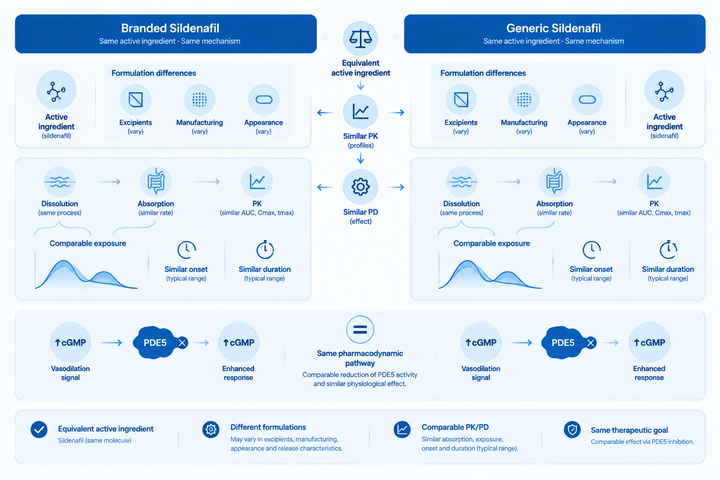
Generic comparison

Branded and generic sildenafil share the same active pharmaceutical ingredient, so their fundamental molecular pharmacology is centered on PDE5 inhibition. Sildenafil binds to PDE5 and reduces enzymatic hydrolysis of cGMP, thereby modifying intracellular signaling downstream of nitric oxide. The shared mechanism can be represented through the PDE5 pathway and NO/cGMP pathway. Product-level distinctions therefore arise primarily from pharmaceutical formulation and drug-input characteristics rather than a different molecular pharmacodynamic target.

The downstream pharmacodynamic sequence includes preservation of cGMP signaling and modulation of smooth-muscle physiology associated with vascular relaxation. The molecular target does not become a different target simply because the active ingredient is supplied by a branded or generic manufacturer. Comparative interpretation should consequently distinguish active-ingredient pharmacology from formulation performance. This separation is central to pharmacodynamics, where receptor or enzyme interaction is considered independently from the concentration-time profile generated by a particular pharmaceutical product.

A mechanistic comparison can therefore be organized into two layers: shared sildenafil pharmacology and potentially different pharmaceutical input characteristics. The first layer encompasses PDE5 inhibition, cGMP preservation, and downstream signaling. The second encompasses dosage form, dissolution, absorption, systemic exposure, and concentration-time behavior. This distinction also supports a structured brand vs generic interpretation and links formulation terminology with PK comparison without implying that one product has an intrinsically different pharmacological mechanism.

Mechanistic Element Branded Sildenafil Generic Sildenafil
Active ingredient Sildenafil Sildenafil
Primary molecular target PDE5 PDE5
cGMP handling Reduced PDE5-mediated hydrolysis Reduced PDE5-mediated hydrolysis
Downstream signaling NO/cGMP-linked pharmacodynamics NO/cGMP-linked pharmacodynamics

PK Comparison: Exposure, Half-Life, Distribution

The PK comparison between branded and generic sildenafil focuses on how formulation and pharmaceutical manufacturing characteristics translate into systemic exposure. Relevant parameters include absorption rate, extent of absorption, peak concentration, time to peak, overall exposure, distribution, metabolism, and elimination. These parameters form the basis of pharmacokinetics and the resulting PK curve. When active ingredient and systemic exposure are comparable, the resulting concentration-time behavior can be interpreted within the same sildenafil pharmacological framework.

Distribution describes movement of sildenafil between plasma and tissues after systemic entry, while metabolism and elimination determine the later portion of the exposure profile. Hepatic CYP3A4 metabolism is an important disposition pathway, and elimination contributes to the decline in systemic concentration. The half-life is a disposition descriptor rather than a direct measurement of pharmacodynamic duration. Accordingly, branded-versus-generic interpretation should keep formulation effects on early drug input separate from later distribution and clearance processes.

Comparative PK terminology includes Cmax, Tmax, exposure, and concentration-time shape. A difference in an early curve segment can reflect dissolution or absorption characteristics, whereas differences in the terminal phase relate more closely to distribution and elimination. The resulting framework connects absorption comparison with distribution and PK comparison. These distinctions prevent a formulation-related change in drug input from being automatically interpreted as a change in intrinsic sildenafil pharmacodynamics.

PK Parameter Branded Sildenafil Generic Sildenafil
Absorption Determined by formulation and drug input Determined by formulation and drug input
Peak exposure Product-specific concentration-time characteristic Product-specific concentration-time characteristic
Distribution Sildenafil disposition after systemic entry Sildenafil disposition after systemic entry
Metabolism CYP-associated hepatic metabolism CYP-associated hepatic metabolism
Terminal half-life Disposition parameter for sildenafil Disposition parameter for sildenafil

Onset Comparison: Formulation-Driven Differences

Onset is a pharmacodynamic concept that emerges from the relationship between drug concentration and biological response. Formulation can influence the timing of systemic drug entry, making the early exposure phase relevant to observed sildenafil onset. Conventional tablets, soft-tabs, chewable forms, ODT products, suspensions, and liquids can differ in disintegration, dispersion, or dissolution behavior. These physical processes precede or accompany absorption and therefore can modify the shape of the early input profile without changing sildenafil's PDE5 target.

Time to peak is a PK descriptor rather than a synonym for onset. A concentration maximum occurs at a specific point on the time to peak profile, while pharmacodynamic onset reflects the emergence of a measurable biological response. Consequently, two formulations could have different early concentration-time characteristics without establishing a proportionally different pharmacodynamic response. The distinction is especially important when interpreting an onset curve, because the curve represents a PK/PD relationship rather than dissolution alone.

Generic and branded products can therefore be compared through formulation-specific drug input, absorption rate, exposure, and pharmacodynamic linkage. Relevant terminology includes form onset comparison, absorption, and onset variability. A formulation that disperses differently may alter the early PK profile, but the downstream molecular sequence remains sildenafil-mediated PDE5 inhibition, cGMP preservation, and NO-dependent signaling. This layered approach avoids equating dosage-form characteristics with intrinsic pharmacodynamic differences.

Onset Metric Branded Sildenafil Generic Sildenafil
Drug input Depends on branded dosage-form characteristics Depends on generic dosage-form characteristics
Dissolution Formulation-dependent Formulation-dependent
Time to peak PK characteristic influenced by absorption PK characteristic influenced by absorption
Pharmacodynamic onset Linked to concentration-response relationship Linked to concentration-response relationship
Onset variability May reflect input and absorption variability May reflect input and absorption variability

Duration Comparison: PD Window & Exposure Tail

Duration describes the temporal persistence of a pharmacodynamic effect, whereas the PK exposure tail describes declining systemic concentrations. These concepts are related through concentration-response behavior but are not interchangeable. For sildenafil, the terminal exposure phase reflects distribution and elimination, while pharmacodynamic persistence depends on the concentration-response relationship and PDE5 inhibition. The duration comparison between branded and generic products therefore requires separation of formulation-driven input from the later disposition profile.

A formulation difference primarily affects the early portion of the concentration-time profile, while systemic distribution, metabolism, and elimination govern later exposure. The half-life provides a mathematical descriptor of concentration decline and does not itself define the duration of pharmacodynamic activity. Similarly, the full PK curve should not be interpreted as a direct pharmacodynamic curve. Comparative analysis becomes clearer when PK and PD are represented as linked but distinct layers.

Because branded and generic sildenafil contain the same active ingredient, the downstream PDE5 pathway remains pharmacologically related across products. Product-specific differences can instead be discussed through exposure magnitude, exposure timing, and formulation characteristics. The relationship between systemic concentration and pharmacodynamics determines how PK translates into biological response. This provides a neutral framework for distinguishing exposure tail, half-life, PD persistence, and formulation-related differences without converting those parameters into therapeutic judgments.

Duration Metric Branded Sildenafil Generic Sildenafil
Pharmacodynamic window Linked to sildenafil concentration-response behavior Linked to sildenafil concentration-response behavior
Exposure tail Governed by distribution and elimination Governed by distribution and elimination
Half-life Sildenafil disposition parameter Sildenafil disposition parameter
Formulation contribution Primarily influences early drug input Primarily influences early drug input

Formulation Influence: Absorption & Onset Variability

Dosage form is a pharmaceutical variable that can influence how sildenafil enters the systemic circulation. Standard tablets require disintegration and dissolution, while soft tabs, chewable preparations, and ODT formulations use different physical presentation characteristics. Oral suspension and liquid form preparations introduce additional dispersion and handling characteristics. These differences can influence drug input and early absorption without changing sildenafil's molecular pharmacology.

The formulation-to-PK sequence can be represented as dosage form, disintegration or dispersion, dissolution, gastrointestinal drug availability, absorption, systemic concentration, and pharmacodynamic response. This sequence connects absorption with absorption comparison and form onset comparison. The resulting early exposure pattern may affect observed time-to-peak or onset variability, but the magnitude and direction of any difference depend on the specific formulation and its pharmaceutical characteristics.

Branded and generic products may use different excipients, manufacturing processes, or dosage-form designs while delivering sildenafil as the active ingredient. Such differences belong to formulation science rather than target pharmacology. The distinction is useful when interpreting generics and brand names in relation to concentration-time behavior. A mechanistic comparison should therefore separate formulation-driven drug input from absorption, distribution, metabolism, elimination, and the downstream PDE5-mediated pharmacodynamic sequence.

Formulation Factor Branded Sildenafil Generic Sildenafil
Dosage-form design Manufacturer-specific pharmaceutical design Manufacturer-specific pharmaceutical design
Disintegration or dispersion Depends on dosage form Depends on dosage form
Dissolution Influenced by formulation characteristics Influenced by formulation characteristics
Absorption Depends on resulting drug input Depends on resulting drug input
Onset variability Can reflect formulation and absorption characteristics Can reflect formulation and absorption characteristics

Frequently Asked Questions

Branded and generic sildenafil contain the same active pharmaceutical ingredient, sildenafil, so their fundamental molecular mechanism is centered on PDE5 inhibition. Sildenafil reduces PDE5-mediated cGMP hydrolysis, supporting preservation of NO-linked cGMP signaling. Product differences are more appropriately considered at the pharmaceutical formulation and PK levels, including dissolution, absorption, exposure, and concentration-time behavior. Thus, a formulation difference does not inherently represent a different molecular PDE5 mechanism.

PK profiles can be influenced by pharmaceutical formulation, manufacturing characteristics, dosage form, dissolution, and absorption. Relevant parameters include peak concentration, time to peak, overall exposure, and concentration-time curve shape. Because branded and generic products contain sildenafil as the active ingredient, downstream disposition processes remain part of the same sildenafil PK framework. Comparative interpretation should distinguish early formulation-dependent drug input from distribution, metabolism, and elimination characteristics.

Formulation can influence the early drug-input phase through differences in disintegration, dispersion, dissolution, and absorption. Tablets, soft-tabs, chewable forms, ODT products, suspensions, and liquid preparations can therefore produce different early concentration-time characteristics. However, onset is a pharmacodynamic concept rather than a direct measurement of dissolution or time to peak. Any formulation-related onset difference must be interpreted through the complete PK/PD relationship.

A different concentration-time curve does not automatically establish a different pharmacodynamic duration. Duration reflects persistence of biological effect, whereas the PK curve describes systemic concentration over time. The terminal exposure phase is influenced by distribution and elimination, and half-life is a disposition parameter rather than a direct duration measurement. Branded and generic sildenafil can therefore be compared by separately examining exposure, terminal decline, concentration-response behavior, and pharmacodynamic persistence.

Formulation influences the physical pathway by which sildenafil becomes available for absorption. Tablets require disintegration and dissolution, while soft-tabs, chewable forms, ODT products, suspensions, and liquids have different dispersion or dissolution characteristics. These variables can modify the timing and variability of drug input and consequently influence early systemic exposure. They do not inherently alter sildenafil's active molecular target. Formulation therefore belongs to the PK input layer rather than the intrinsic PDE5 mechanism.

Dose-related interpretation focuses on exposure-response relationships rather than on a simple dose-versus-effect assumption. Changes in administered sildenafil amount can alter systemic concentration and exposure, while formulation can influence the timing of drug input. The resulting PK profile is then connected to PDE5 inhibition through concentration-response behavior. Branded and generic products remain within the same sildenafil pharmacological framework, so dose-related comparisons should distinguish formulation, exposure, and intrinsic pharmacodynamics.

The PDE5 pathway is fundamentally linked to sildenafil as the active ingredient, regardless of whether the product is branded or generic. Sildenafil inhibits PDE5-mediated cGMP hydrolysis, allowing NO-dependent cGMP signaling to persist according to the concentration-response relationship. Formulation differences can change systemic drug input and therefore the timing or magnitude of exposure, but they do not inherently create a separate PDE5 pathway. Mechanistic interpretation should therefore separate molecular pharmacology from pharmaceutical formulation.